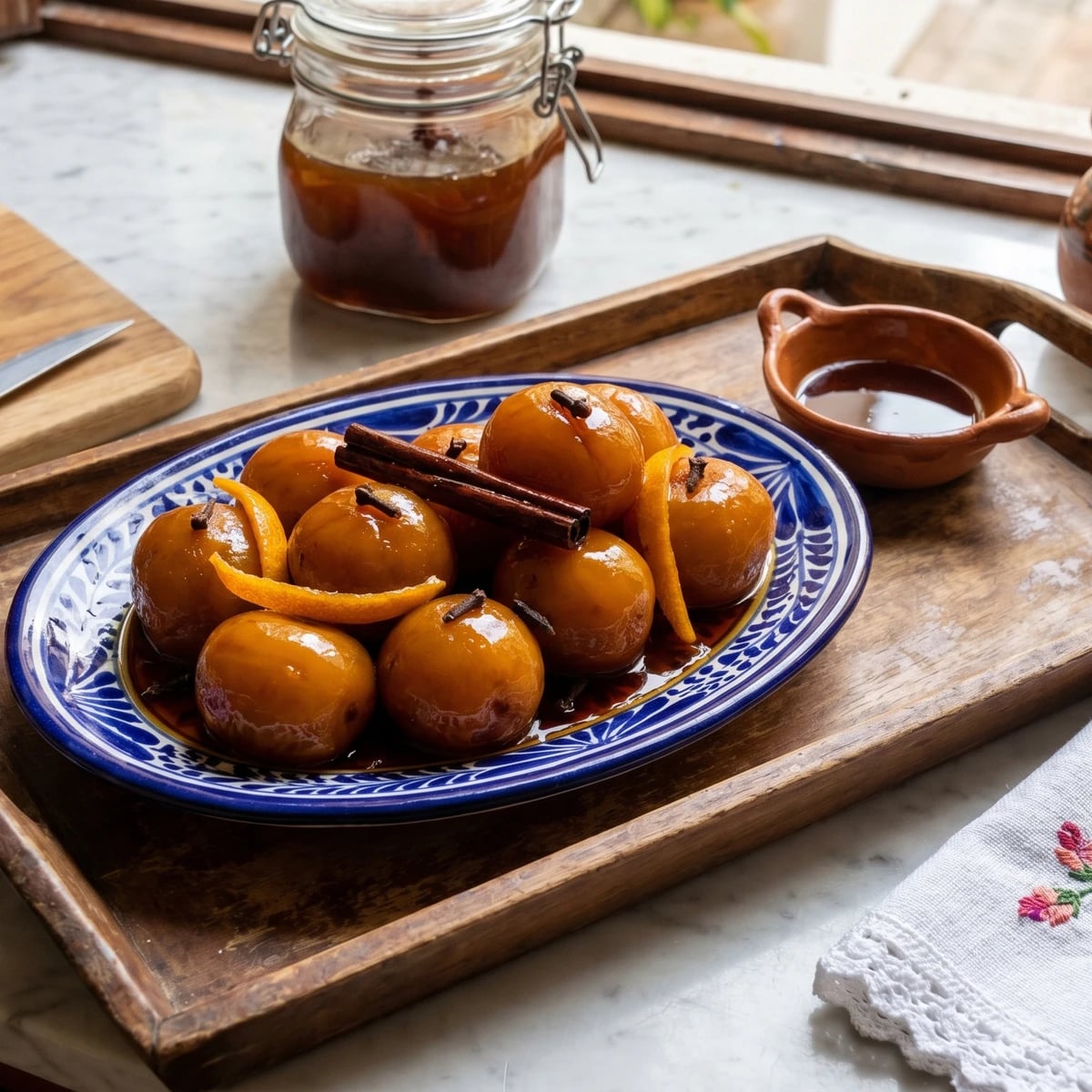
Yucatán's slow-cooked ciricote fruit in dark piloncillo syrup with Ceylon canela and naranja agria peel, cooked until the pit softens edible and served cold against a wedge of queso de bola.
Desserts
Mexican
Special Occasion
Make Ahead
Holiday
30 min
Active Time
2 hr 30 min cook•3 hr total
Yield8 to 10 servings
This dulce is from Yucatán. From the Peninsula, where the kapok and ciricote trees grow in courtyards and along the old henequen roads, and where the dulcerías of Mérida still sell the fruit by the kilo in glass jars stained dark by piloncillo syrup. You will not find ciricote in Oaxaca. You will not find it in Jalisco. This is Peninsula territory and the dulce belongs to it.
The ciricote itself is the work. The green-skinned fruit of the Cordia dodecandra tree has a hard pit at its center, and the whole purpose of the dulce is to cook the fruit so patiently in piloncillo syrup that the pit softens until you can bite through it. Hours of low simmering. No shortcuts. No me vengas con atajos. The cal bath at the start firms the skin so it holds its shape, the piloncillo gives the deep mahogany color and the molasses depth, and the canela and naranja agria carry the Peninsula flavors that anchor this dish to Mérida and not somewhere else.
My mother did not make this. She was from Jalisco and ciricote was not part of her world. I learned it in 2009 from Doña Hortensia in Valladolid, an eighty-year-old woman who made it every May when her tree fruited and sold it at the parque to anyone who asked. She told me three things and I have not forgotten them. Pierce every fruit. Use the cal. Wait until the next day to eat it. Saber cocinar es saber vivir, and this dulce teaches patience like few dishes do.
Serve it the way Yucatán serves it: cold, with a wedge of queso de bola alongside. The salt of the Edam against the deep sweet of the piloncillo is the architecture of the Peninsula's whole sweet tradition. Cada estado, su propia cocina.
The ciricote tree (Cordia dodecandra) is native to the Yucatán Peninsula and southern Mexico, and its fruit was consumed by the ancient Maya long before sugar arrived with the Spanish; pre-conquest preservation relied on honey from the native melipona bee, which the Maya cultivated and which still produces honey used in Peninsula sweets today. The piloncillo version of the dulce emerged during the colonial sugar economy, when cane sugar plantations in Tabasco and Veracruz made dark unrefined sugar widely available, and the technique of long-simmered fruit en almíbar entered Yucatán through colonial convent kitchens. Queso de bola, the Dutch Edam imported through the port of Sisal during the 19th-century henequen boom, became permanently linked to Peninsula sweets when Mérida's bourgeoisie began pairing the salty imported cheese with local dulces, a pairing now considered inseparable from the tradition.
The technique, the tradition, and the story behind every dish.
star anise pod (optional)southern Yucatán variation
1
sea salt
a pinch
queso de bola (Edam) wedges (optional)
for serving
pan francés or pan de caja (optional)
for serving
Equipment Needed
•Wide heavy-bottomed pot or 6-quart clay cazuela
•Paring knife for piercing the fruit
•Non-reactive bowl for the cal bath
•Slotted spoon
•Wooden spoon for gentle stirring
Instructions
1
Prepare the ciricote
Wash the ciricote under cold water and trim the stem ends. The fruit should be firm-ripe, deep green or just turning yellow, never soft. Soft ciricote falls apart in the syrup and the pit will never soften correctly. With a paring knife, pierce each fruit twice, straight through to the pit. These holes let the cal bath in and the syrup in later. Without them you have whole fruit floating in sweet water.
Ciricote (Cordia dodecandra) is sold at the Lucas de Gálvez and San Benito markets in Mérida from late spring into summer. If you cannot find it fresh, do not substitute. This is its dulce. Make tejocote or chilacayota in the season that belongs to them.
2
Cal bath to firm the fruit
Dissolve the cal in 6 cups of cold water in a non-reactive bowl. Stir well, let the chalky sediment settle for a minute, then submerge the pierced fruits in the clear liquid on top. Cover and leave for 2 hours at room temperature. The cal sets the pectin in the skin so the fruit holds its shape through hours of simmering. The señoras of Valladolid will tell you skip this step and you have ciricote mush. They are right.
3
Rinse thoroughly
Drain the fruit and rinse under cold running water for several minutes, rolling each piece between your fingers. Then soak in clean water for 15 minutes, drain, and rinse one more time. Cal left on the fruit tastes like chalk. Rinse until the water runs clear and the fruit feels clean, not slick.
4
Build the piloncillo syrup
Chop the piloncillo cones with a heavy knife or smash them inside a clean towel with a mallet. Place the broken piloncillo, 8 cups of fresh water, the canela, sour orange peel, cloves, star anise, and pinch of salt in a wide heavy-bottomed pot or cazuela. Bring to a simmer over medium heat, stirring until every piece of piloncillo has dissolved. Do not let it boil hard yet. You want the spices to steep into the syrup, not race past it.
5
Add the fruit and cook low
Lower the ciricote into the simmering syrup. The fruit should be submerged. If it floats, lay a small plate on top to keep it down. Bring back to a bare simmer, the kind where one bubble breaks the surface every few seconds. Cook uncovered for 2 to 2.5 hours. The syrup will darken from amber to deep mahogany. The fruit will turn from green to a translucent caramel color. La cocina no es decoración, es trabajo.
Do not stir aggressively. Move the pot in a slow circular motion every 20 minutes or push the fruit gently with a wooden spoon. Stirring breaks the skins.
6
Test the pit
The dulce is ready when you can press a fruit against the side of the pot with a spoon and the pit gives slightly under pressure. Pull one out, let it cool for a minute, and bite carefully. The pit of a properly cooked ciricote softens until it is edible, almond-like, a little chewy. That softened pit is the whole point of the dulce. If it is still hard, keep cooking. Some batches take three hours. The fruit tells you when, not the clock.
7
Reduce the syrup
Once the pits are tender, lift the fruit out gently with a slotted spoon and set aside. Raise the heat under the syrup to medium-high and reduce for 8 to 12 minutes, until it coats the back of a wooden spoon and runs in a slow thread when you lift it. Watch closely at the end. Piloncillo syrup goes from perfect to scorched in a minute and burned piloncillo tastes like ruin.
8
Combine and rest
Return the fruit to the reduced syrup. Turn off the heat. Let the dulce cool completely in the pot, uncovered, for at least 4 hours, or overnight on the counter if the kitchen is not too warm. The fruit drinks the syrup as it cools. This rest is not optional. Eaten warm, the dulce tastes thin. Eaten frío the next day, it tastes like Yucatán.
9
Serve cold
Transfer to a Talavera or slipware platter and serve frío, two or three fruits per person with a generous spoon of syrup, a stick of canela alongside, and a wedge of queso de bola on the side. The salty Edam against the deep piloncillo sweetness is the Yucatán way. Eat the fruit whole, pit and all. Así se hace y punto.
Chef Tips
•Cal (calcium hydroxide) is sold in Mexican markets as 'cal para nixtamal.' It is the same cal used for making tortillas. A small bag costs almost nothing and lasts years. Do not skip the cal bath. The señoras of Valladolid will tell you the same thing and they have been making this dulce longer than any of us.
•Piloncillo is non-negotiable. Brown sugar from the supermarket will not give you the molasses depth or the mahogany color. The dark cone-shaped piloncillo, the one that looks almost black, is what you want. Light piloncillo will produce a paler, flatter dulce.
•Naranja agria, the bitter Seville orange of the Peninsula, is the right peel for this. If you cannot find it, regular orange peel with a squeeze of lime is the compromise. It is not the same thing but it is honest about what it is.
•Eat this cold, the day after you make it. Warm and same-day, the syrup has not penetrated the fruit. Cold and rested, the dulce is dense, deep, and exactly what it should be.
Advance Preparation
•This dulce is made for advance preparation. Cook it one day ahead, minimum. Two or three days ahead is better. The fruit needs time to absorb the syrup.
•Stored in its syrup in a clean glass jar in the refrigerator, the dulce keeps for up to 3 weeks. The flavor only deepens.
•Do not freeze. The skin breaks down and the texture is lost.
Frequently Asked Questions
Nutrition Information
1 serving (about 180g)
Calories
500 calories
Total Fat
4 g
Saturated Fat
3 g
Trans Fat
0 g
Unsaturated Fat
1 g
Cholesterol
20 mg
Sodium
160 mg
Total Carbohydrates
112 g
Dietary Fiber
2 g
Sugars
105 g
Protein
5 g
Where cooking meets culture.
Culinary guides, cultural storytelling, and the editorial depth that makes cooking meaningful.