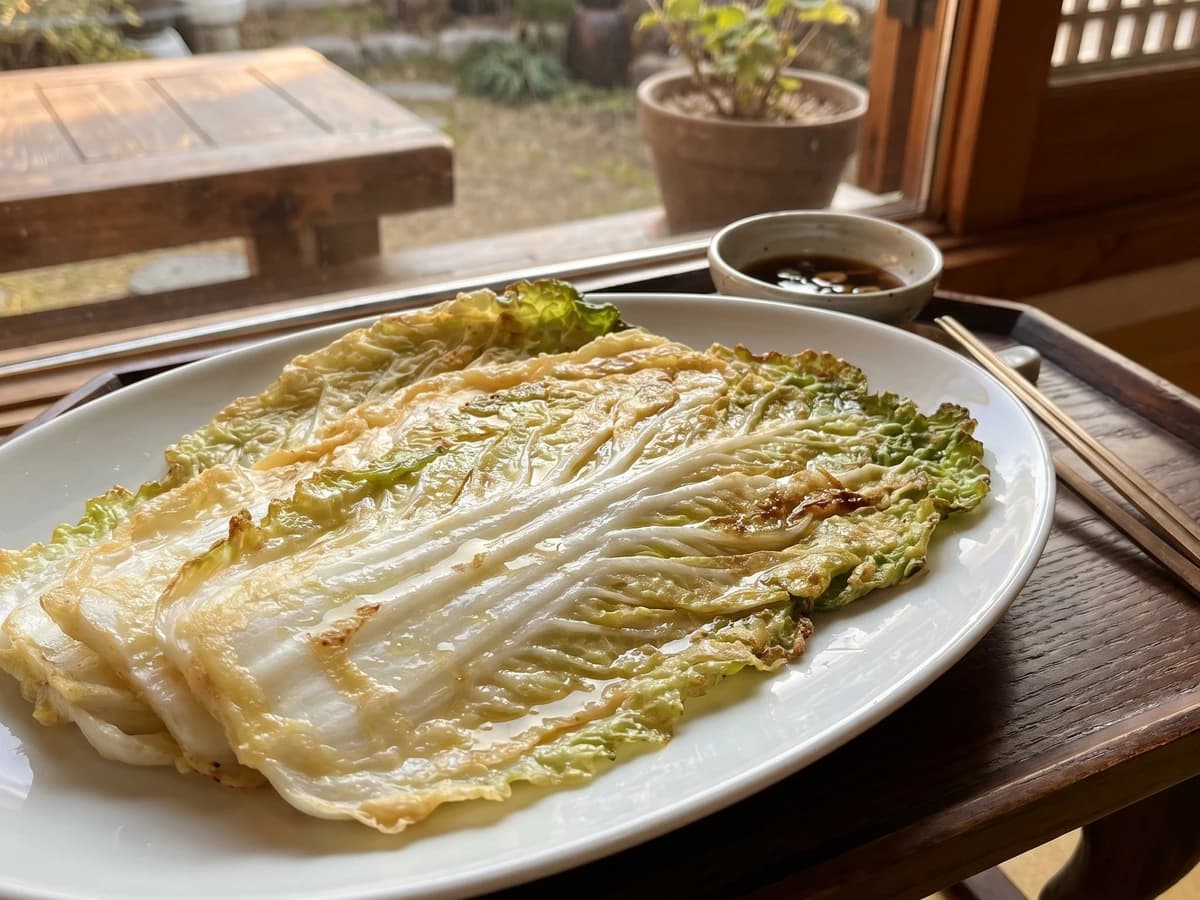
Chef Jeong-sun
Baechu-jeon (배추전, Napa Cabbage Pancake)
A Gyeongsang home pancake made from one whole napa cabbage leaf at a time, flattened at the rib, brushed in thin salted batter, and fried until sweet, tender, and quietly crisp at the edges.
A cooking platform built around craft, culture, and the stories behind what we eat.
Created by
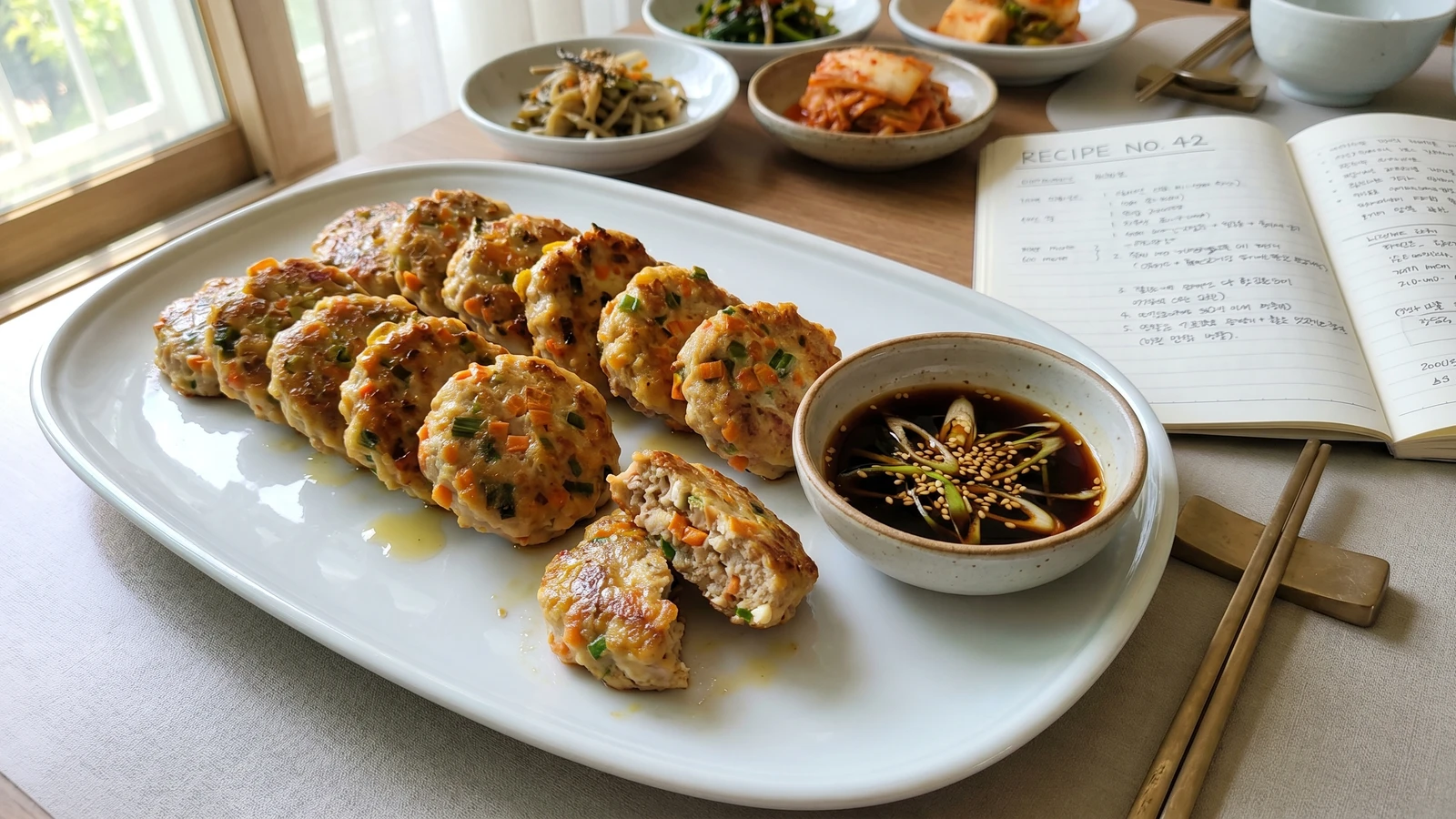
Small pork and beef patties with tofu and vegetables squeezed dry, shaped into careful coins, dipped in flour and egg, then pan-fried for the holiday table.
Donggeurangttaeng lives or dies by dryness. Not dry in the eating, dry in the mixing bowl. If the tofu carries water, if the onion is chopped too large, if the meat is handled lazily, the patties split in the pan and the cook blames the recipe. The recipe is innocent. Wring the tofu until your hand gets tired, then wring once more.
This is holiday jeon (pan-fried food), the kind that fills trays before Seollal or Chuseok, but it also belongs in a lunchbox and on a potluck table where children take three before the adults sit down. My teacher Master Seong-nyeo made us shape them all the same size, four centimeters across, one centimeter thick. I thought she was being severe. She was teaching even cooking. A thick one browns outside and stays raw in the middle; a thin one turns hard before the meat is done.
Use pork for softness and beef for depth, tofu for lightness, and vegetables cut fine enough that the patty holds together as one bite. Season plainly. This is not a gochujang dish, and it doesn't need sweetness. 손맛 is real, the hand-taste your grandmother trusted, and I still measure it, so it can be handed on. Tonight it asks for chopping, squeezing, shaping, and patience at the pan. That is all.
Donggeurangttaeng belongs to the broader Korean family of jeon, foods coated in flour and egg and pan-fried for ancestral rites, holidays, banquets, and ordinary side dishes. The round minced-meat version became especially common in modern home cooking because ground meat, tofu, and small vegetables could stretch modest ingredients into a festive tray. Its name comes from donggeuran, meaning round, and ttaeng, a homey sound attached to the small coin shape rather than a formal court term.
Quantity
250g
Quantity
150g
Quantity
200g
drained and squeezed very dry
Quantity
1/2 small, about 70g
minced fine
Quantity
1 small, about 60g
minced fine
Quantity
3
minced fine
Quantity
2 cloves
minced
Quantity
1 large
for the meat mixture
Quantity
1 tablespoon
Quantity
1 teaspoon
Quantity
3/4 teaspoon
Quantity
1/4 teaspoon
freshly ground
Quantity
1/3 cup
for dredging
Quantity
3 large
beaten with 1 pinch salt, for coating
Quantity
3 to 4 tablespoons
for pan-frying
Quantity
2 tablespoons soy sauce, 1 tablespoon rice vinegar, 1 teaspoon water, 1/2 teaspoon toasted sesame seeds, a few thin scallion slices
| Ingredient | Quantity |
|---|---|
| ground pork | 250g |
| ground beef | 150g |
| firm tofudrained and squeezed very dry | 200g |
| onionminced fine | 1/2 small, about 70g |
| carrotminced fine | 1 small, about 60g |
| scallionsminced fine | 3 |
| garlicminced | 2 cloves |
| eggfor the meat mixture | 1 large |
| soy sauce | 1 tablespoon |
| toasted sesame oil | 1 teaspoon |
| fine sea salt | 3/4 teaspoon |
| black pepperfreshly ground | 1/4 teaspoon |
| all-purpose flourfor dredging | 1/3 cup |
| eggsbeaten with 1 pinch salt, for coating | 3 large |
| neutral oilfor pan-frying | 3 to 4 tablespoons |
| dipping sauce (optional) | 2 tablespoons soy sauce, 1 tablespoon rice vinegar, 1 teaspoon water, 1/2 teaspoon toasted sesame seeds, a few thin scallion slices |
Wrap the tofu in a clean kitchen towel and squeeze until it feels crumbly and no longer weeps water, then press it under a plate for 10 minutes while you chop the vegetables. You should have about 140g squeezed tofu left. This number matters: too much water loosens the meat mixture, and loose patties crack in the pan.
Mince the onion, carrot, and scallions very fine, about the size of short-grain rice. Large pieces push the meat apart as it cooks. If the onion is juicy, press it in a small sieve or squeeze it in your hand so it does not water down the mixture.
In a wide bowl, combine the pork, beef, squeezed tofu, onion, carrot, scallions, garlic, 1 egg, soy sauce, sesame oil, salt, and pepper. Mix with your hand for 2 full minutes, folding and pressing until the mixture turns sticky and holds together when pinched. That stickiness is the protein binding; without it, the patty is only chopped things pretending to be one dish.
Fry one teaspoon of the mixture in a small pan and taste it. It should be savory and gentle, with the tofu and meat still clear. Add up to 1/4 teaspoon more salt only if it tastes flat. Do not guess with raw ground meat, and do not season until it tastes salty now, because the flour and egg coating will soften the edges.
Lightly oil your palms. Shape the mixture into 22 to 24 patties, each about 4 cm wide and 1 cm thick. Flatten the center just a little with your thumb, because meat swells as it cooks. Lay them on a tray in one layer and chill for 15 minutes if your kitchen is warm or the mixture feels soft.
Put the flour in a shallow dish and the beaten eggs with a pinch of salt in another. Dust each patty lightly in flour, pat off the excess, then dip it in egg. The flour should be a thin veil, not a winter coat. Too much flour makes a pale shell that separates from the meat.
Heat 2 tablespoons oil in a wide nonstick or well-seasoned skillet over medium-low heat. Add patties in a single layer, leaving space between them. Fry 3 to 4 minutes on the first side and 3 minutes on the second, until golden with browned edges and cooked through to 71 C or 160 F in the center. Keep the heat moderate; egg browns fast, and ground meat needs time.
Move the patties to a rack or paper-lined tray for 2 minutes so the coating settles. Serve warm or at room temperature with the dipping sauce. For a holiday table, stack them only after they cool slightly; hot jeon piled too soon softens from its own trapped moisture.
1 serving (about 43g)
Culinary guides, cultural storytelling, and the editorial depth that makes cooking meaningful.
Discover Culinary ExplorerChef Jeong-sun
A Gyeongsang home pancake made from one whole napa cabbage leaf at a time, flattened at the rib, brushed in thin salted batter, and fried until sweet, tender, and quietly crisp at the edges.

Chef Jeong-sun
A holiday jeon of fresh shiitake or oyster mushrooms, salted lightly, dusted thinly, and carried through egg in a quiet pan until the mushroom stays earthy and the coating stays tender.

Chef Jeong-sun
Soaked mung beans ground coarse, folded with pork, bracken, sprouts, and kimchi, then fried thick until the edges crisp and the center stays tender enough for a shared table.

Chef Jeong-sun
A summer garlic chive pancake fried thin, crisp at the edges and chewy in the center, with just enough batter to hold the green pile together and a sharp soy-vinegar dip.