
Chef Jeong-sun
Agwi-jjim (Braised Monkfish with Bean Sprouts)
Firm monkfish buried under crisp soybean sprouts, minari, and a red gochugaru sauce thickened at the end; Masan's market dish asks for heat, timing, and a steady hand.
A cooking platform built around craft, culture, and the stories behind what we eat.

Created by
A gentle soy-braised chicken from the home table, with potato, carrot, and shiitake simmered until the sauce clings dark and glossy without hiding the chicken under chili or sugar.
Dak-jjim is not jjimdak with its temper cooled down. That is the misunderstanding. The Andong market version has its own place, dark, sweet, often loud with dried chilies and glass noodles, but this older home braise is quieter: chicken, potato, carrot, shiitake, and ganjang (soy sauce) simmered until the sauce clings. No chili wall. No sugar curtain.
Master Seong-nyeo made us blanch the chicken before it ever saw the soy. Then she made us wash the pot. I thought that was her usual severity, which was not a small thing, but the sauce proved her right: clean brown, not muddy gray, with the chicken tasting like chicken. Covered simmering gives tenderness. Uncovered simmering at the end gives the shine and the salt balance. Skip either one and the dish tells on you.
Tonight it asks for knife work more than strength. Cut the potatoes large, about 4 cm, so they soften with the chicken instead of collapsing into the sauce. Add the onion late so it stays sweet and visible. Measure the soy, the sugar, and the water, then taste at the end, because 손맛 is real. I still measure it, so it can be handed on.
This is comfort food for rice, not a performance. Put the pot in the center, spoon the sauce over each bowl, and let the carrots and potatoes do their small bright work among the brown pieces of chicken. A table does not need to be grand to be cared for.
Jjim is an old Korean method name for foods cooked with moist heat, first closer to steaming and later also used for covered braises in a small amount of seasoned liquid. Soy-seasoned dak-jjim belongs to the household chicken-jjim line, while Andong jjimdak is the younger market version associated with Andong Gu Market in the 1980s, darker, sweeter, and often carrying dried chilies and glass noodles. This mild version keeps the seasoning to ganjang (soy sauce), aromatics, root vegetables, and reduction, the older home logic that makes one chicken feed the rice table.
Quantity
4
Quantity
1 cup
for soaking the mushrooms
Quantity
1, 1.2 to 1.4 kg
cut into 10 to 12 bone-in pieces
Quantity
8 cups
for blanching
Quantity
2 medium, about 350 g
peeled and cut into 4 cm chunks
Quantity
1 large, about 180 g
cut into 2.5 cm rolling-cut pieces
Quantity
1 medium, about 200 g
one-quarter grated and the rest cut into wedges
Quantity
6 cloves
minced
Quantity
2 teaspoons
minced
Quantity
6 tablespoons
Quantity
2 tablespoons
Quantity
1 tablespoon
Quantity
1 tablespoon
Quantity
3/4 cup
Quantity
1/2 teaspoon
Quantity
6
Quantity
4
white parts cut into 5 cm lengths and green parts thinly sliced
Quantity
2 teaspoons
Quantity
1 tablespoon
| Ingredient | Quantity |
|---|---|
| dried shiitake mushrooms (pyo-go beoseot) | 4 |
| warm waterfor soaking the mushrooms | 1 cup |
| whole chickencut into 10 to 12 bone-in pieces | 1, 1.2 to 1.4 kg |
| waterfor blanching | 8 cups |
| potatoespeeled and cut into 4 cm chunks | 2 medium, about 350 g |
| carrotcut into 2.5 cm rolling-cut pieces | 1 large, about 180 g |
| onionone-quarter grated and the rest cut into wedges | 1 medium, about 200 g |
| garlicminced | 6 cloves |
| fresh gingerminced | 2 teaspoons |
| ganjang (Korean soy sauce) | 6 tablespoons |
| cheongju (Korean rice wine) or mirin | 2 tablespoons |
| light brown sugar | 1 tablespoon |
| mulyeot (Korean rice syrup) or honey | 1 tablespoon |
| water or unsalted chicken stock | 3/4 cup |
| freshly ground black pepper | 1/2 teaspoon |
| peeled fresh chestnuts (optional) | 6 |
| scallionswhite parts cut into 5 cm lengths and green parts thinly sliced | 4 |
| toasted sesame oil | 2 teaspoons |
| toasted sesame seeds | 1 tablespoon |
Put the dried shiitake mushrooms in 1 cup warm water and weight them with a small bowl so they stay submerged. Soak 20 minutes, then squeeze them gently, trim off the tough stems, and halve the caps. Strain the soaking liquid through a fine sieve and save 3/4 cup. That liquid gives the braise depth without making it taste heavy.
Trim away loose yellow fat and any bone fragments from the chicken. Bring 8 cups water to a boil in a large pot, add the chicken pieces, and boil 3 minutes, just until the outside turns opaque and foam rises. Drain, rinse the pot, and rinse the chicken pieces quickly in a bowl of warm water. This is not to cook the chicken. It cleans the surface so the soy sauce can make a clear brown braise instead of a muddy one.
In a bowl, stir together the reserved 3/4 cup mushroom soaking liquid, 3/4 cup water or unsalted stock, ganjang, cheongju, brown sugar, rice syrup, grated onion, garlic, ginger, and black pepper. Six tablespoons of soy sauce is enough for this amount of chicken because the sauce will reduce. If you start too salty, there is nowhere honest to go.
Put the blanched chicken in a wide heavy pot and pour the sauce over it. Bring it to a boil over medium-high heat, then lower to a steady simmer, cover, and cook 15 minutes. Turn the pieces once or twice. Covered heat tenderizes the meat first; the shine comes later.
Add the potatoes, carrot, shiitake caps, optional chestnuts, and the white scallion lengths. Tuck the vegetables down into the sauce, cover again, and simmer 15 to 18 minutes, until the potatoes are nearly tender when pierced. The potato pieces are large on purpose. Cut them small and they break before the chicken is ready.
Add the onion wedges, uncover the pot, and raise the heat to medium. Simmer 10 to 12 minutes, spooning the sauce over the chicken and vegetables every few minutes, until the sauce has reduced to about 3/4 cup and coats the spoon. The chicken should be cooked through, with no pink at the bone, or 74°C on an instant-read thermometer. This last uncovered cooking is what makes dak-jjim dak-jjim, not boiled chicken in soy water.
Turn off the heat. Stir in the toasted sesame oil, scatter over the green scallion slices and sesame seeds, and let the pot rest 5 minutes before serving. That short rest lets the sauce settle back into the chicken and potatoes. Serve with hot rice, kimchi, and one clean vegetable banchan so the table has balance.
1 serving (about 460g)
Culinary guides, cultural storytelling, and the editorial depth that makes cooking meaningful.
Discover Culinary ExplorerChef Jeong-sun
Firm monkfish buried under crisp soybean sprouts, minari, and a red gochugaru sauce thickened at the end; Masan's market dish asks for heat, timing, and a steady hand.

Chef Jeong-sun
A quick Korean rice bowl built on contrast: warm rice, cold popping flying-fish roe, chopped vegetables, gim, sesame oil, and the crisp rice bottom a hot stone bowl gives you.
Chef Jeong-sun
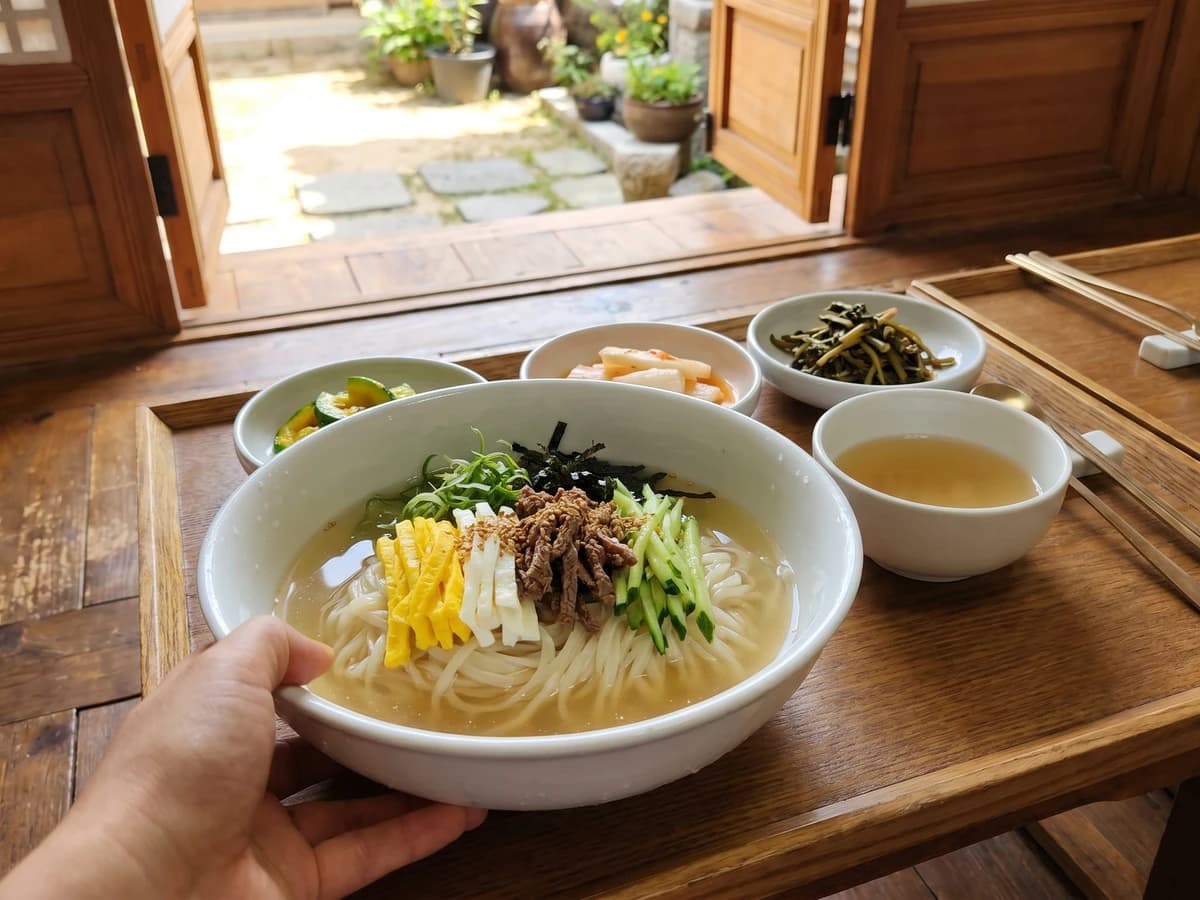
Andong's guest noodles, wheat and roasted soybean flour rolled thin, boiled and rinsed cold, then set in a clear chilled anchovy broth with careful strips of beef, egg, and cucumber.

Chef Jeong-sun
Andong's ritual-table rice served on an ordinary day: separate soy-sesame namul, warm rice, and clear radish soup, mixed without gochujang so every vegetable keeps its own voice.