
Chef Thomas
A Proper Ploughman's Board
A board of good cheddar, thick ham, proper pickle, hard-boiled eggs, and crusty bread. Not cooking so much as assembling with conviction, and one of the finest lunches the English kitchen has ever produced.
A cooking platform built around craft, culture, and the stories behind what we eat.
Created by Chef Thomas
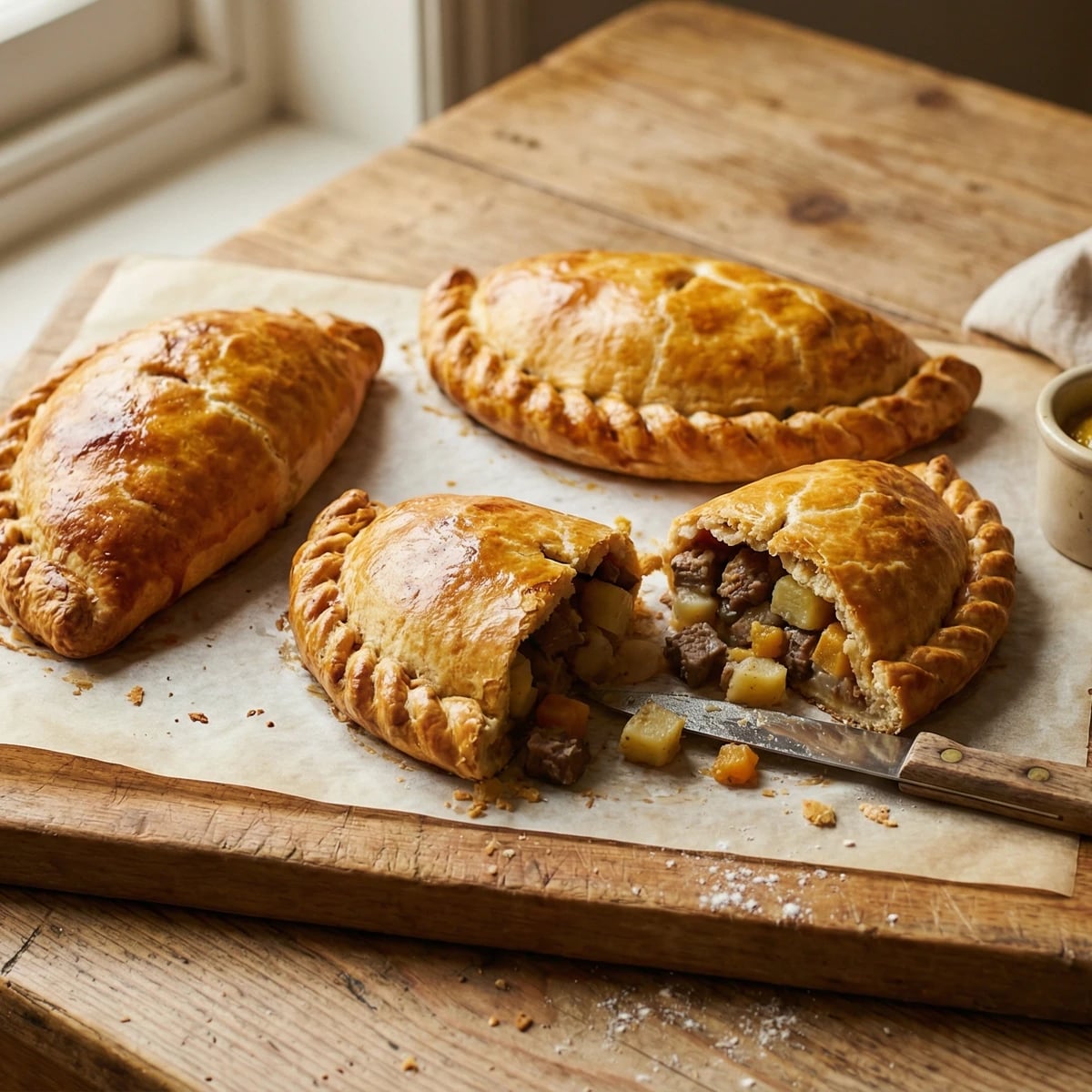
Proper Cornish pasties, beef skirt and root vegetables sealed in a short, sturdy pastry and baked until the kitchen smells like the kind of supper worth carrying a long way home for.
The wind changed last week and the swedes at the market were the size of bowling balls. I bought one without a plan and carried it home under my arm like a parcel. By the time I'd put the kettle on, I knew what it was for.
A Cornish pasty is not a complicated thing. Beef, potato, swede, onion, pastry. Five ingredients and some pepper. But the simplicity is the whole point. Everything goes in raw, sealed together in a case of short pastry, and the oven does the rest. The vegetables steam in their own moisture, the beef gives up its juices, the knob of butter melts through and makes a small, self-contained gravy that soaks into the potato. You open one up and the steam hits your face and smells of pepper and supper and the honest satisfaction of something made properly with your hands.
These were miners' food. Built to travel, to hold their heat for hours down in the tin mines, to be eaten without cutlery in the dark. The crimped edge was the handle, held by dirty hands and discarded afterwards. I like knowing that. I like that the shape of the thing still carries the memory of who it was made for: working people who needed something warm and filling and good, packed with care by someone who loved them.
I make pasties when the cold comes in and the root vegetables are at their best, because a swede in October is a different thing entirely from a swede in May. The market decides. I wrote it down in the notebook last year: pasties, Saturday, first frost. The kitchen stayed warm all afternoon.
Quantity
500g
Quantity
120g
cold and cubed
Quantity
120g
cold and cubed
Quantity
1 teaspoon
Quantity
150-175ml
Quantity
1
beaten, for glazing
Quantity
400g
trimmed and cut into small pieces
Quantity
200g
peeled and diced
Quantity
200g
peeled and diced
Quantity
1 medium
finely chopped
Quantity
to taste
Quantity
a knob, divided into four
| Ingredient | Quantity |
|---|---|
| strong bread flour | 500g |
| unsalted buttercold and cubed | 120g |
| lardcold and cubed | 120g |
| fine sea salt | 1 teaspoon |
| cold water | 150-175ml |
| eggbeaten, for glazing | 1 |
| beef skirttrimmed and cut into small pieces | 400g |
| waxy potatoespeeled and diced | 200g |
| swedepeeled and diced | 200g |
| onionfinely chopped | 1 medium |
| salt and black pepper | to taste |
| butter | a knob, divided into four |
Put the flour and salt into a large bowl. Add the cold butter and lard in cubes. Rub the fat into the flour with your fingertips, working quickly, until the mixture looks like rough breadcrumbs with a few larger flakes still visible. Those flakes are fine. They'll make the pastry short and flaky. Add the cold water gradually, mixing with a knife, then bring it together with your hands. The dough should hold when pressed but not feel sticky. If it's dry and cracking, add a splash more water. Wrap it in cling film and rest it in the fridge for at least thirty minutes. The pastry needs the cold. Don't skip this.
While the pastry rests, dice the potato and swede into pieces roughly the size of your smallest fingernail. Not too uniform, but not too big either. You want them to cook through in the oven without turning to mush. Cut the beef skirt into small pieces, about the same size. The meat should be in distinct pieces, never minced. Finely chop the onion. Toss everything together in a bowl and season generously with salt and pepper. More pepper than you think. The filling wants to be well seasoned before it goes into the pastry, because you can't adjust it afterwards.
Set the oven to 200C/180C fan. Divide the pastry into four equal pieces and roll each one out on a lightly floured surface into a circle roughly the size of a dinner plate. Don't worry about perfection. A wonky circle is still a circle. Pile a quarter of the filling onto one half of each round, leaving a decent border at the edge. Place a small knob of butter on top of the filling. It will melt into the meat and vegetables as they cook, making its own gravy inside the pastry.
Brush the edges of the pastry with beaten egg. Fold the unfilled half over the filling to make a half-moon shape. Press the edges together firmly, then crimp along the curved seam by folding the pastry over itself in small, tight pleats, pinching as you go. The crimp runs along the side, not across the top. This isn't decorative. The crimp locks the pasty shut so nothing leaks, and it gave the miners a handle to hold while eating with dirty hands. They'd throw the crust away. You don't have to.
Place the pasties on a lined baking sheet. Brush all over with beaten egg. Cut a small slit in the top of each one to let the steam escape. Bake for ten minutes at 200C, then turn the oven down to 170C/150C fan and bake for another thirty-five to forty minutes. The pastry should be a deep, burnished gold, properly coloured, not pale and blonde. When you lift a pasty, it should feel solid and heavy in your hand. The filling inside will be bubbling and the kitchen will smell of pepper and butter and baked pastry, which is the smell of a good decision.
Let the pasties rest for ten minutes before eating. They hold their heat like a stone pulled from a fire. The filling inside is scalding when they come out of the oven, and the resting lets everything settle. A pasty eaten too soon burns the roof of your mouth and falls apart. A pasty that has rested for ten minutes is a different thing entirely: the pastry firms, the filling thickens, and the whole thing becomes something you can pick up and eat with your hands, standing in the garden if you like, or sitting at the table if that's more your evening.
1 serving (about 410g)
Culinary guides, cultural storytelling, and the editorial depth that makes cooking meaningful.
Discover Culinary Explorer
Chef Thomas
A board of good cheddar, thick ham, proper pickle, hard-boiled eggs, and crusty bread. Not cooking so much as assembling with conviction, and one of the finest lunches the English kitchen has ever produced.

Chef Thomas
Puff pastry twisted with anchovy and Parmesan, baked until golden and shattering and salty, the kind of thing you put out with drinks that disappears before anyone sits down.

Chef Thomas
Fresh oysters wrapped in crisp streaky bacon and grilled until the salt of the sea meets the smoke of the cure, served on hot buttered toast the way the Victorians intended, only simpler and at home.

Chef Thomas
Boiled eggs wrapped in a dark, spiced coat of sausage meat and crumbled black pudding, fried to a deep gold. The kind of thing you eat standing up in the kitchen, still warm, with mustard on your thumb.