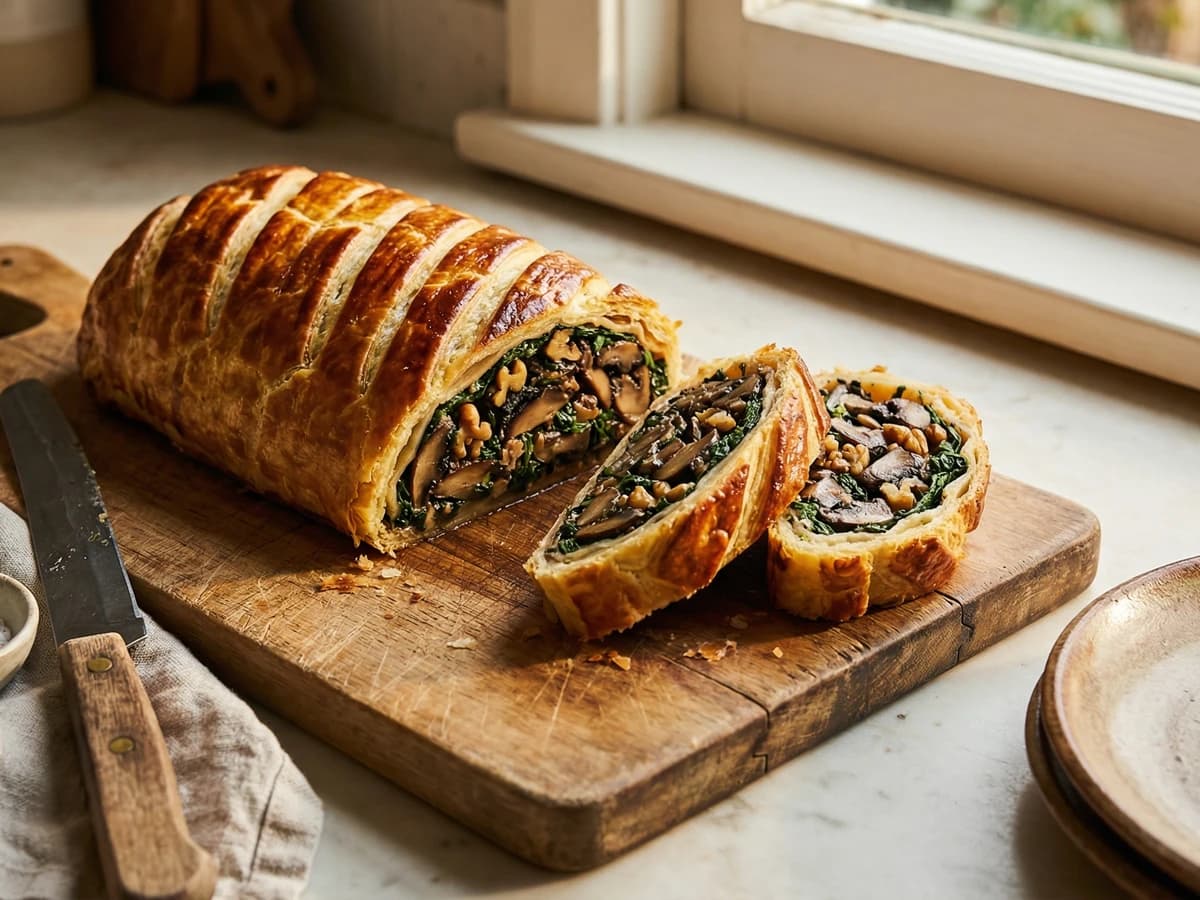
A magnificent whole beef tenderloin swaddled in earthy mushroom duxelles, wrapped in buttery puff pastry that shatters at the knife's touch. This is the centerpiece that silences a holiday table.
Main Dishes
British
Christmas
1 hr 30 min
Active Time
45 min cook•6 hr total
Yield8 servings
Beef Wellington occupies a peculiar place in culinary history. Though named for the Duke who defeated Napoleon, the dish itself has murky origins. Some claim it's a British adaptation of French filet de boeuf en croûte. Others insist it was invented by a London club chef eager to honor the Iron Duke. The truth matters less than the result: a roast so theatrical it demands respect before you've taken a single bite.
I've taught this dish to students who arrived convinced it was beyond their abilities. They were wrong. Wellington rewards organization, not virtuosity. Each component is simple on its own. Seared beef. Sautéed mushrooms. Store-bought puff pastry. The skill lives in the assembly, in keeping everything cold so the pastry stays crisp and the beef cooks evenly.
Make no mistake, this takes time. The duxelles must be bone-dry or it will turn your pastry to cardboard. The beef must chill thoroughly or it will overcook before the exterior browns. But every step can be done ahead. On Christmas Day, all you do is brush, bake, and bask in the applause.
This is food for gathering. Carve it at the table where everyone can see the rosy interior, the golden crust, the layers of flavor you've built. Let them understand that great cooking is not magic. It's simply attention paid in advance.
The technique, the tradition, and the story behind every dish.
Pull the tenderloin from the refrigerator 45 minutes before searing. Season it aggressively on all sides with salt and pepper. Heat 2 tablespoons olive oil in your largest skillet over high heat until it shimmers and just begins to smoke. Sear the beef on all sides until a deep brown crust forms, about 2 minutes per side. You want color, not cooking. The interior should remain completely raw. Transfer to a plate and let it cool to room temperature, then refrigerate for at least 30 minutes.
The sear creates the Maillard crust that gives Wellington its savory depth. Don't rush it. Brown means flavor.
2
Make the duxelles
Pulse the mushrooms in a food processor until they resemble coarse sand. Work in batches to avoid turning them to paste. Melt the butter in a large skillet over medium-high heat. Add the mushrooms, spreading them in a thin layer. This is critical: the mushrooms must release their moisture and dry out completely. Cook without stirring for 3 minutes to let them brown, then stir and repeat. After 10 minutes, add the shallots and garlic. Cook 3 minutes more until fragrant. Add the sherry and thyme, scraping up any browned bits. Continue cooking until the mixture is completely dry and pulls away from the pan cleanly, another 5 to 8 minutes. Season generously with salt and pepper. Spread on a plate and refrigerate until cold.
Wet duxelles will steam inside the pastry and ruin everything. When you think it's dry enough, cook it three minutes longer.
3
Build the prosciutto layer
Lay a large sheet of plastic wrap on your work surface, at least 18 inches long. Arrange the prosciutto slices in an overlapping rectangle, slightly longer than your tenderloin and wide enough to wrap around it with a 2-inch overlap. Spread the cold duxelles in an even layer over the prosciutto, leaving a 1-inch border on all sides. If using pâté, spread it in a thin layer over the duxelles.
4
Roll the beef
Remove the twine from your chilled, seared tenderloin. Place it at the bottom edge of the prosciutto layer. Using the plastic wrap to help you, roll the prosciutto and mushroom mixture tightly around the beef, creating a compact cylinder. Twist the plastic wrap ends like a candy wrapper and refrigerate for at least 1 hour or up to 24 hours. The roll must be cold and firm before the next step.
This is your make-ahead milestone. The wrapped beef keeps beautifully refrigerated overnight. Christmas Eve prep saves Christmas Day sanity.
5
Wrap in pastry
Roll out one sheet of puff pastry to a rectangle large enough to wrap your beef roll with a 2-inch overlap. If needed, overlap two sheets and press the seam firmly with a rolling pin. Unwrap the chilled beef roll from its plastic and place it in the center of the pastry. Brush the pastry edges with egg wash (yolks beaten with cream). Fold the pastry over the beef, pressing the seam firmly to seal. Trim any excess. Fold and seal the ends like a package. Place seam-side down on a parchment-lined baking sheet.
Cold hands and a cold room are your allies. If the pastry feels soft or sticky at any point, slide everything into the refrigerator for 15 minutes.
6
Score and chill
Brush the entire surface with egg wash. Using a sharp paring knife, score the pastry with diagonal lines about 1 inch apart, cutting only through the top layer. This isn't decoration. The scores allow steam to escape and help the pastry puff evenly. Refrigerate uncovered for at least 30 minutes or up to 4 hours. The pastry must be cold when it hits the oven.
7
Bake the Wellington
Position a rack in the center of your oven and heat to 425°F. Brush the chilled Wellington with a second coat of egg wash and sprinkle with flaky sea salt. Bake for 25 to 30 minutes until the pastry is deeply golden and an instant-read thermometer inserted through the end registers 120°F for medium-rare or 130°F for medium. The internal temperature will rise another 5 to 10 degrees as it rests.
Trust your thermometer, not your timer. Ovens vary. A $15 instant-read thermometer is the single most important tool for roasting meat properly.
8
Rest and carve
Transfer the Wellington to a cutting board and let it rest for 10 minutes. This is not optional. Cutting too soon spills juices and leaves you with dry beef. After resting, use a sharp serrated knife to cut into slices about 1-inch thick. The pastry should shatter slightly, the mushroom layer should hold firm, and the beef should be rosy pink from edge to edge. Serve immediately on warmed plates.
Chef Tips
•Ask your butcher to trim and tie the tenderloin. You want the chain and silverskin removed. A uniform cylinder cooks evenly.
•Good puff pastry makes or breaks this dish. All-butter brands like Dufour are worth seeking out. The flavor difference is pronounced.
•The pâté layer is traditional but optional. Without it, you'll have a cleaner, more modern version that still impresses.
•A red Bordeaux or California Cabernet Sauvignon stands up beautifully to the rich beef and earthy mushrooms. Pour generously.
•Leftover Wellington (unlikely as that sounds) reheats poorly. The pastry goes soft. Eat it all while the applause is fresh.
Advance Preparation
•Duxelles can be made up to 3 days ahead and refrigerated in an airtight container.
•Beef can be seared 2 days ahead and refrigerated.
•The prosciutto-wrapped roll (before pastry) can be assembled 24 hours ahead.
•Fully assembled Wellington can be refrigerated up to 6 hours before baking. Add 5 minutes to baking time if very cold.
•For large gatherings, prepare two smaller Wellingtons rather than one giant one. They cook more evenly and carve more neatly.
Frequently Asked Questions
Nutrition Information
1 serving (about 340g)
Calories
1385 calories
Total Fat
69 g
Saturated Fat
19 g
Trans Fat
1 g
Unsaturated Fat
48 g
Cholesterol
106 mg
Sodium
230 mg
Total Carbohydrates
2 g
Dietary Fiber
1 g
Sugars
0 g
Protein
55 g
Where cooking meets culture.
Culinary guides, cultural storytelling, and the editorial depth that makes cooking meaningful.