
Chef Lupita
Almendrados Conventuales Poblanos
Puebla's convent almond cookies, made from blanched almonds, sugar syrup, egg yolks, canela, and patient hands, the kind of sweet that belongs beside coffee in talavera, not in a plastic bakery box.
A cooking platform built around craft, culture, and the stories behind what we eat.
Created by
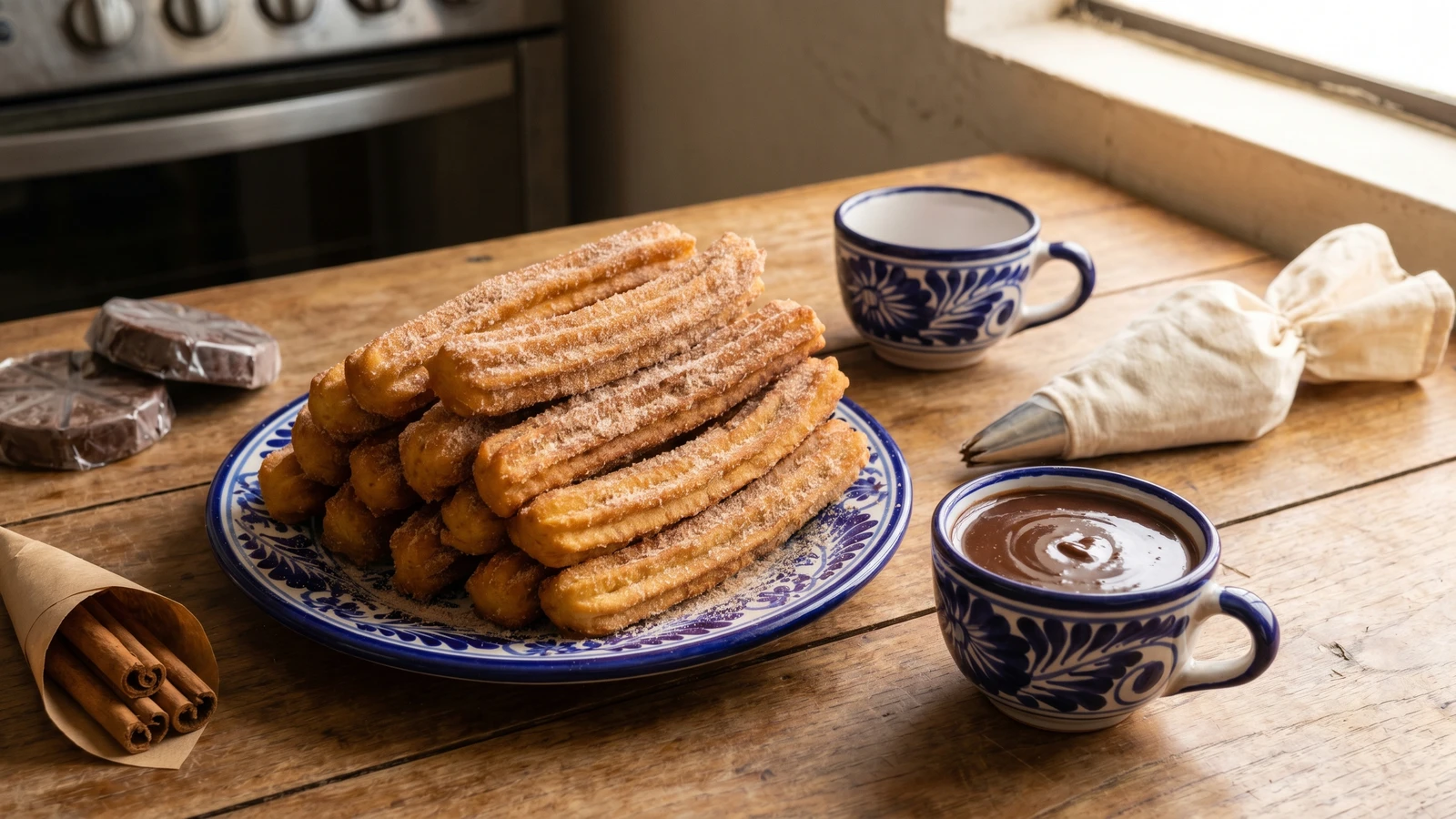
Puebla's churreria table: star-ridged dough fried until crisp, rolled in cinnamon sugar, and served with thick chocolate de mesa in talavera cups.
Puebla owns this version at the table: churros served with chocolate thick enough to cling to the ridges. Walk near the zocalo on a cool evening and you understand it. The plate is not precious. It is a pile of hot fried dough, cinnamon sugar on your fingers, chocolate in a talavera cup, and someone telling you to eat before the crust softens.
This dish comes from a Spanish frying technique married to Mexican chocolate. That matters. The churro dough is wheat flour, water, butter, salt, and egg, beaten until it fights the spoon, then pushed through a star tip so the ridges crisp in the oil. Smooth churros are wrong. The shape is not decoration. It creates the crust.
The chocolate is not cocoa powder stirred into milk. Use chocolate de mesa, the kind with cacao, sugar, and canela. In Puebla, with its convent sweets and talavera on the table, this makes sense: wheat, sugar, cinnamon, milk, and cacao meeting in one cup. No me vengas con atajos. If the chocolate is thin, it will run off the churro like sadness.
My mother did not make churros often. She bought them, like a sensible woman with work to do. But in her notebook she wrote one instruction twice: masa caliente, aceite listo. Hot dough, oil ready. She was right. Saber cocinar es saber vivir.
Churros arrived in Mexico through Spanish colonial cooking, where wheat flour frying traditions became part of urban street and cafe food during the 19th and early 20th centuries. Chocolate, by contrast, has deep Mesoamerican roots: cacao drinks were prepared long before the conquest, and colonial Puebla helped turn chocolate, sugar, milk, and cinnamon into a sweet table tradition tied to convent kitchens. Puebla's identity as a city of sweets, talavera ceramics, and cafe culture makes churros con chocolate feel at home there, even though the dough itself is not pre-Columbian.
Quantity
1 cup
Quantity
1/2 cup
Quantity
6 tablespoons
Quantity
1 tablespoon
Quantity
1/2 teaspoon
Quantity
1 1/4 cups
Quantity
2
room temperature
Quantity
1 teaspoon
Quantity
2 quarts
Quantity
3/4 cup
Quantity
1 1/2 teaspoons
Quantity
2 cups
Quantity
6 ounces
chopped
Quantity
2 ounces
chopped
Quantity
1 tablespoon
Quantity
1 teaspoon
mixed with 1 tablespoon cold milk
| Ingredient | Quantity |
|---|---|
| water | 1 cup |
| whole milk | 1/2 cup |
| unsalted butter | 6 tablespoons |
| granulated sugar | 1 tablespoon |
| fine sea salt | 1/2 teaspoon |
| all-purpose flour | 1 1/4 cups |
| large eggsroom temperature | 2 |
| Mexican vanilla extract | 1 teaspoon |
| neutral frying oil, such as canola or safflower | 2 quarts |
| granulated sugar, for coating | 3/4 cup |
| ground canela or Ceylon cinnamon, for coating | 1 1/2 teaspoons |
| whole milk, for the chocolate | 2 cups |
| Mexican chocolate de mesachopped | 6 ounces |
| dark chocolate, 60 to 70 percent cacaochopped | 2 ounces |
| piloncillo or dark brown sugar (optional) | 1 tablespoon |
| cornstarchmixed with 1 tablespoon cold milk | 1 teaspoon |
Combine the water, 1/2 cup milk, butter, 1 tablespoon sugar, and salt in a heavy saucepan. Bring it to a full boil over medium heat. The butter must be completely melted before the flour goes in. This is the base of the choux dough, and if the liquid is shy, the flour will clump.
Add the flour all at once and stir hard with a wooden spoon. The dough will look rough at first, then pull together into one thick mass. Keep cooking and stirring for 2 minutes, until a thin film forms on the bottom of the pan and the dough smells faintly toasted. That little bit of cooking removes the raw flour taste.
Transfer the dough to a bowl and let it cool for 5 minutes. Beat in the eggs one at a time, mixing fully after each addition. Add the vanilla. The dough should be thick, glossy, and stubborn enough to hold a ridge. If it pours, it is too loose. Churro dough should make you work a little.
Mix the 3/4 cup sugar with the canela in a shallow dish. Use true canela if you can find it, the brittle Mexican cinnamon sold in loose curls at the mercado. Cassia cinnamon is harsher. It works, but it is a compromise, not an upgrade.
Heat the oil in a heavy pot to 365F. Use a thermometer. Guessing with frying oil is how people burn churros outside and leave them raw in the center. Fit a pastry bag with a large closed-star tip, about 1/2 inch wide, and fill it with the warm dough.
Pipe 5-inch lengths of dough directly into the oil, cutting each one with scissors. Fry 4 or 5 at a time so the oil temperature does not collapse. Turn them as they cook, 4 to 5 minutes total, until deep golden with crisp ridges. They should sound firm when tapped with the tongs.
Lift the churros onto a wire rack for 30 seconds, then roll them in the cinnamon sugar while the surface is still warm enough to catch it. Do not pile them on paper towels. They will sweat and soften. Fried pastry needs air around it. Así se hace y punto.
Warm the 2 cups milk in a saucepan over medium-low heat. Add the chocolate de mesa, dark chocolate, and piloncillo if using. Whisk until the chocolate melts completely. Add the cornstarch slurry and simmer gently for 2 to 3 minutes, whisking, until the chocolate thickens enough to coat a spoon. It should cling to the churro, not disappear into it.
Pile the churros on a talavera plate and pour the chocolate into small talavera cups. Serve while the churros are crisp and the chocolate is glossy and thick. Churros wait for nobody. Make the table come to them.
1 serving (about 75g)
Culinary guides, cultural storytelling, and the editorial depth that makes cooking meaningful.
Discover Culinary ExplorerChef Lupita
Puebla's convent almond cookies, made from blanched almonds, sugar syrup, egg yolks, canela, and patient hands, the kind of sweet that belongs beside coffee in talavera, not in a plastic bakery box.

Chef Lupita
Ciudad de Mexico's panaderia banderillas are long sticks of hojaldre pressed with sugar, baked until amber, and finished with a hard glaze for coffee at the kitchen table.

Chef Lupita
Mérida's pale egg-yolk-and-vanilla kisses, tiny cookies built on eight yolks and a perfume of orange blossom, sandwiched with guava paste and dusted heavy with powdered sugar.

Chef Lupita
Hidalgo's bisquet de nata carries Pachuca's mining history into the breakfast table: a Cornish-style bread softened by Mexican nata, split warm and eaten with café de olla.