Culinary Explorer

A cooking platform built around craft, culture, and the stories behind what we eat.
Discover Culinary Explorer
Chocolate Caliente Yucateco

Chocolate Caliente Yucateco

Created by

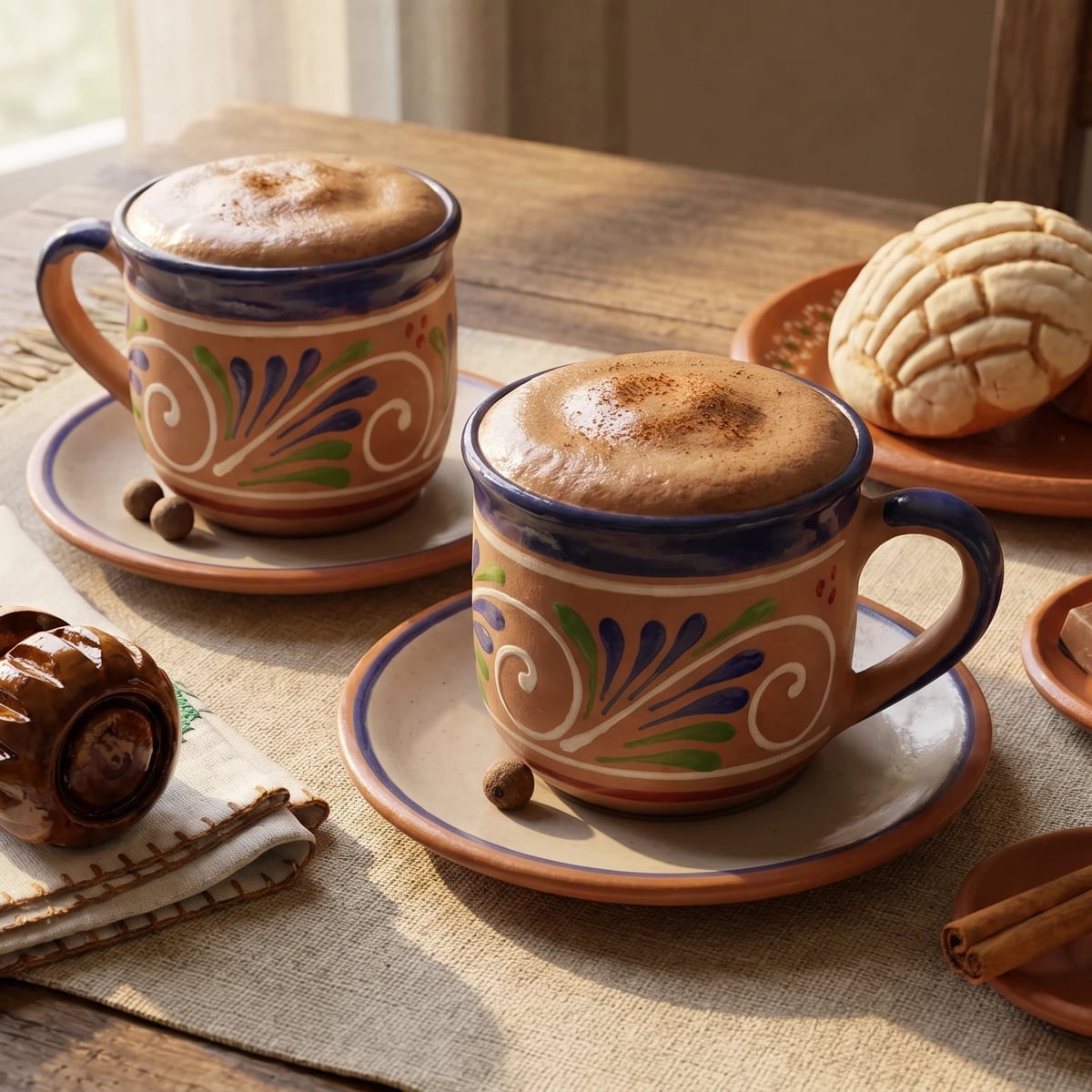
Yucatán's December cup. Mexican chocolate tablets melted into milk with true canela and pimienta gorda, whisked with a molinillo until the foam crowns the jarrito. The drink that closes a Mérida holiday night.

Beverages
Mexican
Christmas
Holiday
Comfort Food
5 min
Active Time
15 min cook20 min total
Yield4 servings

This is a Yucatecan cup. It belongs to Mérida, to Valladolid, to the small towns where the December nights actually turn cool and the families pull out the molinillo that has lived in the kitchen drawer for forty years.

The chocolate is Mexican chocolate, tablets ground with sugar, canela, and almond, the kind you buy in a six-pack at any Yucatecan mercado. The canela is the real one, the soft, flaky stick that crumbles between your fingers, not the hard cassia bark that most of the world calls cinnamon. The pimienta gorda is what sets the Yucatecan version apart from the cup they drink in Oaxaca or Puebla. Pimienta gorda grows in the peninsula. It carries warmth, clove, a quiet pepper. Drop three berries into the milk and you taste the Yucatán in the cup. Leave it out and you have a generic Mexican hot chocolate. Cada estado, su propia cocina.

My mother did not drink Yucatecan chocolate. She was from Jalisco and made hers plain, no pimienta, no orange peel. I learned this version from a señora named Doña Rosalba in Mérida who made it every night from the first week of December until Día de Reyes in January. She told me the pimienta gorda was non-negotiable and that anyone who whisked the chocolate with a spoon instead of a molinillo did not understand what they were drinking. She was right on both counts.

The foam is the dish. A cup of chocolate caliente without espuma is a cup of warm sweet milk. The molinillo, the carved wooden whisk you roll between your palms, is what makes the foam rise. No me vengas con atajos. Buy the molinillo. They cost almost nothing and they last a lifetime.

Cacao is native to Mesoamerica and the Maya of the Yucatán Peninsula cultivated and traded it for over two thousand years before the conquest, drinking it cold, unsweetened, and often foamed with the addition of ground maize, chile, and achiote. The Spanish addition of cane sugar, milk, and Old World spices like canela and pimienta gorda (which is itself a New World allspice, native to the Caribbean and Yucatán) transformed the bitter ceremonial xocolātl into the sweet hot beverage now drunk across Mexico. The molinillo, the carved wooden whisk first documented in the colonial period, was a Spanish-era innovation designed to mimic the foamed texture that pre-Columbian Maya cooks had achieved by pouring the chocolate from one vessel to another at height; the foam itself, in both eras, has always been considered the most prized part of the drink.

The technique, the tradition, and the story behind every dish.

Discover Culinary Explorer

Ingredients

whole milk

Quantity

4 cups

Mexican chocolate tablets

Quantity

2 (about 90 grams each)

broken into pieces

true Mexican canela (Ceylon cinnamon)

Quantity

1 stick, about 4 inches long

pimienta gorda (allspice berries)

Quantity

3 whole

lightly cracked

orange peel

Quantity

1 strip, about 2 inches long

no white pith

fine sea salt

Quantity

1 pinch

piloncillo (optional)

Quantity

1 tablespoon

grated, only if your chocolate is not sweet enough

Equipment Needed

  • Heavy saucepan or clay olla
  • Wooden molinillo
  • Fine-mesh strainer
  • Thick clay jarritos or hand-painted ceramic mugs from Ticul

Instructions

  1. 1

    Warm the milk with the spices

    Pour the whole milk into a heavy saucepan or a clay olla if you have one. Add the canela stick, the cracked pimienta gorda, the orange peel, and the pinch of salt. Set over medium-low heat. You want the milk to warm slowly, not boil. Slow heat pulls the perfume out of the canela and the pimienta. Rushing it scorches the milk and you taste it in the cup.

    Use true Mexican canela, the soft, flaky Ceylon stick that shatters between your fingers. The hard, glossy cassia bark sold as cinnamon in most American supermarkets is a different spice and it does not belong in this cup.
  2. 2

    Infuse, then strain

    Hold the milk at a bare simmer for 8 to 10 minutes. Small bubbles around the edge of the pot, never a rolling boil. The milk will take on the color of weak tea and the kitchen will smell of canela and pimienta. Strain the milk into a clean pot. Discard the spent canela, pimienta, and orange peel. They have given everything they had to give.

  3. 3

    Melt the chocolate

    Return the strained milk to low heat. Drop in the broken pieces of Mexican chocolate. Stir with a wooden spoon until every piece dissolves. This takes 4 or 5 minutes. The chocolate is grainy on purpose, ground with sugar and almond and canela, and it will not go completely smooth the way couverture does. That texture is the chocolate, not a flaw. Taste it. If the cup is not sweet enough for the people at your table, grate in a little piloncillo. Yucatecan cooks lean drier than the central Mexican version.

  4. 4

    Foam with the molinillo

    Stand the molinillo upright in the pot, the carved head submerged in the chocolate, the handle between your palms. Roll the handle back and forth quickly, the way you would warm your hands on a cold morning. Do not stir in circles. The carved rings of the molinillo whip air into the chocolate and a thick brown foam rises to the surface. Keep going for two minutes. The foam, espuma, is the whole point. A cup of Mexican chocolate without foam is just sweet milk. Así se hace y punto.

    If you have no molinillo, an immersion blender will get you the foam. A whisk will get you partway there. A spoon will not. The molinillo exists for a reason and it is worth owning one.
  5. 5

    Serve at once

    Pour into thick clay jarritos or hand-painted ceramic mugs, the kind they fire in Ticul. Spoon a generous crown of foam onto each cup. Serve immediately, while the foam still holds. Pan dulce on the side, a concha, a marranito, whatever the panaderia had this morning. In Mérida, on a December night, this is the cup that ends the day.

Chef Tips

  • Mexican chocolate is not the same as baking chocolate or eating chocolate. The grainy texture from the unrefined sugar and ground almond is the chocolate. Do not try to substitute Belgian couverture or unsweetened cocoa powder. You will be making something else. Abuelita, Ibarra, Mayordomo from Oaxaca, or any Yucatecan brand from a Mérida mercado will all work.
  • Pimienta gorda is allspice. The English name confuses people because it sounds like a blend, but it is one single berry, native to the Yucatán and the Caribbean, and it is the spice that anchors the Yucatecan version of this drink. Look for whole berries, not ground. Ground allspice loses its perfume fast.
  • Some cooks in Yucatán use part water and part milk, especially during fasting weeks. Some use only water. Whole milk gives the richest cup. Use what your house drinks.

Advance Preparation

  • The infused, strained milk can be made several hours ahead and refrigerated. Reheat gently before adding the chocolate.
  • Do not whisk the foam until the moment you are ready to serve. Foam does not hold. It collapses within minutes and the second cup is never as good as the first.

Frequently Asked Questions

Nutrition Information

1 serving (about 290g)

Calories
365 calories
Total Fat
14 g
Saturated Fat
8 g
Trans Fat
0 g
Unsaturated Fat
5 g
Cholesterol
25 mg
Sodium
95 mg
Total Carbohydrates
49 g
Dietary Fiber
1 g
Sugars
44 g
Protein
10 g

Note: Chef personas and recipes are created with AI assistance. Cook with care: follow safe food-handling practices, check doneness with a thermometer when needed, and adapt for allergies and your kitchen.

Where cooking meets culture.

Culinary guides, cultural storytelling, and the editorial depth that makes cooking meaningful.

Discover Culinary Explorer

More from Yucatecan Beverages

Browse the full collection