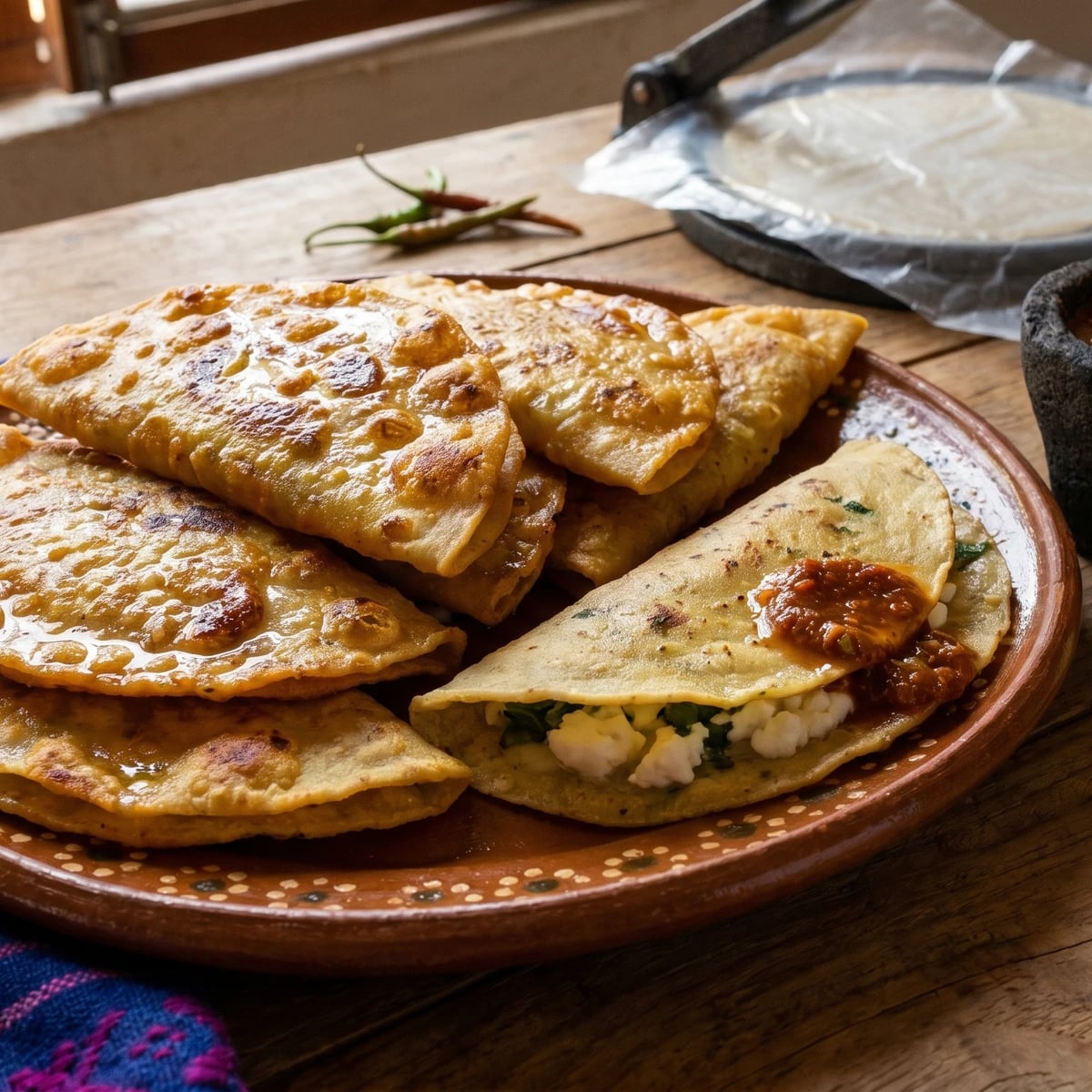
Tuxtla Gutierrez's chiquiadas are small fried quesadillas of fresh corn masa and queso fresco, sealed tight, fried in manteca, and eaten hot with salsa de chile de arbol.
Appetizers & Snacks
Mexican
Game Day
Comfort Food
Potluck
30 min
Active Time
20 min cook•50 min total
Yield16 chiquiadas
Chiapas, especially Tuxtla Gutierrez in the Central Depression, is where these chiquiadas live. They belong to the market table, the afternoon craving, the tray carried out hot enough that the cheese still softens inside the masa. This is food from the Maya south, but not a tamal and not a northern flour quesadilla. Corn masa does the work here.
The filling is queso fresco, or a good fresh Chiapas cheese if your market has it. The masa is pressed small, folded like a quesadilla, sealed hard at the edge, then fried in manteca de cerdo until the shell turns golden and crisp under your teeth. No me vengas con atajos. If the edge opens in the fat, the cheese escapes, the oil spits, and the cook has not done her job.
I learned to watch the hands before I watched the pan. The señoras in Tuxtla press the masa thin but not fragile, spoon the cheese only in the center, and close each chiquiada with the heel of the palm, not with fancy little fork marks. The lesson is practical: control the moisture, control the seal, control the heat. Así se hace y punto.
Chiquiadas belong to Chiapas's corn-masa snack tradition, a family of market foods that includes empanadas, garnachas, and fried quesadillas sold around Tuxtla Gutierrez and nearby towns. Their form reflects the older Mesoamerican habit of cooking filled masa parcels, while the deep-frying in pork lard became common after Spanish-introduced pigs made manteca available in colonial kitchens. In Chiapas, fresh local cheeses from the highlands and central valleys gave these small fried quesadillas their identity, separate from the flour-tortilla quesadillas of northern Mexico.
The technique, the tradition, and the story behind every dish.
fresh nixtamal corn masa or masa harinamixed with warm water if using masa harina
2 cups
fine sea salt
1/2 teaspoon
manteca de cerdosoftened, for the masa
1 tablespoon
queso fresco or fresh Chiapas cheesecrumbled
10 ounces
epazote leavesfinely chopped
2 tablespoons
white onionfinely chopped
1/4 cup
manteca de cerdofor frying
2 cups
salsa de chile de arbol (optional)
1 cup
lime halves (optional)
for serving
Equipment Needed
•Tortilla press lined with plastic
•Heavy deep pot or clay cazuela for frying
•Kitchen thermometer
•Wire rack set over a tray
Instructions
1
Prepare the masa
Put the fresh nixtamal masa in a bowl with the salt and 1 tablespoon of softened manteca. Knead for 2 minutes until smooth and pliable. If using masa harina, mix it first with the warm water, rest it for 10 minutes, then knead in the salt and manteca. The masa should feel like a soft earlobe, moist but not sticky.
2
Mix the filling
Combine the crumbled queso fresco, epazote, and white onion in a bowl. Taste the cheese before you add salt. Many fresh cheeses are already salty enough. The filling must be dry and loose, not wet. Wet filling opens the chiquiada in the fat, and then you have a mess, not a botana.
3
Press the rounds
Divide the masa into 16 balls, each about the size of a walnut. Line a tortilla press with two pieces of plastic cut from a clean bag. Press each ball into a 4-inch round, thin enough to fold easily but thick enough to hold the cheese. Do not make them as thin as tortillas. These must survive frying.
4
Fill and seal
Place 1 generous tablespoon of the cheese filling on one half of each masa round, leaving a clean border. Fold the masa over the filling and press the edge firmly with your fingers or the heel of your palm. Check every edge. If you see a crack, pinch it closed with a damp fingertip. The seal is the recipe here.
5
Heat the manteca
Melt the 2 cups of manteca in a heavy pot or deep cazuela over medium heat until it reaches 350F. If you do not have a thermometer, drop in a tiny piece of masa. It should bubble immediately and rise slowly, not darken at once. La manteca es el sabor, but hot fat still needs discipline.
6
Fry until crisp
Fry the chiquiadas in batches, 3 or 4 at a time, turning once, for 3 to 4 minutes total. They should turn deep golden with small blisters across the surface. Do not crowd the pot. Crowding drops the temperature and makes greasy masa. Drain on a rack, not paper towels, so the bottoms stay crisp.
7
Serve hot
Serve the chiquiadas hot, with salsa de chile de arbol and lime halves at the table. Bite carefully. The shell should crack under your teeth and the cheese should be soft, not running like melted yellow cheese. This is Chiapas, not a stadium nacho stand. Cada estado, su propia cocina.
Chef Tips
•Fresh nixtamal masa from a tortilleria is best. Masa harina works when you have no tortilleria, but it needs the rest after hydration or the edges will crack.
•Use queso fresco or a fresh Chiapas cheese. Do not use cheddar, Monterey Jack, or stringy melting cheese. Chiquiadas are about the contrast between crisp masa and soft, salty fresh cheese.
•Epazote belongs here in a small amount. It gives the filling that green, sharp market flavor. If your epazote is tired and black at the edges, leave it out instead of using bad herbs.
•Fry in manteca de cerdo. Vegetable oil will cook the masa, yes, but it will not give the same flavor. A substitution is a compromise, not an improvement.
Advance Preparation
•The cheese filling can be mixed up to one day ahead and kept refrigerated. Keep it covered so it does not dry out.
•The masa can be mixed 2 hours ahead and covered with a damp towel. If it stiffens, knead in warm water 1 teaspoon at a time.
•Chiquiadas are best fried just before serving. Reheat leftovers on a dry comal or in a 375F oven until crisp again.
Frequently Asked Questions
Nutrition Information
1 serving (about 70g)
Calories
165 calories
Total Fat
11 g
Saturated Fat
5 g
Trans Fat
0 g
Unsaturated Fat
5 g
Cholesterol
20 mg
Sodium
245 mg
Total Carbohydrates
13 g
Dietary Fiber
1 g
Sugars
1 g
Protein
4 g
Where cooking meets culture.
Culinary guides, cultural storytelling, and the editorial depth that makes cooking meaningful.