Culinary Explorer

A cooking platform built around craft, culture, and the stories behind what we eat.
Discover Culinary Explorer
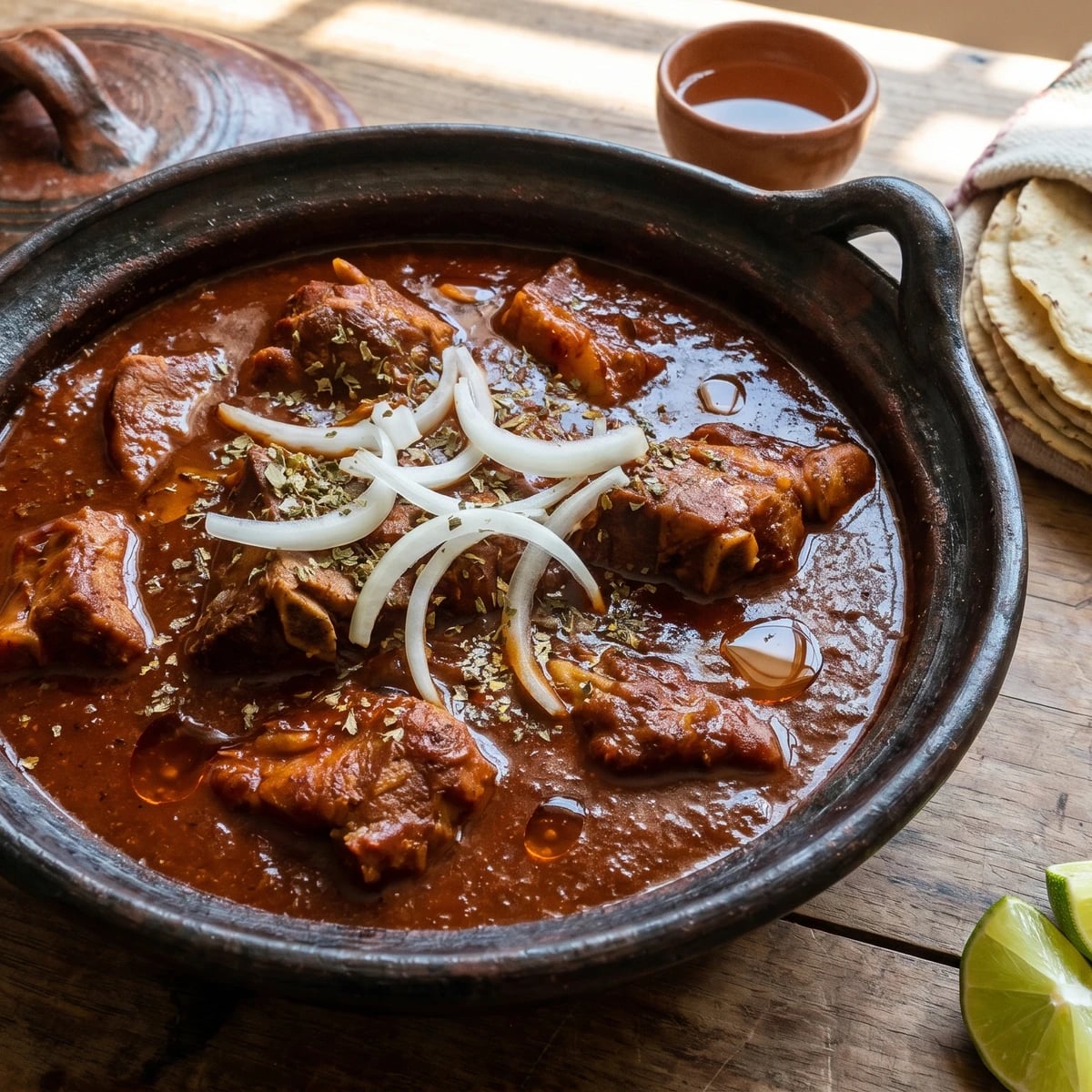
Chileajo de Cerdo Mixteco

Chileajo de Cerdo Mixteco

Created by

Mixteca Oaxaca's celebration stew of pork shoulder braised in a thick roasted paste of guajillo, ancho, a full head of garlic, pineapple vinegar, and warm spices. Wedding food built to feed a courtyard from one cazuela.

Soups & Stews
Mexican
Special Occasion
Celebration
Make Ahead
35 min
Active Time
2 hr 30 min cook3 hr 5 min total
Yield8 servings

This dish belongs to the Mixteca region of Oaxaca. Not the Valles Centrales, not the Istmo, not the coast. The Mixteca: the high, dry country west of the state capital where the cooking is drier, more concentrated, and built on chile pastes thick enough to hold to the back of a spoon. Huajuapan de León is the town most people associate with chileajo, and that is where I first ate it properly, at a wedding in a packed courtyard behind the church, served from clay cazuelas the size of washbasins by women who had been cooking since before sunrise.

Chileajo means exactly what it says: chile and garlic. Ten guajillos for color and body. Four anchos for depth and sweetness. A full head of garlic, roasted on the comal until the cloves go soft and sweet, that gives the dish its name. But what separates this stew from every other chile-braised pork in Mexico is the pineapple vinegar. That tartness cuts through the richness of the lard and the density of the paste. It is what the señoras in Huajuapan will tell you makes chileajo chileajo and not just another guisado de puerco. Without the vinegar, you have a generic chile stew. With it, you have Mixteca cooking.

This is wedding food. Fiesta food. Mayordomía food. The kind of dish a team of women starts in darkness, working clay cazuelas over wood fire until a hundred guests sit down at midday. The paste is thick by design: it coats the pork without sliding off, which means it holds for hours over a low flame while the celebration happens around it. I have three versions in my notebook from the Mixteca, collected in kitchens between Huajuapan and Juxtlahuaca, and not one of them agrees on the exact number of cloves or the ratio of guajillo to ancho. That is how it should be. The argument is part of the tradition. Cada estado, su propia cocina, and within Oaxaca, each region guards its own.

Chileajo descends from the pre-Hispanic Mixtec practice of grinding dried chiles with stone tools into concentrated pastes for preserving and seasoning meat, a technique documented in early colonial accounts of indigenous foodways in the Mixteca Alta. The garlic and fruit vinegar that give the modern dish its name arrived with the Spanish in the 16th century, but the underlying method of building thick, spiced chile sauces predates the conquest by centuries. The dish remains the centerpiece of mayordomías and wedding celebrations in towns like Huajuapan de León and Santiago Juxtlahuaca, where communal preparation by teams of women the day before the feast follows a pattern largely unchanged from colonial-era descriptions of Mixtec ceremonial cooking.

The technique, the tradition, and the story behind every dish.

Discover Culinary Explorer

Ingredients

bone-in pork shoulder

Quantity

3 pounds

cut into 2-inch chunks

white onion

Quantity

1 medium

halved

head of garlic

Quantity

1 (about 12 cloves)

cloves separated

bay leaves

Quantity

2

kosher salt

Quantity

1 tablespoon, plus more to taste

dried chile guajillo

Quantity

10

stemmed and seeded

dried chile ancho

Quantity

4

stemmed and seeded

dried chile de arbol

Quantity

3

stemmed

cumin seeds

Quantity

1 teaspoon

whole cloves

Quantity

6

black peppercorns

Quantity

8

dried Mexican oregano

Quantity

1 tablespoon, plus more for serving

dried thyme

Quantity

1/2 teaspoon

dried avocado leaves (hojas de aguacate)

Quantity

3

pineapple vinegar

Quantity

3 tablespoons

manteca de cerdo (pork lard)

Quantity

3 tablespoons

hand-pressed corn tortillas (optional)

Quantity

for serving

warmed

lime wedges (optional)

Quantity

for serving

sliced white onion (optional)

Quantity

for serving

Equipment Needed

  • Heavy 6-quart Dutch oven or deep clay cazuela
  • Cast iron comal or heavy skillet for toasting chiles, garlic, and spices
  • High-powered blender
  • Fine-mesh strainer
  • Wooden spoon for frying the paste

Instructions

  1. 1

    Cook the pork

    Place the pork shoulder chunks in a heavy 6-quart pot. Cover with cold water by two inches. Add one half of the onion, 4 peeled garlic cloves, the bay leaves, and the salt. Bring to a gentle simmer over medium heat. Skim the gray foam that rises in the first ten minutes. Cold water draws the flavor out slowly. A rolling boil clouds the broth and toughens the meat. Reduce heat until you see lazy bubbles every few seconds. Cover partially and cook for one and a half to two hours, until the pork pulls apart easily with a fork but still holds its shape. Remove the pork to a plate. Strain the broth and reserve it. You will need at least two cups for the paste.

  2. 2

    Toast the chiles

    While the pork simmers, heat a dry comal or cast iron skillet over medium heat. Toast the guajillo chiles first, pressing them flat with a spatula, about 30 seconds per side. They will puff, blister slightly, and release a warm, earthy smell. The ancho is thicker and needs the same time but watch that it does not blacken. The chile de arbol is small and thin and burns in seconds: give it 15 seconds per side, no more. Transfer all toasted chiles to a heatproof bowl and cover with hot tap water. Hot water, not boiling. Let them soften for 20 minutes.

    Burned chile is bitter chile, and there is no recovering from it. If one goes black, throw it out and toast another. You are toasting to wake the oils, not to carbonize the skin.
  3. 3

    Roast garlic and onion

    On the same comal, place the remaining garlic cloves (about 8), unpeeled, and the other onion half, cut side down. Let them roast over medium heat, turning the garlic occasionally, until the skins are charred in spots and the cloves feel soft when pressed, about 10 to 12 minutes. The onion should be deeply browned on the cut face. The roasting sweetens the garlic and takes the raw edge off the onion. This is the 'ajo' in chileajo, and it should be generous. Peel the garlic when cool enough to handle.

  4. 4

    Toast the spices and avocado leaves

    In the same dry comal, add the cumin seeds, cloves, and black peppercorns. Toast for about 45 seconds, shaking the comal, until fragrant. The moment you smell them, pull them off the heat. Briefly toast the avocado leaves, about 5 seconds per side, until they release their anise-like scent. Crumble them into the spice pile. These leaves are Oaxacan to the bone. If you have never smelled a toasted hoja de aguacate, you have not smelled Oaxacan cooking.

  5. 5

    Blend the paste

    Drain the soaked chiles and discard the soaking water. Place them in a blender with the roasted garlic, roasted onion, toasted spices, crumbled avocado leaves, oregano, thyme, pineapple vinegar, and one cup of the reserved pork broth. Blend on high until completely smooth, scraping down the sides as needed. This should take two to three minutes in a good blender. You want a thick, uniform paste with no visible pieces of chile skin. Strain through a fine-mesh sieve into a bowl, pressing the solids with the back of a spoon to extract every bit of flavor. Discard the skins. The paste should be the color of fired clay, deep red-brown, and thick enough to coat a spoon without dripping.

    The pineapple vinegar is not optional and not decorative. It is what separates chileajo from every other chile-braised pork in Mexico. The tartness holds the richness of the sauce together. A tablespoon of good apple cider vinegar is a compromise if you cannot find pineapple vinegar, but know what you are missing.
  6. 6

    Fry the paste in lard

    In a heavy, deep cazuela or Dutch oven, melt the manteca de cerdo over medium heat. When the lard shimmers, pour in the strained chile paste. It will sputter and pop. Stand back but do not walk away. Stir constantly with a wooden spoon for eight to ten minutes. The paste will darken from red-brown to a deeper, almost brick color, and the lard will begin to separate and pool around the edges. That separation is your signal that the paste is cooked. This step is the recipe. La manteca es el sabor. Skip it and the sauce will taste raw and flat, no matter what you do afterward.

    The frying deepens the chile flavor, blooms the spices into the fat, and changes the texture from a raw puree to a cooked sauce. You cannot skip this step any more than you can skip the chiles themselves. No me vengas con atajos.
  7. 7

    Braise the pork in the paste

    Add the cooked pork pieces to the fried paste. Stir to coat every chunk. Add one to one and a half cups of the reserved pork broth, enough to loosen the sauce so it flows around the meat but remains thick. This is not a soupy stew. The sauce should cling to the pork like a thick mole. Reduce heat to low, cover partially, and simmer for 25 to 30 minutes, stirring occasionally so nothing catches on the bottom. Taste for salt. The vinegar will brighten as it simmers, and the garlic will mellow into the background while the chiles take center stage. When the lard rises in small pools on the surface and the sauce coats the meat without sliding off, it is done.

  8. 8

    Rest and serve

    Pull the pot off the heat and let the chileajo rest for ten minutes. The sauce will tighten as it cools slightly, and the flavors will settle. Serve directly from the cazuela at the center of the table, family-style, the way it is served in the courtyards of the Mixteca. Warm corn tortillas, sliced white onion, lime wedges, and a pinch of dried oregano on the side. Each person tears a tortilla, takes a piece of pork, and drags it through the sauce. Recetas probadas y garantizadas.

Chef Tips

  • The garlic is the backbone of this dish and the reason it has 'ajo' in the name. Do not reduce the amount. Roasting it on the comal is not a suggestion: raw garlic blended into the paste gives you a sharp, acrid sauce. Roasted garlic gives you the sweet, deep, mellow flavor that makes chileajo what it is.
  • Pineapple vinegar is what the cooks in the Mixteca use. If you live near a Mexican market, ask for vinagre de piña. If you cannot find it, a good-quality apple cider vinegar is the closest substitute. White distilled vinegar is too harsh and will fight the chiles instead of supporting them. The vinegar is a compromise, not an upgrade.
  • This stew is thick on purpose. It was designed to hold for hours at a celebration without breaking or thinning out. If your sauce is too loose, cook it uncovered for another ten minutes and it will reduce. If it is too tight, add broth by the quarter cup. The right consistency coats the meat the way mole coats a tamale: completely and without sliding off.
  • Bone-in pork shoulder is the only cut for this. The bone gives body to the broth, the fat keeps the meat from drying out during the long simmer, and the collagen melts into the sauce. Lean pork loin will give you dry, stringy meat in a thin sauce. La manteca es el sabor, and that starts with buying the right cut.

Advance Preparation

  • Chileajo is better the second day. The paste thickens, the pork absorbs more of the sauce, and the vinegar mellows into the background. Make it a full day ahead, refrigerate it in the cazuela, and reheat gently over low heat with a splash of broth to loosen. This is exactly how it is done for weddings in the Mixteca: cooked the day before, served the day of.
  • The chile paste alone can be made up to three days ahead and refrigerated in an airtight container. Fry it in lard when you are ready to cook. The paste only concentrates as it sits.
  • The stew keeps refrigerated for up to four days. It freezes well for two months. Thaw overnight in the refrigerator and reheat slowly.

Frequently Asked Questions

Nutrition Information

1 serving (about 280g)

Calories
370 calories
Total Fat
26 g
Saturated Fat
9 g
Trans Fat
0 g
Unsaturated Fat
16 g
Cholesterol
100 mg
Sodium
620 mg
Total Carbohydrates
8 g
Dietary Fiber
2 g
Sugars
2 g
Protein
26 g

Note: Chef personas and recipes are created with AI assistance. Cook with care: follow safe food-handling practices, check doneness with a thermometer when needed, and adapt for allergies and your kitchen.

Where cooking meets culture.

Culinary guides, cultural storytelling, and the editorial depth that makes cooking meaningful.

Discover Culinary Explorer

More from Oaxacan Soups & Stews

Browse the full collection