
Chef Lupita
Aporreadillo Michoacano con Huevo
Michoacán's Tierra Caliente almuerzo, where salted beef is softened, pounded, fried in lard, folded with egg and chile perón salsa, then served beside morisqueta like a proper working table.
A cooking platform built around craft, culture, and the stories behind what we eat.
Created by
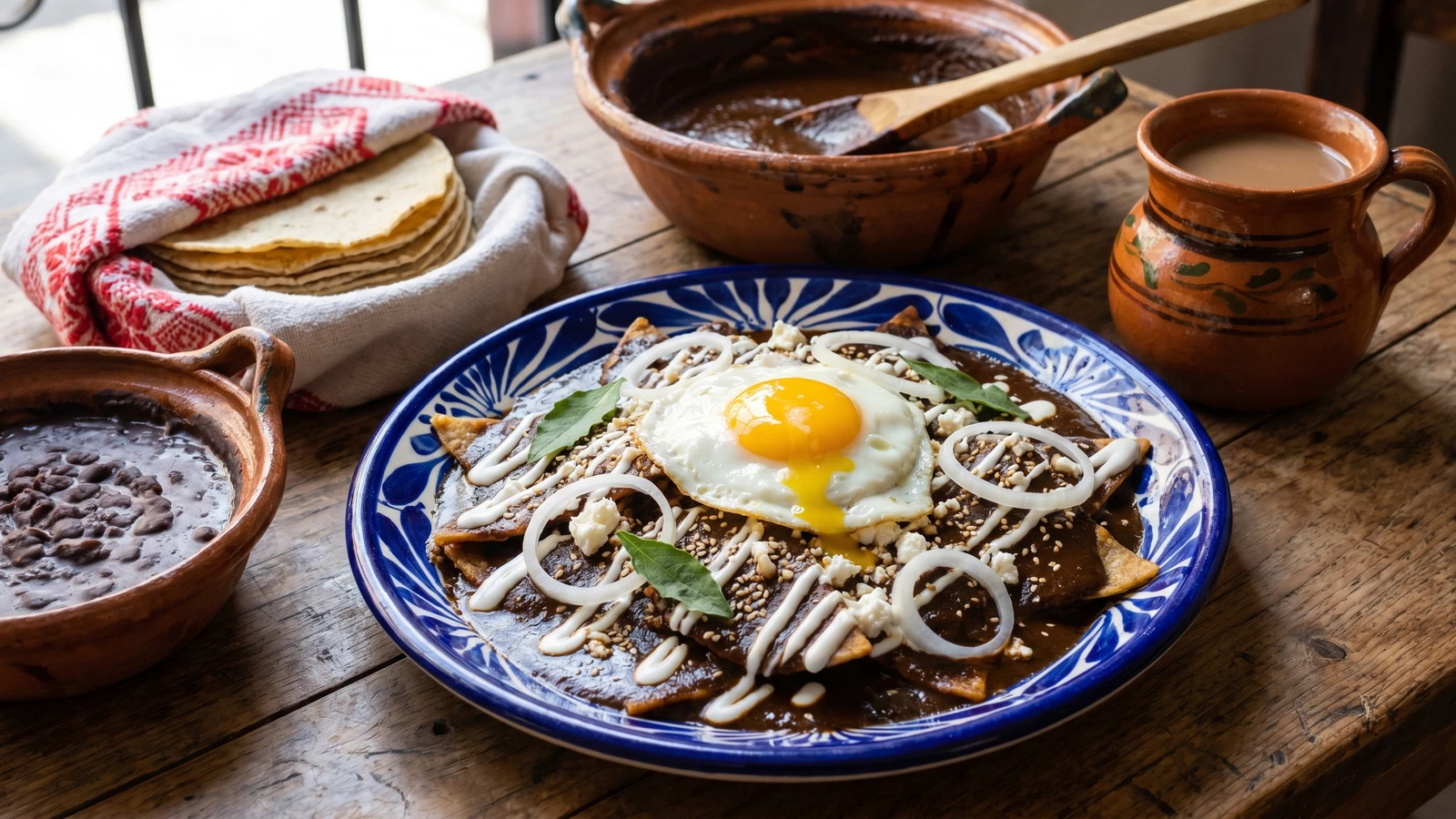
Puebla's morning resurrection of yesterday's mole, ladled over lard-fried tortilla totopos and crowned with crema, queso fresco, raw white onion, toasted sesame, and a runny-yolked egg.
This is a Puebla dish, and more specifically a Puebla morning dish. Chilaquiles exist all over Mexico, in salsa verde, in salsa roja, in red mole, in green mole, but the version finished with mole poblano belongs to the kitchens of the Angelopolis, where mole is made in such quantity for Sunday and for special occasions that there is always some left in the cazuela on Monday morning. That leftover is what becomes breakfast.
Let me be clear about one thing before you start. Chilaquiles are breakfast. They are not nachos. Nachos are a Tex-Mex invention from Piedras Negras that took a wrong turn at the border. Chilaquiles are day-old corn tortillas, cut and fried in lard until crisp, then dressed in a warm sauce at the moment of service. The structure matters. The texture matters. Too much sauce and you have soup. Too little and you have dry chips. You are aiming for the moment between crisp and soft, the bite where the totopo gives way under the tooth but has not yet surrendered.
The mole poblano is the second non-negotiable. Real mole poblano is not chocolate sauce. It is a slow-built sauce of chile mulato, chile ancho, chile pasilla, and chile chipotle, with toasted nuts and seeds, dried fruit, spices, day-old bolillo or tortilla for body, and a small amount of chocolate at the end to round the bitter edge. If you are making this dish from scratch mole, set aside two days. If you are making it from yesterday's mole, which is the point, set aside thirty minutes. Mole always tastes better on the second day. The chiles and the spices marry overnight.
My mother kept a page in her notebook for chilaquiles, three different versions, one in salsa verde, one in salsa roja, and one she copied from a poblana woman who lived in our building in Colonia Roma. The poblana version had a note in the margin: 'el mole de ayer, nunca el de hoy.' Yesterday's mole, never today's. She was right. Saber cocinar es saber vivir, and using leftovers well is half of that knowledge.
Chilaquiles take their name from the Nahuatl 'chilaquilitl,' meaning 'chiles and greens,' a reference to the pre-Columbian practice of softening day-old tortillas in chile-based sauces, documented in the Codice Florentino compiled by Bernardino de Sahagun in the 16th century. The dish predates the Spanish conquest and was a way of using nixtamalized corn that had already been pressed and griddled, a daily necessity in a culture that did not waste maize. Mole poblano, the version of mole most associated with the city of Puebla, was codified in its current form in the 18th and 19th centuries through the convent kitchens of Santa Rosa and Santa Monica, and the marriage of mole poblano to chilaquiles is a specifically Pueblan culinary economy: the elaborate Sunday sauce becomes Monday's breakfast, and nothing is lost.
Quantity
12
cut into quarters or sixths
Quantity
1/2 cup, plus more as needed for frying
Quantity
3 cups
yesterday's mole, loosened with chicken broth to a pourable consistency
Quantity
1 cup, plus more as needed
warmed
Quantity
4
Quantity
1/2 cup
do not substitute sour cream
Quantity
1/2 cup
crumbled (or queso ranchero if you can find it)
Quantity
1/2 medium
sliced into thin rings
Quantity
2 tablespoons
Quantity
for garnish
Quantity
for serving
Quantity
for serving
warmed
| Ingredient | Quantity |
|---|---|
| day-old corn tortillascut into quarters or sixths | 12 |
| manteca de cerdo (pork lard) | 1/2 cup, plus more as needed for frying |
| prepared mole poblanoyesterday's mole, loosened with chicken broth to a pourable consistency | 3 cups |
| chicken brothwarmed | 1 cup, plus more as needed |
| large eggs | 4 |
| crema mexicanado not substitute sour cream | 1/2 cup |
| queso frescocrumbled (or queso ranchero if you can find it) | 1/2 cup |
| white onionsliced into thin rings | 1/2 medium |
| toasted sesame seeds (ajonjoli tostado) | 2 tablespoons |
| fresh epazote or cilantro leaves (optional) | for garnish |
| refried black beans (optional) | for serving |
| hand-pressed corn tortillas (optional)warmed | for serving |
If your tortillas are fresh, lay the cut pieces out on a sheet pan and let them sit at room temperature for two to three hours, or dry them in a 200F oven for 15 minutes. Day-old tortillas fry up crisp. Fresh tortillas absorb the lard and turn soggy. This is not a step you can skip. The totopo has to hold its structure under the mole.
Heat the manteca in a wide heavy skillet or cazuela over medium-high heat until it shimmers. Fry the tortilla pieces in batches, turning once, until golden and crisp at the edges, about two minutes per side. Lift them out with a slotted spoon and drain on a wire rack. Salt them lightly while they are still hot. You want them crisp enough that you can hear them when they hit the rack. La manteca es el sabor and the totopos fried in lard taste like nothing fried in oil ever will.
Pour the mole poblano into a wide saucepan over medium-low heat. Stir in the warm chicken broth a little at a time until the mole reaches the consistency of heavy cream, pourable but with body. It should coat the back of a spoon and slide off in a thick ribbon. Cold mole from the refrigerator will be stiff. Warm it slowly and stir often so the bottom does not scorch. Taste for salt. Mole that sat overnight deepens in flavor and sometimes needs a small adjustment.
Wipe out the skillet you used for the totopos, leaving a film of lard. Crack the eggs in one at a time over medium heat. Cook estrellados, sunny side up, until the whites are set and the yolks are still runny, about three minutes. The yolk is going to break over the chilaquiles at the table. That is half the pleasure of this plate.
Work quickly now. Pile a generous portion of the crisp totopos in a wide shallow plate. Ladle the warm mole over them, enough to coat every piece but not so much that they drown. The totopos should soften slightly at the edges but stay crisp in the center. Chilaquiles are not soup. They are not nachos either. They live in the moment between crisp and soft, and you have about two minutes before the structure collapses. So me vengas con atajos: dress them to order, not ahead.
Slide a fried egg onto each plate of mole-dressed totopos. Drizzle the crema in zigzags across the top. Scatter the crumbled queso fresco, the raw white onion rings, and the toasted sesame seeds over everything. Tuck a few epazote or cilantro leaves on top. Serve with refried black beans on the side and a stack of warm corn tortillas. The egg yolk breaks. The crema cuts the mole. The onion bites back. Así se hace y punto.
1 serving (about 465g)
Culinary guides, cultural storytelling, and the editorial depth that makes cooking meaningful.
Discover Culinary ExplorerChef Lupita
Michoacán's Tierra Caliente almuerzo, where salted beef is softened, pounded, fried in lard, folded with egg and chile perón salsa, then served beside morisqueta like a proper working table.

Chef Lupita
Guerrero's Costa Grande aporreado is salted cecina pounded soft, scrambled with egg, and finished in a red guajillo and chile de árbol salsa loud with garlic and cilantro.

Chef Lupita
Los Altos de Chiapas turns two-night fermented white corn into a tart-sweet atole, cooked with canela and piloncillo, then poured hot into jícaras for desayuno.

Chef Lupita
Oaxaca's Mixteca region ferments nixtamalized masa for days until it turns tart and alive, then simmers it with piloncillo and canela into a thick, warm atole served at first light in clay.