
Chef Lupita
Agua de Chaya con Limón
Yucatán's everyday tonic of boiled chaya leaves blended with lima agria, sugar, and ice. The bright green jarra that sits on every Peninsula table from Mérida to Valladolid.
A cooking platform built around craft, culture, and the stories behind what we eat.
Created by
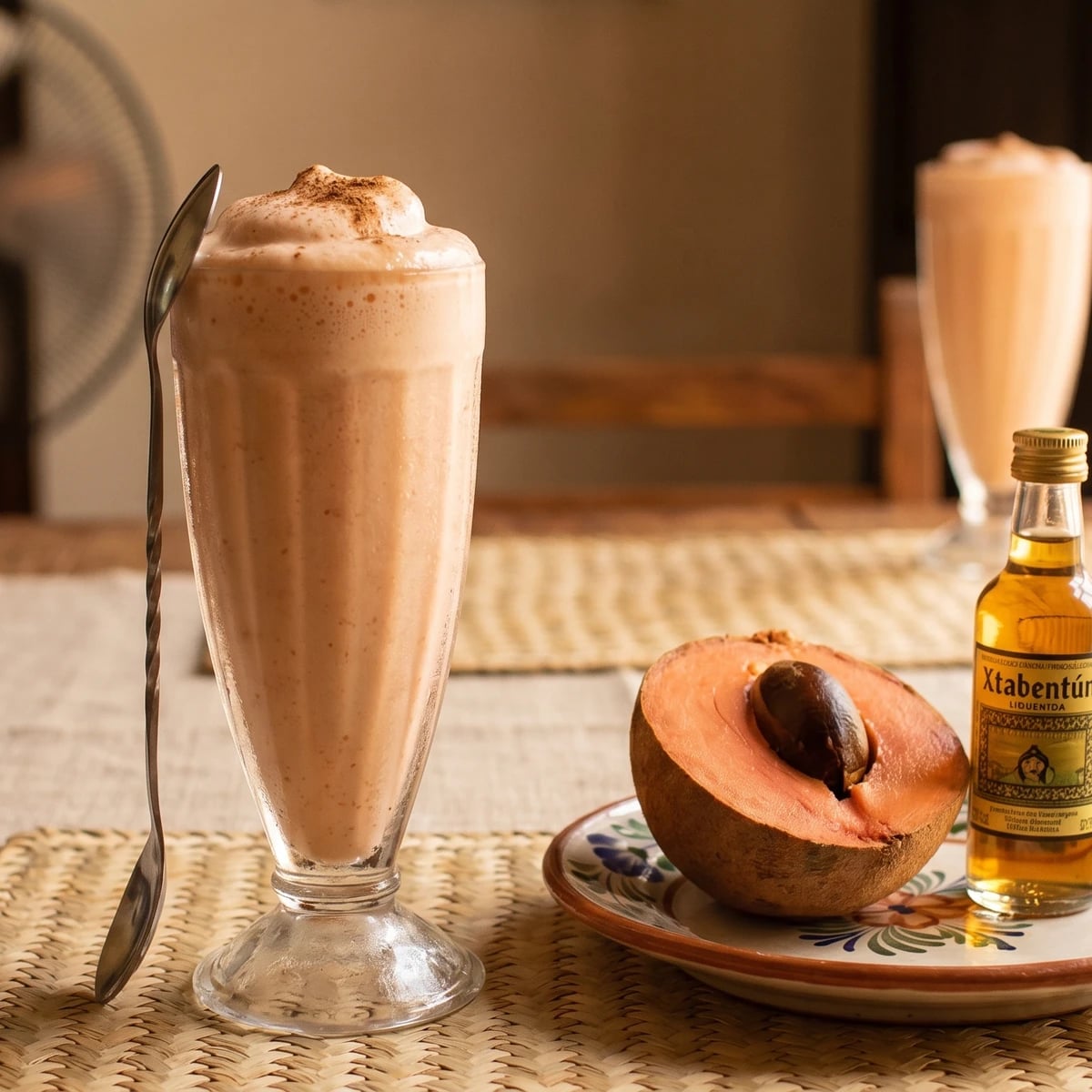
Yucatán's mamey champola, ripe sapote whipped into cold milk until the surface rises into a pale orange foam. Mérida's afternoon antidote to the heat, served in a tall glass at a sorbeteria that has been pouring it for a hundred years.
Champola is Yucatecan. Mérida, specifically. The drink lives on the corners of the Centro Histórico, in the old sorbeterias with marble counters and ceiling fans turning lazily over patrons who came in to escape the heat and ordered a champola instead of a beer. La Sorbetería Colón has been pouring them since 1907. That is the lineage.
Mamey is the fruit that makes this work. It is not a mango. It is not a papaya. It is a sapote, dense and custardy, with a flesh the color of a sunset over the Yucatán coast, somewhere between sweet potato and pumpkin custard with a soft almond note from the pit. You cannot substitute. If your mercado does not carry mamey, this is not the day to make champola. Cook what the market is selling. The fruit dictates the calendar.
The technique is simple and that is the trap. Cold milk, ripe mamey, a little sugar, a blender. The discipline is in the cold and in the blending. Cold milk, cold glasses, a full minute on high so the surface rises into foam. Warm milk gives you a sad shake. A short blend gives you a thick puree. Neither one is champola. My mother did not make this drink, she was from Jalisco and Jalisco does not have mamey the way Yucatán does, but I have sat in a Mérida sorbeteria at three in the afternoon when the heat off the limestone streets makes the air shimmer, and I will tell you there is no drink in Mexico that answers that heat better than a tall, foaming champola. Cada estado, su propia cocina.
Mamey sapote (Pouteria sapota) is native to southern Mexico and Central America, and the Maya cultivated it long before the conquest, using both the flesh as food and the toasted seed (pixtle) as a flavoring for ceremonial drinks. The word 'champola' likely derives from Cuban Spanish, where it described a similar drink made with guanábana, and traveled to the Yucatán peninsula through the brisk maritime trade between Mérida and Havana in the 19th century, when Yucatecan cooks adapted it to the abundant local mamey. Mérida's heladerias and sorbeterias, several of which date to the late Porfiriato, codified the drink in its current form and remain its primary keepers, with La Sorbetería Colón on the Plaza Grande operating continuously since 1907.
Quantity
1 large (about 2 pounds whole)
yielding roughly 2 cups of pulp
Quantity
4 cups
very cold
Quantity
1/2 cup, or to taste
Quantity
1 teaspoon
Mexican vanilla from Papantla if you can find it
Quantity
1 pinch
Quantity
for serving
Quantity
for dusting
| Ingredient | Quantity |
|---|---|
| ripe mamey sapoteyielding roughly 2 cups of pulp | 1 large (about 2 pounds whole) |
| whole milkvery cold | 4 cups |
| granulated sugar | 1/2 cup, or to taste |
| pure vanilla extractMexican vanilla from Papantla if you can find it | 1 teaspoon |
| fine sea salt | 1 pinch |
| crushed ice | for serving |
| ground Mexican cinnamon (canela) (optional) | for dusting |
A mamey is ready when it gives slightly under thumb pressure, the way a ripe avocado does. The skin is rough and brown, like sandpaper that has been through a few seasons. If it is hard, leave it on the counter for two or three days. An unripe mamey is starchy and chalky. A ripe one tastes like sweet potato kissed by pumpkin custard with a whisper of almond from the pit. Without that ripeness, there is no champola. Pregúntale a las señoras del mercado.
Slice the mamey lengthwise from stem to base, cutting around the large central pit. Twist the halves apart. Lift out the shiny dark pit and discard it (or save it; the seed, called pixtle in Yucatán, is roasted and ground into a chocolate-bitter powder used in pozol). With a spoon, scoop the deep salmon flesh away from the skin in clean strokes. Discard any fibrous threads close to the pit and the skin. You want pure, dense pulp.
The champola lives or dies on cold. Put the milk in the freezer for ten minutes before you blend. Put the glasses in the freezer too. A frosted glass in Mérida heat is half the pleasure of this drink. The pulp should be cool from the refrigerator, not warm from a sunny counter. No me vengas con atajos. This is the step everyone wants to skip and it is the step that makes the difference.
Place the mamey pulp, cold milk, sugar, vanilla, and salt in a blender. Start on low to break up the pulp, then ramp to high. Blend for a full minute, longer than you think. You are not just combining. You are whipping air into the milk so the surface rises into a pale orange foam that holds its shape for a few seconds when the blender stops. That foam is the champola. Without it, you have a smoothie. Así se hace y punto.
Pull the glasses from the freezer. Drop a small handful of crushed ice into each one, then pour the champola over the ice slowly so the foam stays intact on top. Dust with a pinch of ground canela if you like. Serve immediately with a long spoon. Drink it slowly on a hot afternoon, the way they do at the sorbeterias in Mérida that have been open since before any of us were born. Saber cocinar es saber vivir.
1 serving (about 390g)
Culinary guides, cultural storytelling, and the editorial depth that makes cooking meaningful.
Discover Culinary Explorer
Chef Lupita
Yucatán's everyday tonic of boiled chaya leaves blended with lima agria, sugar, and ice. The bright green jarra that sits on every Peninsula table from Mérida to Valladolid.

Chef Lupita
Yucatán's signature green agua fresca, chaya leaves blanched and blended with ripe pineapple and lima agria, served ice-cold from a sweating glass jarra against the Mérida heat.

Chef Lupita
Yucatán's hibiscus agua, flor de jamaica steeped off the heat with canela and pimienta gorda, sweetened with piloncillo, and chilled until the deep ruby color is the most-poured drink on the Peninsula.

Chef Lupita
The Peninsula's floral sour-lime refresher, juiced cold and perfumed with a single strip of peel. The aroma is what makes it Yucatecan, and a Persian lime will not get you there.