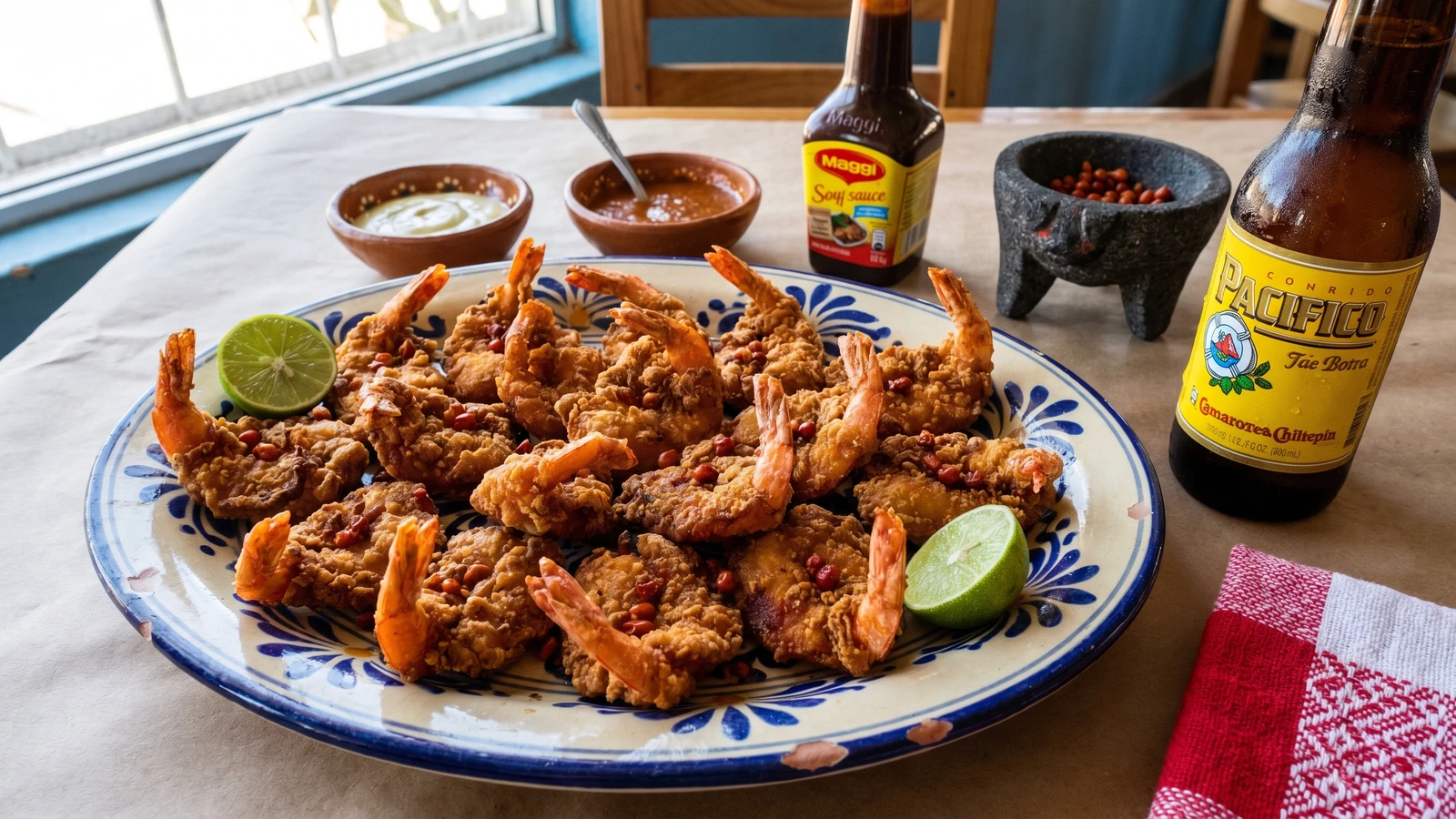
A Sonoran botana from the marisquerias of the Sea of Cortez: large shrimp split open mariposa-style, breaded in seasoned cracker meal, fried in lard until the edges crackle, and finished with crushed chiltepín, the wild chile of the desert.
Appetizers & Snacks
Mexican
Game Day
Quick Meal
Outdoor Dining
25 min
Active Time
15 min cook•40 min total
Yield4 servings as a botana
This is from Sonora. Specifically from the coastal towns along the Sea of Cortez, Guaymas, San Carlos, Puerto Penasco, where the shrimp boats come in and the marisquerias have been serving this exact botana on patios with paper-covered tables and ice buckets full of Pacifico for as long as anyone remembers. Sonora is shrimp country. Sonora is also chiltepín country. This dish is what happens when those two facts share a plate.
The chiltepín is not optional and it cannot be substituted. It is a wild bush chile, smaller than a peppercorn, that grows in the Sierra Madre and the Sonoran desert. It is foraged by hand. The Seri and Yaqui peoples used it long before the Spanish arrived, and Sonoran ranchers have been keeping jars of it on their kitchen tables for generations. It hits sharp, clean, and fast, then it is gone. No lingering burn. That clean heat is what makes this dish Sonoran and not just a fried shrimp from somewhere.
The breading is cracker meal, not panko, not flour, not anything fancy. Saltines, crushed fine, mixed with oregano and chiltepín. The marisquerias have been doing it this way since the saltine cracker showed up in Mexican pantries in the early 20th century. It fries up lighter and crisper than breadcrumbs and tastes like the coast.
My mother did not cook Sonoran food. She was from Jalisco. But the first time I ate camaron empanizado al chiltepín was at a marisqueria in Bahia de Kino, sitting at a plastic table with my recorder running, listening to a senora named Dona Mague tell me that the chiltepín on the table came from her brother's ranch outside Hermosillo. I wrote it in my notebook the way she said it. Cada estado, su propia cocina, and this one belongs to Sonora.
The chiltepín (Capsicum annuum var. glabriusculum) is the only chile native to what is now the United States and northern Mexico, and it is the wild ancestor of every domesticated chile in the Capsicum annuum family, including the bell pepper, the jalapeno, and the serrano. In Sonora it has been gathered from wild bushes in the Sierra Madre Occidental for at least 8,000 years, and its harvest remains largely uncommercialized; pickers known as chiltepineros still walk the foothills each fall to collect the tiny red berries by hand. The breaded shrimp itself reflects Sonora's 20th-century coastal economy: industrial shrimp farming and wild harvesting in the Sea of Cortez positioned the state as Mexico's second-largest shrimp producer after Sinaloa, and the marisqueria culture of Guaymas codified dishes like this one as the everyday botana of the Pacific northwest.
The technique, the tradition, and the story behind every dish.
peeled and deveined with tails left on, butterflied open
saltine crackers
Quantity
2 cups
crushed fine
all-purpose flour
Quantity
1/2 cup
large eggs
Quantity
2
whole milk
Quantity
2 tablespoons
dried Mexican oregano
Quantity
1 tablespoon
crumbled
garlic cloves
Quantity
2
grated on a microplane
kosher salt
Quantity
1 1/2 teaspoons, divided
freshly ground black pepper
Quantity
1 teaspoon
ground chile chiltepín
Quantity
1 teaspoon, plus more for finishing
onion powder
Quantity
1 teaspoon
vegetable oil or pork lard
Quantity
about 4 cups
for frying
whole dried chiltepín
Quantity
2 tablespoons
for crushing at the table
lime halves (optional)
Quantity
for serving
mayonnaise mixed with a squeeze of lime (optional)
Quantity
for serving
Salsa Huichol or Tamazula (optional)
Quantity
for serving
Maggi sauce (optional)
Quantity
for serving
cold cerveza (Pacifico, Tecate, or Modelo Especial) (optional)
Quantity
for serving
Ingredient
Quantity
large raw shrimp (16/20 count)peeled and deveined with tails left on, butterflied open
1 1/2 pounds
saltine crackerscrushed fine
2 cups
all-purpose flour
1/2 cup
large eggs
2
whole milk
2 tablespoons
dried Mexican oreganocrumbled
1 tablespoon
garlic clovesgrated on a microplane
2
kosher salt
1 1/2 teaspoons, divided
freshly ground black pepper
1 teaspoon
ground chile chiltepín
1 teaspoon, plus more for finishing
onion powder
1 teaspoon
vegetable oil or pork lardfor frying
about 4 cups
whole dried chiltepínfor crushing at the table
2 tablespoons
lime halves (optional)
for serving
mayonnaise mixed with a squeeze of lime (optional)
for serving
Salsa Huichol or Tamazula (optional)
for serving
Maggi sauce (optional)
for serving
cold cerveza (Pacifico, Tecate, or Modelo Especial) (optional)
for serving
Equipment Needed
•Sharp paring knife for butterflying the shrimp
•Three shallow plates or wide bowls for the breading station
•Wide heavy skillet or 12-inch cast iron pan for frying
•Wire rack set over a sheet pan for draining
•Slotted spider or kitchen tongs
•Small molcajete or mortar for crushing the chiltepín
•Frying thermometer (optional but helpful)
Instructions
1
Butterfly the shrimp
Lay each peeled shrimp flat on the cutting board. Slice down the curved back with a sharp paring knife, deep enough to open the shrimp like a book but not all the way through. Press it flat with the side of the knife. Leave the tails on. This cut is called mariposa and it is how the marisquerias from Guaymas to Puerto Penasco serve a shrimp that fries flat, crisps evenly, and looks like what it is: a coastal shrimp, generous and proud.
Pat the butterflied shrimp dry with paper towels before you bread them. Wet shrimp gives you soggy breading. The flour cannot do its job on a damp surface.
2
Crush the crackers
Put the saltines in a zip-top bag and crush them with a rolling pin until they are fine, almost the texture of coarse sand. No big shards. Big shards burn before the shrimp cooks. In the marisquerias they pulse them in a blender, but the bag works at home and gives you the texture you want. Asi se hace y punto.
3
Build the breading station
Set out three shallow plates. Plate one: the flour mixed with 1/2 teaspoon of the salt, the onion powder, and half the black pepper. Plate two: the eggs beaten with the milk, the grated garlic, and a pinch of salt. Plate three: the crushed saltines mixed with the oregano, the ground chiltepín, the remaining salt, and the rest of the pepper. The cracker meal is the seasoning. Do not be shy with it.
4
Bread the shrimp
Take one butterflied shrimp by the tail. Press it into the flour on both sides and shake off the excess. Dip it into the egg, letting the extra drip back into the plate. Press it firmly into the cracker meal, pressing down so the crumbs stick to every surface, including the cut interior. Lay it on a wire rack or sheet pan. Repeat with all the shrimp. Let them rest for ten minutes before frying. The breading sets and stops sliding off in the oil.
5
Heat the frying fat
Pour the oil or lard into a wide heavy skillet or cast iron pan to a depth of about one inch. Heat over medium-high to 350F. If you do not have a thermometer, drop in a pinch of cracker meal: it should bubble immediately and turn gold within fifteen seconds. La manteca es el sabor and lard fries cleaner and tastes better, but a neutral oil works if that is what you have. No me vengas con atajos like baking these in an air fryer. This is a fried botana. Fry it.
6
Fry the shrimp
Working in batches so the pan is not crowded, lower the breaded shrimp into the hot fat. They cook fast, about 90 seconds per side, until the cracker meal turns a deep golden brown and the tails curl. Crowding the pan drops the temperature and gives you greasy, pale shrimp. Patience now. Lift them out with a slotted spider and let them drain on a wire rack, never on paper towels. Paper towels trap steam underneath and the bottoms go soft.
7
Finish with chiltepín and serve
Pile the fried shrimp on a platter while the next batch fries. Crush the whole dried chiltepín between your fingers or in a small molcajete and scatter the bright red flecks over the hot shrimp. The chiltepín is the soul of this dish. It is the wild chile of the Sonoran desert, foraged not farmed, and it hits sharp and clean and disappears fast. Serve with lime halves, the lime mayonnaise, salsa Huichol, a few drops of Maggi if your guests want it, and a cold cerveza. Eat with your hands. This is botana, not dinner.
Chef Tips
•Buy the largest shrimp you can afford, 16/20 count or bigger. Small shrimp overcook before the breading browns and you end up with rubber inside a crust. The Sonoran version is generous. Honor that.
•If you cannot find chiltepín at a Mexican market or a sonorense specialty shop, do not substitute jalapeno powder or cayenne. It will not taste right. Order chiltepín online from a Sonoran source, or wait until you can. A substitution is a compromise, not an upgrade, and in this case the compromise removes the dish's reason for existing.
•Lard fries crisper and cleaner than vegetable oil and adds a savory depth that neutral oil cannot. La manteca es el sabor. If you have it, use it. If you do not, a high-smoke-point oil like avocado or peanut works.
•The sauces on the table are not garnish, they are the ritual. Lime mayonnaise, Salsa Huichol, Maggi, a few drops of soy if someone insists. Each diner builds their own bite. That is the marisqueria way.
Advance Preparation
•The shrimp can be butterflied and held on ice in the refrigerator up to four hours ahead.
•The breading station can be set up an hour ahead and the shrimp breaded thirty minutes before frying. Do not bread them earlier than that or the coating gets gummy.
•Fried shrimp does not hold. Fry it and eat it. Reheated camaron empanizado is a sad shadow of the original.
Frequently Asked Questions
Nutrition Information
1 serving (about 230g)
Calories
500 calories
Total Fat
23 g
Saturated Fat
4 g
Trans Fat
0 g
Unsaturated Fat
18 g
Cholesterol
350 mg
Sodium
1020 mg
Total Carbohydrates
33 g
Dietary Fiber
1 g
Sugars
1 g
Protein
42 g
Where cooking meets culture.
Culinary guides, cultural storytelling, and the editorial depth that makes cooking meaningful.