Chef Lupita
Acúmara Tatemada al Comal
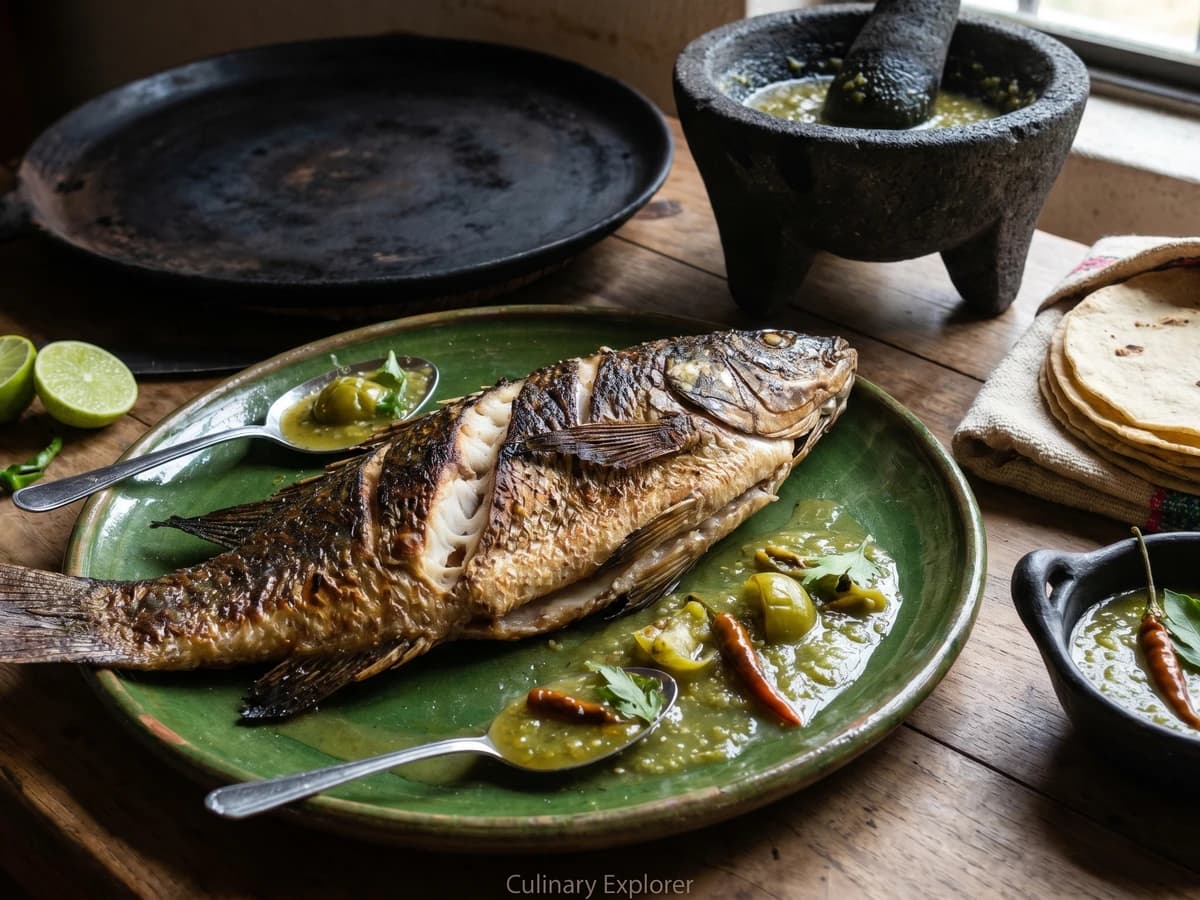
Michoacán's Lake Pátzcuaro acúmara, a whole kurucha from the lago tatemada on a comal de leña and served with chile perón atápakua, corn tortillas, and P'urhépecha discipline.
A cooking platform built around craft, culture, and the stories behind what we eat.

Created by
Nuevo Leon's milk-fed kid goat staked on an iron cross and slow-roasted beside open mesquite coals for four hours, served on hand-stretched sobaquera flour tortillas with salsa borracha and frijoles charros.
Cabrito belongs to Nuevo Leon. Specifically to Monterrey, where the cabriterias along Avenida Madero have been splaying milk-fed kid goats on iron crosses beside mesquite fires since before there were paved roads in the state. This is the dish of the north. Not tacos, not fajitas, not the Tex-Mex inventions that crossed the border and came back unrecognizable. Cabrito al pastor is the meal that anchors a norteño Sunday.
The animal is a cabrito lechal, a kid goat between 28 and 40 days old that has eaten nothing but its mother's milk. Older than that and the meat turns gamy and you have chivo, a different animal and a different dish. The cabrito is split open butterfly-style, mounted on a flat iron cross called an asador, and staked vertically beside, not over, a long bed of mesquite coals. It cooks for four hours by radiant heat, the way they do it in the chaparral country where the goats graze and the mesquite grows on the same land. Cada estado, su propia cocina, and this one belongs to Nuevo Leon.
Flour tortillas are the bread of the north. Sobaqueras, the enormous thin ones stretched across the cook's forearm, are what cabrito demands. Wheat grows in the north because corn does not. Anybody who tries to wrap cabrito in a corn tortilla has not understood the geography of the dish. The accompaniments are also northern: frijoles charros with bacon and chile, guacamole made without cilantro the way norteños prefer it, salsa borracha built on chile pasilla and beer, cebollitas cambray charred whole on the same fire. The whole table is one regional argument against the idea that Mexican food is one thing. La manteca es el sabor, the mesquite is the soul, and the rest is patience.
My mother's notebook had only one note about cabrito: 'Solo en Monterrey, solo con mesquite, solo el mero domingo.' Only in Monterrey, only with mesquite, only on Sunday. She had eaten it once, at a cousin's wedding in San Pedro Garza Garcia, and she never made it at home in the city because she said it was not honest to try. I learned this recipe from Doña Ofelia, who has been splaying cabritos at her family cabriteria in Allende, Nuevo Leon, for fifty-three years. She watched me write it down and said: 'Si no tienes mesquite, no lo hagas.' If you do not have mesquite, do not make it. Recetas probadas y garantizadas.
Cabrito al pastor entered Nuevo Leon's culinary identity through the Sephardic Jewish converso families who settled the Nuevo Reino de Leon in the 16th and 17th centuries, fleeing the Inquisition in central Mexico for the remote northeast frontier. These settlers brought a Mediterranean tradition of slow-roasting young goat that married with the indigenous chichimeca practice of cooking over mesquite coals, producing a regional dish that has no real equivalent in the rest of the country. Monterrey's industrialization in the late 19th century turned cabrito from a rural rancho meal into a city specialty, and by the 1940s the cabriterias of the Barrio Antiguo had established the asador-and-cross presentation that remains the visual signature of the dish. The flour tortilla tradition of the north, including the sobaquera, follows the same wheat-belt geography: corn does not grow well in the arid plains of Nuevo Leon, Coahuila, Chihuahua, and Sonora, and Mexican wheat agriculture in those states predates the railroad.
Quantity
1 whole, 8 to 10 pounds
dressed and split open butterfly-style
Quantity
1/2 cup
Quantity
1/4 cup
melted
Quantity
1
cloves crushed to a paste with 1 tablespoon salt
Quantity
2 tablespoons
Quantity
1 teaspoon
freshly ground
Quantity
10 to 12 pounds
split into logs and kindling
Quantity
for serving
warmed
Quantity
for serving
Quantity
for serving
Quantity
for serving
Quantity
for serving
Quantity
for serving
Quantity
for serving
| Ingredient | Quantity |
|---|---|
| whole milk-fed kid goat (cabrito lechal)dressed and split open butterfly-style | 1 whole, 8 to 10 pounds |
| coarse sea salt | 1/2 cup |
| pork lard (manteca de cerdo)melted | 1/4 cup |
| head of garliccloves crushed to a paste with 1 tablespoon salt | 1 |
| fresh lime juice | 2 tablespoons |
| black pepperfreshly ground | 1 teaspoon |
| mesquite hardwoodsplit into logs and kindling | 10 to 12 pounds |
| sobaquera flour tortillas (large, thin, hand-stretched) (optional)warmed | for serving |
| frijoles charros (optional) | for serving |
| guacamole norteño (avocado, lime, salt, no cilantro) (optional) | for serving |
| salsa borracha (pasilla and beer) (optional) | for serving |
| salsa molcajeteada de chile de arbol (optional) | for serving |
| cebollitas cambray asadas (grilled spring onions) (optional) | for serving |
| lime wedges (optional) | for serving |
Find a milk-fed kid, between 28 and 40 days old, no older. The Spanish word is cabrito lechal. The meat should be pale pink, almost white, and the carcass should weigh between 8 and 10 pounds dressed. An older goat is chivo, not cabrito, and chivo is a different dish. If your butcher does not know the difference, find another butcher. Ask for the animal split open along the breastbone, butterfly-style, with the head and offal kept separately for fritada.
Lay the butterflied goat flat. Push the iron asador, a flat metal cross with prongs, through the carcass: the long arm runs through the spine, the cross arms through the shoulders and hips. The animal should be stretched open like a flag. Tie the legs to the cross with butcher's twine if needed to keep it from curling as it cooks. This is the norteño technique. The cross is what makes it cabrito al pastor and not cabrito al horno.
Build a long, narrow fire of mesquite logs in a fire pit or large open grill. Mesquite, not oak, not charcoal briquettes, not gas. The wood comes from the chaparral country of Nuevo Leon and Coahuila and the smoke is part of the recipe. Let the fire burn down until you have a deep bed of glowing coals with low flames. You want radiant heat from the side, not flame underneath.
Combine the melted lard, garlic paste, lime juice, and black pepper in a small bowl. Rub the mixture over the inside of the cabrito, the cavity side. Salt the outside generously with the coarse sea salt, on both sides. That is the entire seasoning. La manteca es el sabor and the mesquite does the rest. No me vengas con atajos like soy sauce, paprika, or commercial rubs. Cabrito norteño is salt, lard, garlic, and smoke. Asi se hace y punto.
Drive the long end of the asador into the ground or into a heavy iron stand, angled so the cabrito faces the bed of coals from the side. The body of the goat should be 12 to 18 inches from the heat, cavity side toward the fire to start. The animal cooks vertically, by radiant heat, the way they do it at the cabriterias along Avenida Madero in Monterrey. This is not grilling. The goat never sits over flame.
Roast for the first hour and a half cavity side facing the fire. The interior cavity is what catches the heat first and the meat near the ribs needs the most time. After 90 minutes, turn the cross 180 degrees so the skin side faces the fire. Continue roasting another two hours, rotating the cross every 30 minutes so the heat reaches the shoulders, hips, and ribs evenly. Watch the fat. When it starts to drip and the skin turns the color of dark amber, you are close.
After about four hours total, the meat should pull cleanly from the bone with a knife and the skin should be crackling and lacquered a deep mahogany. Cabrito is traditionally served by cut: the riñonada (loin and kidney), the paletilla (shoulder), the pierna (leg), the costillar (ribs), and the pecho (breast). Each cut has a different texture. The riñonada is the most prized, soft and lightly funky from the kidney fat. The pierna is the most cooked through. Anyone who tells you cabrito is one texture has never eaten it properly.
Lift the asador off the fire and lay it flat on a wooden table. Carve the cabrito into the traditional cuts with a heavy knife. Pile the pieces on a wide platter. Bring out the warm sobaqueras, the frijoles charros, the salsa borracha, the salsa de chile de arbol, the guacamole norteño, the cebollitas asadas, and the lime. Each person tears a sobaquera, fills it with meat and salsa, and eats. This is a Sunday meal in Monterrey. It is meant to last hours and feed everyone at the table twice. Saber cocinar es saber vivir.
1 serving (about 245g)
Culinary guides, cultural storytelling, and the editorial depth that makes cooking meaningful.
Discover Culinary ExplorerChef Lupita
Michoacán's Lake Pátzcuaro acúmara, a whole kurucha from the lago tatemada on a comal de leña and served with chile perón atápakua, corn tortillas, and P'urhépecha discipline.

Chef Lupita
Puebla's weekday adobo of pork shoulder braised in a thick guajillo and ancho sauce sharpened with vinegar, cumin, and clove. The deep red of a market spice stall, the dish a poblana cooks without thinking.

Chef Lupita
Loreto's pit-roasted clams, planted hinge-up in beach sand and tatemadas under a fast fire of dried romerillo brush, the resinous Baja desert shrub that gives this dish its smoke.

Chef Lupita
Oaxaca's eighth mole, the silky, almond-and-cinnamon almendrado, served over poached chicken. Mild, sweet, restrained, and a quiet rebuttal to anyone who thinks Mexican food has to be hot to be Mexican.