
Chef Lupita
Acitrón de Cidra Conventual
Puebla's convent-style acitrón, made from cidra peel instead of endangered biznaga, built through repeated syrup soakings until the cubes turn firm, translucent, and ready for rosca or chiles en nogada.
A cooking platform built around craft, culture, and the stories behind what we eat.
Created by
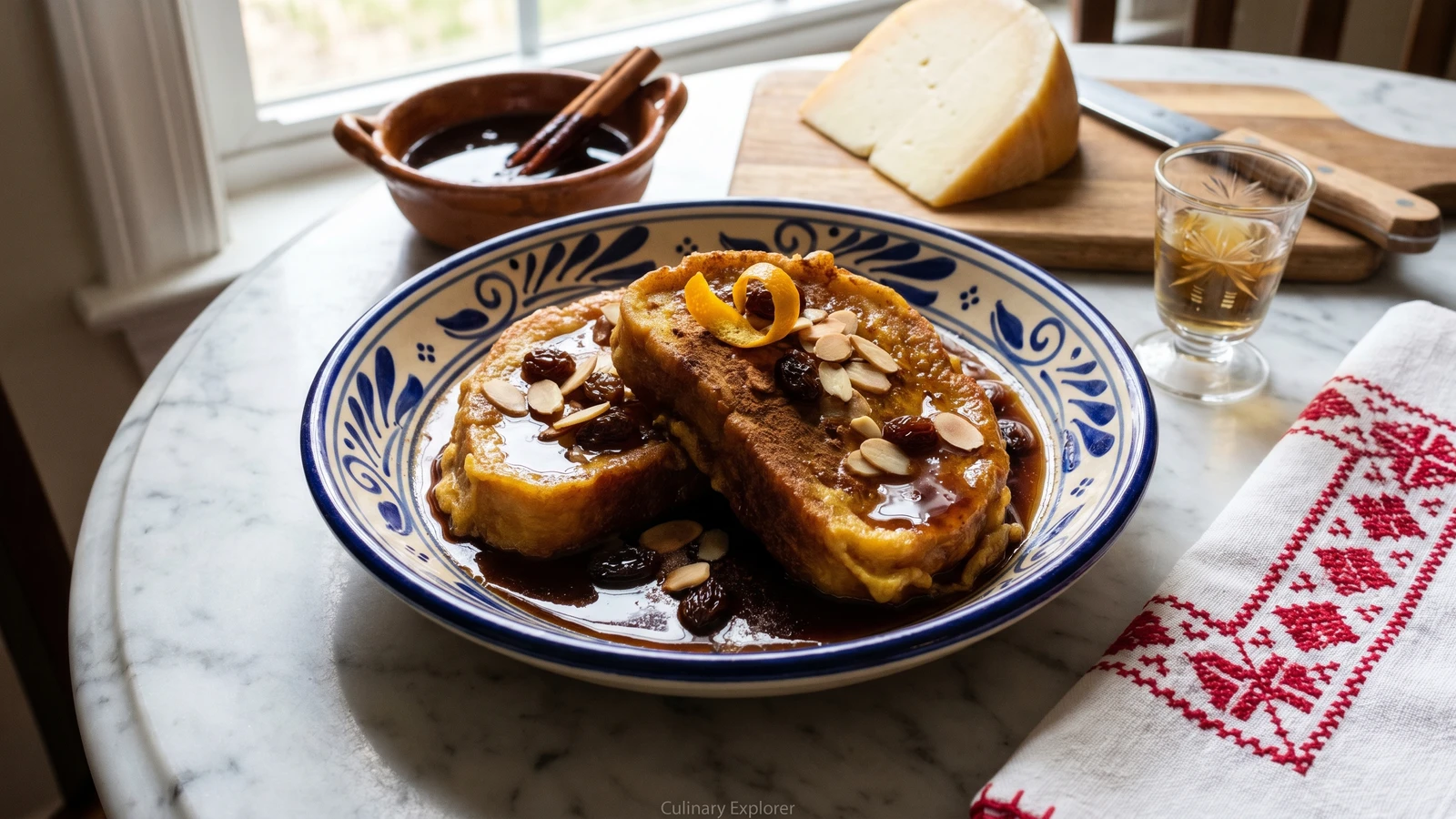
Yucatán's torrija. Day-old pan francés soaked in cinnamon milk, capeado in egg whites whipped to peaks, fried in lard, and bathed in a clove-and-canela syrup spiked with jerez and plumped raisins.
This is a Yucatán dessert. The name means "poor gentlemen," and it tells you exactly what the dish is: bread, milk, eggs, sugar, the ingredients a household always has on the shelf, transformed into something you serve to company. Every Spanish-speaking country has a version of the torrija. Yucatán made it its own with the capeado technique and the jerez.
The capeado is what separates caballeros pobres from a pan dulce soaked in syrup. You whip the egg whites to peaks, fold in the yolks, and coat each milk-soaked slice in that airy batter before frying. It is the same technique the cooks of Mérida use for chiles rellenos, which is no accident. The peninsula's cooking carries a strong Spanish baroque inheritance and the egg-cloud frying belongs to that lineage. The shell puffs in the lard, turns deep gold, and holds up to the syrup without dissolving.
My mother kept a recipe for caballeros pobres in the back of her notebook, traced from a Yucatecan friend in Colonia Roma who served them every Nochebuena with a small glass of Spanish brandy. The note in the margin reads: pan de ayer, no de hoy. Day-old bread, not today's. Fresh bread turns to mush in the milk and the dish collapses. Save your bolillos from yesterday for this, or dry them on the counter overnight. Saber cocinar es saber vivir, and a Yucateca knows that a good dessert can be built from leftover bread if you respect the technique.
Caballeros pobres descends directly from the Spanish torrija, a Lenten and Christmas dish documented in Iberian cookbooks since at least the 15th century, and arrived in Yucatán through the colonial port of Campeche in the 16th and 17th centuries. The peninsula's relative isolation from central Mexico, combined with its sustained trade with Cuba, Spain, and New Orleans through the colonial period, preserved Spanish-Andalusian dessert traditions, the cinnamon-clove syrup, the fortified-wine soak, the capeado, that faded or transformed elsewhere on the mainland. The name itself, "poor gentlemen," is recorded in Spanish convent cookbooks of the 17th century as a humorous reference to a humble dish dressed up in fine clothing, a description that captures exactly what the egg-cloud capeado does for a slice of stale bread.
Quantity
8 thick slices
about 1 inch thick
Quantity
2 cups
Quantity
1
broken in half
Quantity
1/4 cup
Quantity
1 piece, about 2 inches long
Quantity
4
separated
Quantity
1/4 teaspoon
Quantity
about 1 cup
Quantity
1 1/2 cups
Quantity
1 1/2 cups
Quantity
2
Quantity
4
Quantity
1 piece, about 3 inches long
Quantity
1/2 cup
Quantity
3 tablespoons
Quantity
for serving
Quantity
for serving
| Ingredient | Quantity |
|---|---|
| day-old pan francés or bolilloabout 1 inch thick | 8 thick slices |
| whole milk | 2 cups |
| cinnamon stick (canela de Ceylán)broken in half | 1 |
| granulated sugar (for the milk) | 1/4 cup |
| orange peel | 1 piece, about 2 inches long |
| large eggsseparated | 4 |
| fine sea salt | 1/4 teaspoon |
| manteca de cerdo (pork lard) or neutral oil for frying | about 1 cup |
| granulated sugar (for the syrup) | 1 1/2 cups |
| water | 1 1/2 cups |
| cinnamon sticks (canela de Ceylán) | 2 |
| whole cloves | 4 |
| orange peel | 1 piece, about 3 inches long |
| raisins (pasas) | 1/2 cup |
| jerez seco (dry sherry) | 3 tablespoons |
| toasted sliced almonds (optional) | for serving |
| ground Ceylon cinnamon (optional) | for serving |
In a small saucepan, combine the milk, the broken cinnamon stick, the 1/4 cup of sugar, and the 2-inch piece of orange peel. Warm over low heat until the sugar dissolves and the milk smells of cinnamon and citrus, about five minutes. Do not let it boil. Pull it off the heat and let it sit while you build the syrup. The milk needs to be warm but not hot when the bread goes in, or the crumb falls apart.
In a wide saucepan, combine 1 1/2 cups water, 1 1/2 cups sugar, the two cinnamon sticks, the cloves, and the 3-inch orange peel. Bring to a simmer over medium heat and cook for fifteen to twenty minutes, until the syrup thickens enough to coat the back of a spoon. Add the raisins in the last five minutes so they plump but do not turn to mush. Off the heat, stir in the jerez. The alcohol carries the spice into the bread later. No me vengas con atajos, do not skip the sherry. It is what makes this caballeros pobres and not French toast.
Strain the infused milk into a shallow bowl, discarding the cinnamon and peel. Lay the bread slices in the warm milk in a single layer. Soak for about thirty seconds per side. The bread should be saturated but still hold its shape when you lift it. Day-old bolillo is the right bread because fresh bread turns to porridge. If you only have fresh, leave the slices out uncovered overnight or dry them in a low oven for fifteen minutes.
In a clean bowl, beat the egg whites with the pinch of salt until they hold soft peaks. This is the same capeado technique the señoras of Mérida use for chiles rellenos. One at a time, beat the yolks into the whites until the mixture is uniform and pale yellow, still airy. Do this just before frying. A capeado that sits collapses, and you only get one shot at this step.
Heat the lard in a heavy skillet over medium heat until it shimmers, about 350°F. La manteca es el sabor. The lard gives the caballeros a clean, even browning that vegetable oil cannot match. Working one at a time, lift a milk-soaked slice with a slotted spatula, dip it into the egg until completely coated, and slide it into the lard. Fry two or three slices at a time without crowding. Cook for about two minutes per side, until the capeado puffs and turns deep gold. Lift to a wire rack to drain. Do not put them on paper towels or they will steam from below and lose their crisp shell.
Warm the almíbar over low heat if it has cooled. Arrange the fried caballeros in a single layer in a shallow ceramic dish. Spoon the warm syrup over them generously, distributing the raisins across the top. Let them sit for at least ten minutes before serving so the syrup soaks into the egg crown and the bread underneath. They can sit for an hour. They can sit until tomorrow. They only get better as they drink the syrup.
Plate one or two caballeros per person in a shallow bowl with a generous pool of the syrup, the plumped raisins, and a scatter of toasted almonds. Dust with ground canela. In Yucatán these come out at the end of Christmas dinner, at Hanal Pixán, at any meal that calls for a sweet ending with a little ceremony. Así se hace y punto.
1 serving (about 270g)
Culinary guides, cultural storytelling, and the editorial depth that makes cooking meaningful.
Discover Culinary ExplorerChef Lupita
Puebla's convent-style acitrón, made from cidra peel instead of endangered biznaga, built through repeated syrup soakings until the cubes turn firm, translucent, and ready for rosca or chiles en nogada.

Chef Lupita
Ciudad de México's Tulyehualco alegría is popped huautli folded into piloncillo honey, pressed with peanuts, pepitas, and raisins, then cut into the rectangular bars that built a pueblo's identity.

Chef Lupita
Oaxaca's pre-Columbian amaranth bar, popped on a hot comal and bound with piloncillo, honey, and the sacred Zapotec grain that the Spanish tried, and failed, to outlaw.

Chef Lupita
Querétaro's mercado candy of popped amaranto pressed with dark piloncillo syrup, pepitas, pecans, and cacahuate, a Bajío sweet that respects the seed before it decorates the table.