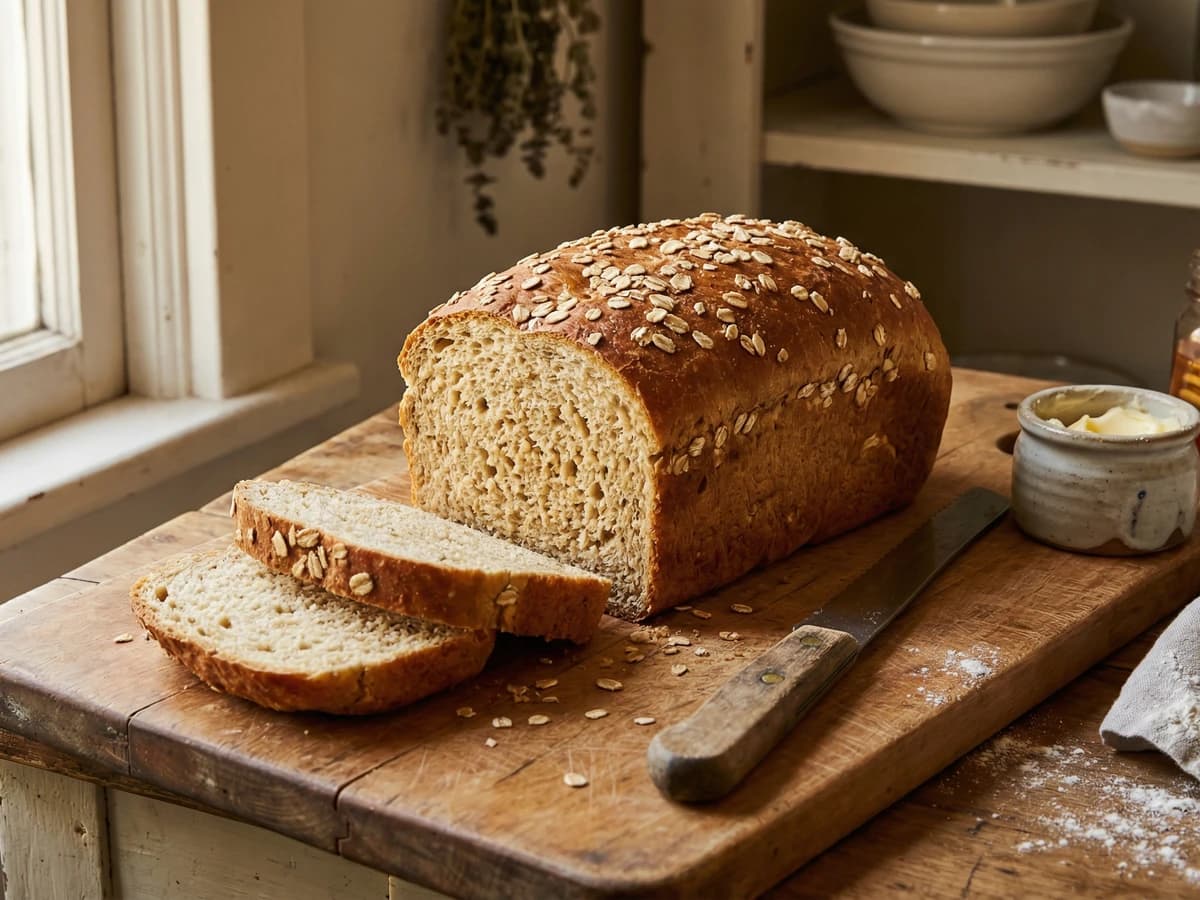
Rich brown butter and toasted Louisiana pecans transform humble bananas into something extraordinary, with a splash of bourbon that deepens every bite and keeps the crumb impossibly moist for days.
Breads
Cajun
Make Ahead
Comfort Food
25 min
Active Time
1 hr 5 min cook•1 hr 30 min total
Yield1 loaf (10-12 slices)
Brown butter changes everything. The moment those milk solids turn golden and the kitchen fills with that nutty, caramelized perfume, you've crossed over from ordinary to something your guests will remember. This banana bread was born in my grandmother Evangeline's kitchen, where overripe bananas never went to waste and good bourbon was always within reach.
I've been making this bread at Lagniappe for twenty years now. Customers who moved away call ahead before visits to make sure we'll have a loaf waiting. The secret isn't complicated: brown your butter until it smells like heaven, toast your pecans until they're fragrant, and use bananas so ripe they look like something you should throw away. Those spotted, blackened bananas are pure gold. The sugars have concentrated, the starches have converted, and they'll give your bread a sweetness and moisture that perfect yellow bananas never could.
The bourbon isn't just for flavor, though it adds a warmth that plays beautifully against the brown butter. Alcohol keeps quick breads tender by inhibiting gluten development. Your bread stays soft for days instead of turning dense and stale. Use something you'd drink. Nothing fancy, just honest Louisiana bourbon that you wouldn't be ashamed to pour over ice.
The technique, the tradition, and the story behind every dish.
Spread your pecans in a single layer on a dry baking sheet. Toast in a 350F oven for 8 to 10 minutes, stirring halfway through. You're looking for a deep golden color and a fragrance that fills the kitchen. The oils inside the nuts are waking up, and that's where the flavor lives. Let them cool completely before chopping, then roughly chop most of them while reserving the prettiest halves for the top.
Louisiana pecans have a richer, more buttery flavor than varieties from other regions. If you can get them from a local farmer or pecan orchard, your bread will thank you.
2
Brown the butter
Cut the butter into tablespoon pieces and place in a light-colored saucepan over medium heat. A light pan lets you see the color change. Swirl occasionally as the butter melts and foams. After about 5 minutes, the foam will subside and you'll see golden-brown specks forming at the bottom. The aroma shifts from buttery to nutty, almost like toasted hazelnuts. The moment you see those amber flecks and smell that fragrance, pull it off the heat and pour into a heatproof bowl. Those browned milk solids are pure flavor.
Brown butter goes from perfect to burned in seconds. Stay at the stove and watch it. When in doubt, pull it early. Slightly under-browned is better than scorched.
3
Prepare your pan and oven
Position a rack in the center of your oven and preheat to 350F. Butter a 9x5-inch loaf pan generously, getting into all the corners. Line the bottom with parchment paper, leaving overhang on the long sides for easy removal. Butter the parchment too. This bread has a lot of sugar and will stick if you're not thorough.
4
Whisk dry ingredients
In a medium bowl, whisk together the flour, baking soda, salt, cinnamon, and nutmeg. The spices are subtle here, just enough to add warmth without announcing themselves. Set this aside.
5
Mash the bananas
Peel your overripe bananas into a large mixing bowl. They should be heavily spotted, nearly black in places, soft enough to mash with a fork. Mash them until mostly smooth with some small chunks remaining. Those chunks become pockets of intense banana flavor in the finished bread. You want about 1 1/4 cups of mashed fruit.
6
Build the batter
Add both sugars to the mashed bananas and stir until combined. The brown butter should be warm but not hot. Pour it into the banana mixture and stir well. Add the eggs one at a time, stirring after each. Pour in the bourbon, vanilla, and buttermilk, mixing until everything comes together into a loose, fragrant batter. The kitchen should smell like a Louisiana celebration.
Room temperature eggs and buttermilk incorporate more smoothly and help the bread rise evenly. Set them out an hour before you start.
7
Fold in flour and pecans
Add the flour mixture to the wet ingredients and fold with a rubber spatula just until the flour disappears. This is critical: overmixing develops gluten and gives you tough, dense bread. Stop the moment you don't see dry streaks. Fold in the chopped toasted pecans with the same gentle hand. The batter will be thick and lumpy. That's exactly right.
8
Fill pan and add topping
Pour the batter into your prepared pan and smooth the top with the spatula. Arrange your reserved pecan halves in a row down the center, pressing them gently into the surface. Sprinkle the turbinado sugar over everything. This creates a crackly, caramelized crust that shatters when you slice.
9
Bake low and slow
Bake for 60 to 70 minutes, rotating the pan halfway through. The bread is done when a toothpick inserted in the center comes out with just a few moist crumbs clinging to it. The top should be deeply golden, the edges pulling slightly from the pan. If the top browns too quickly before the center is done, tent loosely with foil for the last 15 minutes.
Every oven runs differently. Start checking at 55 minutes. The internal temperature should reach 200F to 205F for a fully baked crumb.
10
Cool properly
Let the bread rest in the pan for 15 minutes. This sets the structure so it won't fall apart when you remove it. Use the parchment overhang to lift the loaf onto a wire rack. Let it cool for at least another 30 minutes before slicing. The crumb needs time to finish setting. Patience here rewards you with clean slices that hold together beautifully.
Chef Tips
•The ripeness of your bananas is the single most important factor. Perfectly yellow bananas make bland bread. You want them so ripe they look like garbage. I freeze overripe bananas in their peels until I have enough for bread, then thaw them in a bowl. The liquid that comes out is pure banana nectar, and it goes right in the batter.
•Use bourbon you'd actually drink. The cheap stuff tastes cheap in your bread. I reach for Buffalo Trace or Evan Williams, nothing fancy but honest and full-flavored. About three tablespoons gives you the warmth without making it boozy.
•This bread improves on the second day. The flavors meld, the crumb becomes even more tender. Wrap it tightly and let it rest overnight at room temperature. At Lagniappe, we always bake it the day before we need it.
•For a special occasion, warm slices in a skillet with a little butter and serve with vanilla ice cream and a drizzle of cane syrup. That's how my grandmother Evangeline served it when company came calling.
Advance Preparation
•Brown butter can be made up to a week ahead and refrigerated. Bring to room temperature before using.
•Pecans can be toasted up to 5 days ahead and stored in an airtight container at room temperature.
•Baked bread keeps wrapped tightly at room temperature for 4 to 5 days, or frozen for up to 3 months. Thaw at room temperature in the wrapping.
•Overripe bananas freeze perfectly for up to 6 months. Thaw completely before using, and include any liquid that accumulates.
Frequently Asked Questions
Nutrition Information
1 serving (about 95g)
Calories
350 calories
Total Fat
18 g
Saturated Fat
6 g
Trans Fat
0 g
Unsaturated Fat
11 g
Cholesterol
55 mg
Sodium
225 mg
Total Carbohydrates
44 g
Dietary Fiber
3 g
Sugars
24 g
Protein
5 g
Where cooking meets culture.
Culinary guides, cultural storytelling, and the editorial depth that makes cooking meaningful.