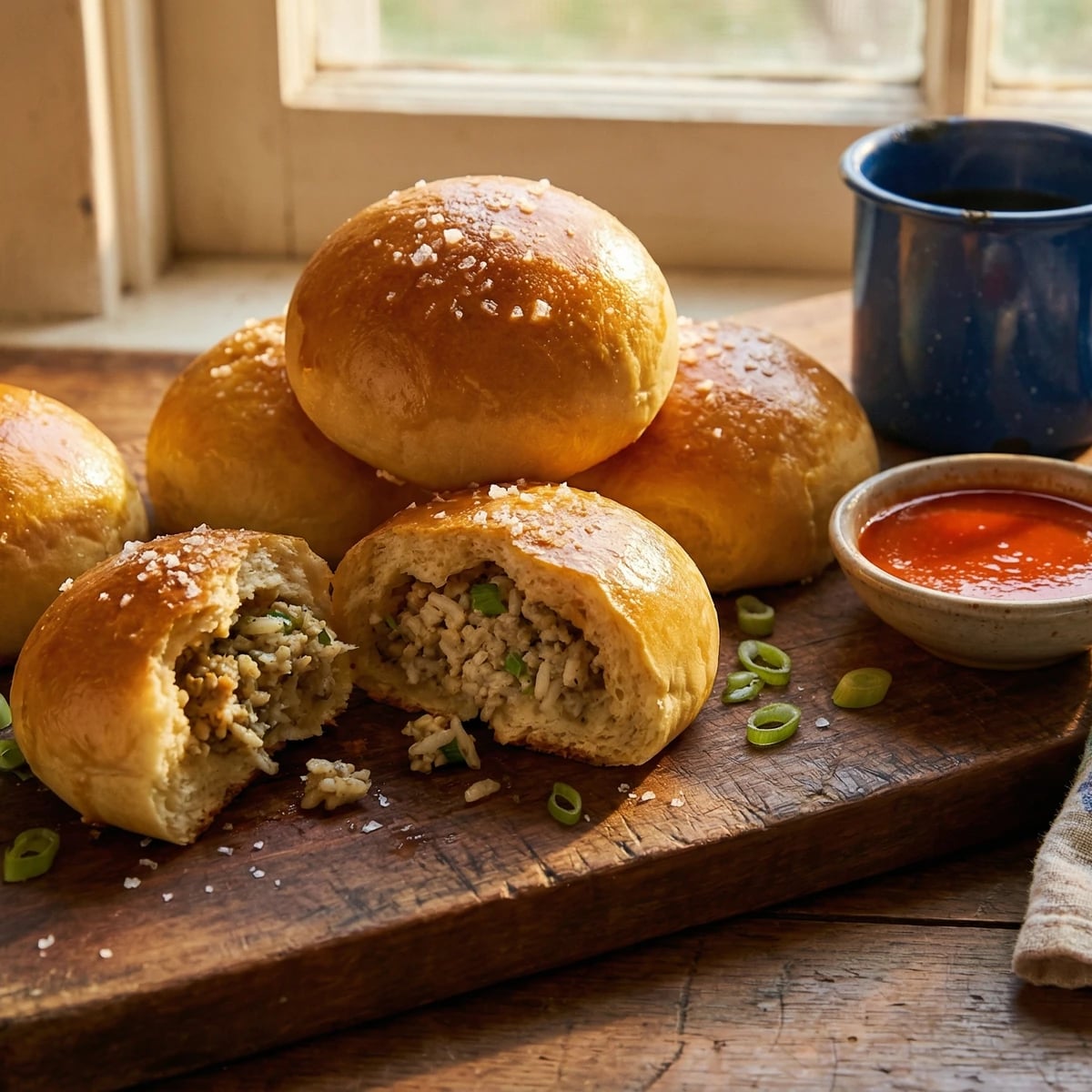
Tender, buttery Czech pastry dough wrapped around spiced Louisiana boudin, where two immigrant traditions meet on a baking sheet and create something neither culture imagined but both would claim as their own.
Breads
Cajun
Game Day
Make Ahead
45 min
Active Time
25 min cook•3 hr 30 min total
Yield16 kolaches
Two cultures walked into a Gulf Coast kitchen and never left. Czech immigrants brought their kolaches to Texas. Cajuns brought their boudin to Louisiana. Somewhere along the I-10 corridor, these traditions collided in the most delicious way possible.
The kolache dough is enriched and tender, slightly sweet in the way good European pastries know to be. It's the kind of dough that tears apart in soft layers, that begs for butter, that makes you close your eyes on the first bite. Inside sits boudin, that glorious Louisiana sausage of pork, rice, and enough seasoning to wake up your whole morning.
I first tasted this combination at a roadside bakery between Houston and Lake Charles. The owner, a Vietnamese woman who'd married a Czech Texan and learned to cook Cajun from her neighbors, had figured out what the rest of us were slow to understand: good food doesn't care about borders. She wrapped boudin in kolache dough because it made sense to her hands, and now it makes sense to everyone who tries it.
At Lagniappe, we serve these on Sunday mornings when the regulars come in looking for something to soak up the night before. The dough is forgiving for home bakers, the filling can be made with store-bought boudin if you're short on time, and the results will have your family asking when you're making them again. That's the bayou way: feed people so well they start planning their next visit before they've finished eating.
The technique, the tradition, and the story behind every dish.
Pour the warm milk into a large mixing bowl. The temperature matters here: too hot kills the yeast, too cold and it won't wake up. Sprinkle the yeast over the surface along with a tablespoon of the sugar. Let it sit for ten minutes until foamy and fragrant, like bread rising in a warm kitchen. If nothing happens, your yeast is dead. Start over with fresh.
Test milk temperature on your wrist. It should feel warm but comfortable, like bathwater for a baby.
2
Build the dough
Add the remaining sugar, softened butter, eggs, and vanilla to the yeast mixture. Whisk until the butter breaks into small pieces throughout. Add the flour and salt, stirring with a wooden spoon until a shaggy dough forms. Turn out onto a floured surface and knead for eight to ten minutes. The dough should become smooth, elastic, and slightly tacky but not sticky. When you poke it, it should spring back slowly.
3
First rise
Place the dough in a buttered bowl, turning once to coat all sides. Cover with a clean kitchen towel and set in a warm spot. Let it rise until doubled in size, about ninety minutes. My grandmother Evangeline used to put her dough near the pilot light of her old stove. Find your warm spot: top of the refrigerator, inside the oven with just the light on, near a sunny window.
If your kitchen runs cold, heat your oven to 200°F, turn it off, and let the dough rise inside with the door cracked.
4
Prepare the boudin filling
While the dough rises, squeeze the boudin from its casing into a bowl. Melt the butter in a skillet over medium heat. Add the onion and bell pepper, cooking until soft and fragrant, about five minutes. Add this to the boudin along with the green onions, Cajun seasoning, and cayenne. Mix everything together with your hands. The filling should be cohesive but not pasty. Taste it. Adjust the seasoning. This is where the magic lives.
5
Shape the kolaches
Punch down the risen dough and divide into sixteen equal pieces. Roll each piece into a smooth ball between your palms. Place on parchment-lined baking sheets, spacing three inches apart. Cover loosely and let rest fifteen minutes. The dough relaxes during this time, making it easier to shape without springing back.
6
Fill the kolaches
Using your thumb or the back of a small measuring cup, press a deep well into the center of each dough ball, leaving a half-inch border around the edges. The well should be generous enough to hold a good portion of filling. Divide the boudin mixture among the kolaches, about two heaping tablespoons each. Don't be shy. At Lagniappe, we always say the filling makes the pastry.
7
Second rise
Cover the filled kolaches loosely with plastic wrap and let rise in a warm spot for thirty minutes. They should look puffy and pillowy, the dough beginning to embrace the filling. Meanwhile, preheat your oven to 375°F.
8
Bake until golden
Brush the exposed dough edges with egg wash, taking care not to let it pool in the filling. Bake for twenty to twenty-five minutes, rotating the pans halfway through. The kolaches are done when the dough is deep golden brown and the filling has set with slightly caramelized edges. The kitchen should smell like heaven and Louisiana had a baby.
If the tops brown too quickly, tent loosely with foil for the last five minutes.
9
Finish and serve
Brush the hot kolaches immediately with melted butter. That butter soaks into the warm dough, adding richness and a beautiful sheen. Sprinkle with flaky sea salt while the butter is still wet. Let cool for five minutes if you can stand the wait. Serve warm with hot sauce on the side for those who want extra heat.
Chef Tips
•Good boudin makes good kolaches. If you can get fresh boudin from a Louisiana meat market, do it. The pre-packaged stuff from grocery stores works but lacks the soul of the real thing.
•The dough can handle more filling than you think. Don't make timid kolaches. Press that well deep and pack it generous.
•These reheat beautifully. Wrap in foil and warm in a 325°F oven for ten minutes. The microwave turns them sad and rubbery.
•For a breakfast spread, make half with boudin and half with cream cheese and jalapeño. That's how we do it at Lagniappe on game days.
Advance Preparation
•The dough can be made the night before and refrigerated after the first rise. Let it come to room temperature for thirty minutes before shaping.
•Unbaked, filled kolaches freeze beautifully for up to two months. Freeze on baking sheets, then transfer to freezer bags. Bake from frozen, adding five to seven minutes to the baking time.
•The boudin filling can be prepared up to two days ahead and refrigerated. Bring to room temperature before filling the kolaches.
Frequently Asked Questions
Nutrition Information
1 serving (about 130g)
Calories
360 calories
Total Fat
19 g
Saturated Fat
9 g
Trans Fat
0 g
Unsaturated Fat
10 g
Cholesterol
38 mg
Sodium
660 mg
Total Carbohydrates
37 g
Dietary Fiber
1 g
Sugars
6 g
Protein
11 g
Where cooking meets culture.
Culinary guides, cultural storytelling, and the editorial depth that makes cooking meaningful.