
Chef Juliana
Bem-Casado
You think tiny wrapped wedding sweets are for people with magic hands. They're not. They're sponge, filling, glaze, and patience, taught in plain steps until they behave.
A cooking platform built around craft, culture, and the stories behind what we eat.
Created by
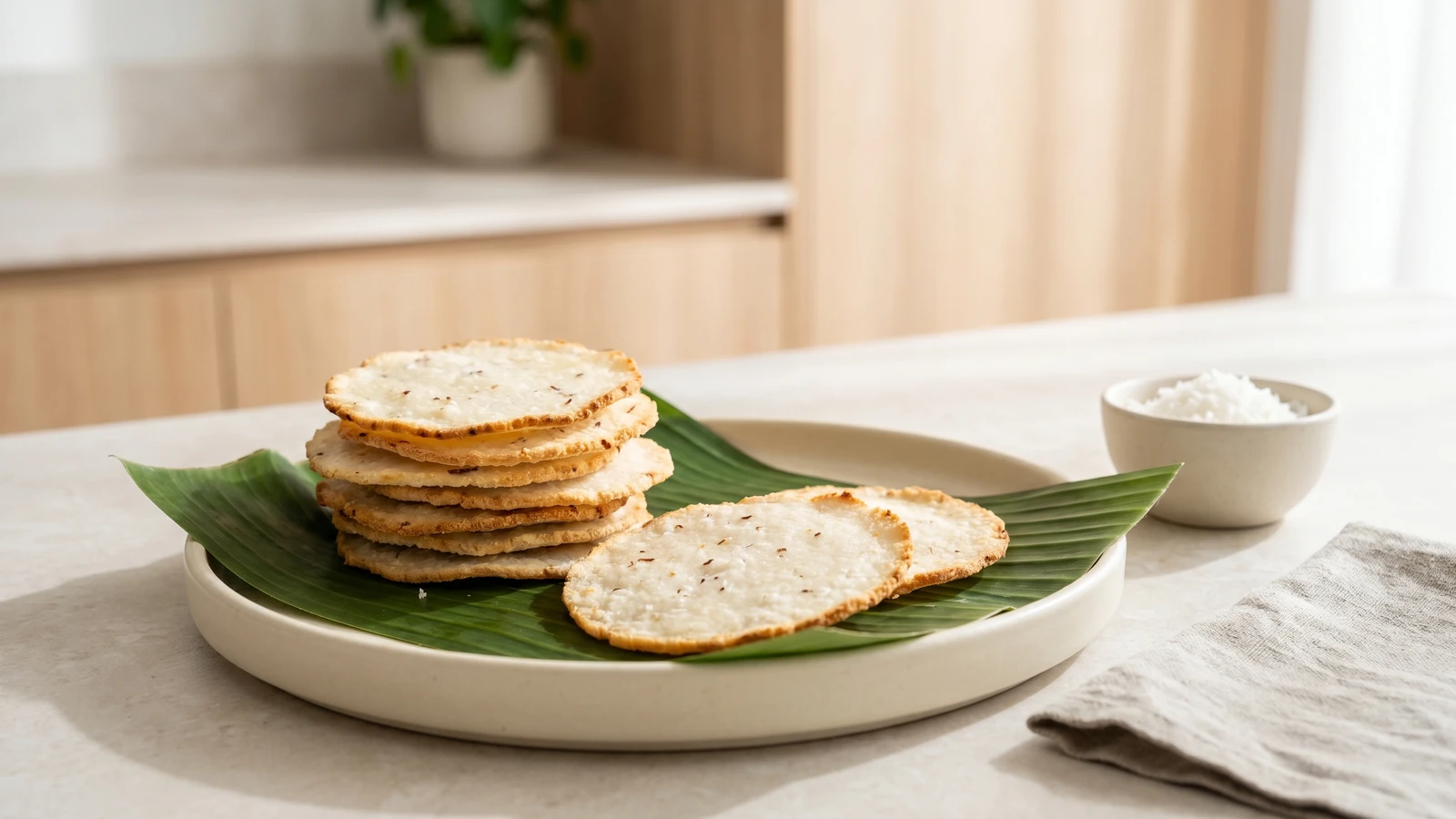
You don't need the right grandmother or a festival oven to learn the logic: grate mandioca fine, squeeze it damp, mix in coconut, and bake thin. Two ingredients, no packet, real crunch.
You see two ingredients and somehow the little voice gets louder: isso não é pra mim. It must need the right grandmother, the right forno, the right hands from Pará. No. A gente is going to be respectful, precise, and not dramatic. Cozinhar não é dom, é um aprendizado, and this one starts with learning how wet cassava behaves.
I won't pretend Santarém Novo is my kitchen. The people of Pará carry the festa practice, the timing, the ovens, the hands that know the dough before a recipe card ever speaks. What I can do, from my São Paulo counter and my old caderno habit, is write the home version the way I wish someone had written for me: cups, checkpoints, and no powder pretending to be food.
The pê-efe, rice, beans, a piece of fish or egg, and something green, is the daily formula that quietly makes a country itself. Mandioca belongs to that same table: farinha beside the beans, beiju in the afternoon, a biscuit for celebration. Comida de verdade feeds Tuesday and festa. The two were never enemies.
The method is simple. Grate fine so the starch can bind. Squeeze until damp, not dripping, so the biscuit crisps instead of turning leathery. Shape thin so the center cooks before the coconut over-browns. Anota aí: two ingredients are enough when you make them behave.
Beiju Chica is associated with Santarém Novo, a municipality in northeastern Pará that is separate from the better-known Santarém on the Tapajós. The cassava-and-coconut biscuit is baked for the December Festividade da Irmandade do Carimbó de São Benedito, a local celebration that joins devotion to São Benedito with carimbó music and dance. The exact festa practice, from the cassava processing to the ovens and shapes, belongs to the Santarém Novo cooks who keep the tradition moving.
Quantity
4 cups tightly packed after grating and squeezing, from about 2 lb / 900 g peeled roots
peeled thickly, woody core removed, finely grated, squeezed damp
Quantity
2 cups loosely packed
finely grated and unsweetened; frozen unsweetened grated coconut may be thawed and patted dry
| Ingredient | Quantity |
|---|---|
| raw sweet cassava (mandioca mansa, aipim, macaxeira, or yuca)peeled thickly, woody core removed, finely grated, squeezed damp | 4 cups tightly packed after grating and squeezing, from about 2 lb / 900 g peeled roots |
| fresh mature coconutfinely grated and unsweetened; frozen unsweetened grated coconut may be thawed and patted dry | 2 cups loosely packed |
Heat the oven to 180 C (350 F). Line two rimmed baking sheets with parchment, or with clean banana leaf pieces warmed for a few seconds until flexible. The leaf gives a faint green smell and helps release the biscuits; parchment is the Tuesday shortcut, clean and reliable, but you lose that little Pará cue.
Peel the cassava thickly, cutting away the brown skin and the pinkish layer under it, then split the roots and pull out the tough center cord. Grate on the fine holes or in a processor until it looks like damp, snowy crumbs with tiny fibers. Fine grating releases the starch that will hold the beiju together; big shreds bake up wiry and fall apart.
Pile the grated cassava in a clean thin towel and twist hard over a bowl until the liquid slows to drops. Open the towel. The massa should clump when you squeeze a fistful, but your palm should not be wet. Too much liquid makes a leathery biscuit; too much squeezing makes sand. If you overshoot, let the squeezed liquid sit 10 minutes, pour off the top liquid, and rub 1 tablespoon of the white goma at the bottom back into the massa.
Add the grated coconut to the damp cassava. Rub and fold with your hands for 2 minutes, until every handful is flecked with coconut and smells clean and sweet. Press a spoonful in your fist; it should hold its shape with rough edges. This mixing spreads the coconut through the starch, so the biscuit eats crisp, not chalky.
Use 1 heaping tablespoon per biscuit. Press each portion onto the prepared sheet into a firm round about 2 1/2 inches wide and 1/4 inch thick, tightening the edges with your fingertips. Thin matters. Too thick and the center stays gummy while the coconut goes too dark; too loose and it crumbles when you flip it.
Bake for 18 minutes, then check one biscuit with a thin spatula. If the underside releases and shows pale gold spots, flip them; if it sticks, give the tray 3 to 5 more minutes because the starch hasn't set. Bake 15 to 18 minutes more, until the tops look matte, the edges are toasted, and the centers no longer show a damp shine. Turn off the oven and leave the biscuits inside with the door cracked for 10 minutes. Crispness here is drying, not burning the coconut into bitterness.
Move the biscuits to a rack and let them cool completely before judging them. They firm up as the last moisture leaves. Eat with coffee, pack for festa, or tuck beside a bowl of fruit after a pê-efe. Store airtight only once cool, or trapped moisture will soften all your good work.
1 serving (about 25g)
Culinary guides, cultural storytelling, and the editorial depth that makes cooking meaningful.
Discover Culinary ExplorerChef Juliana
You think tiny wrapped wedding sweets are for people with magic hands. They're not. They're sponge, filling, glaze, and patience, taught in plain steps until they behave.

Chef Juliana
You think this is bakery magic. It isn't. Scald sour cassava starch, beat in eggs, pipe rings, and let a hot oven crack them into crisp, hollow biscuits.

Chef Juliana
You don't need bakery courage for this. Polvilho, queijo Minas, milk, butter, and your hands make crisp little sticks for coffee, lunchboxes, or the snack that keeps dinner sane.

Chef Juliana
You think frying dough is where things get dramatic. It isn't. Thin sticks, calm oil, and polvilho taught properly give you a crisp, chewy snack without mystery.