Culinary Explorer

A cooking platform built around craft, culture, and the stories behind what we eat.
Discover Culinary Explorer
A Proper Chicken Broth

A Proper Chicken Broth

Created by Chef Thomas

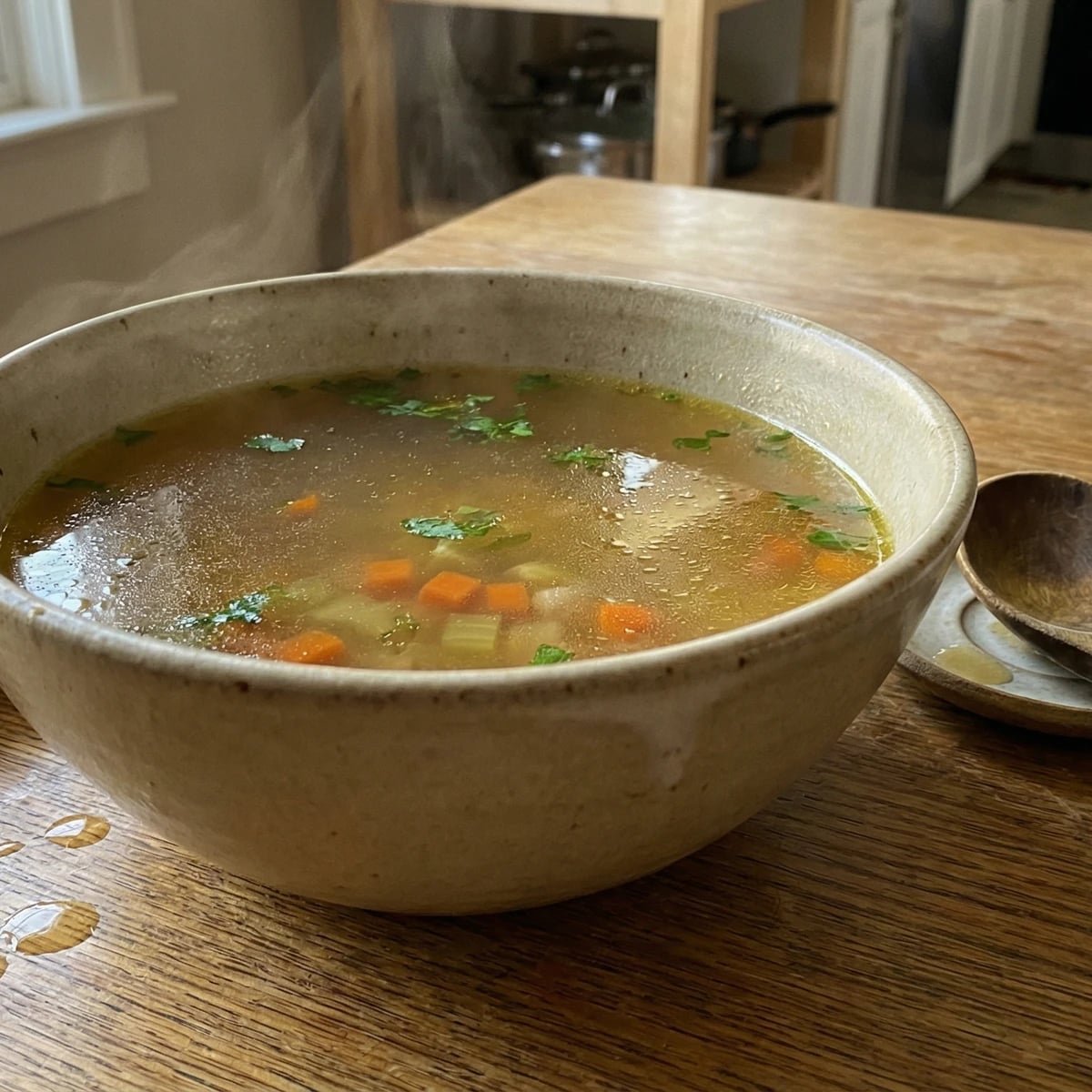
Sunday's roast chicken, simmered slowly on Monday with carrots, celery, leeks, and thyme into a bowl of clear, golden broth that smells like the kitchen is paying attention.

Soups & Stews
British
Weeknight
Comfort Food
Budget Friendly
20 min
Active Time
2 hr 30 min cook2 hr 50 min total
Yield4 generous servings

Monday evening. The house still smells faintly of yesterday's roast. The carcass is sitting in the fridge on a plate, stripped of most of its meat but still holding onto the good stuff: the bones, the jelly, the bits of skin that crisped and stuck to the tin. This is the real reason to roast a whole chicken. Not just the Sunday meal, but the one that follows it.

A proper chicken broth is not a recipe in the usual sense. It's an act of patience. You put the bones in a pot with some vegetables and cold water, and you leave it alone for a couple of hours while the heat does the slow, quiet work of drawing flavour out of things that might otherwise be thrown away. The kitchen fills with a smell that is difficult to describe and impossible to fake: savoury, herbal, warm in a way that has nothing to do with temperature.

I wrote it down in the notebook years ago. "Carcass, carrots, celery, leek, thyme, bay. Two hours. Gold." I haven't changed a word since. The broth doesn't need improving. It needs making. That's all. A recipe is a conversation, not a contract, and this one barely needs to say anything.

If someone in the house is tired, or unwell, or just cold from the walk home, this is what I make. Not because broth fixes things. But because a warm bowl carried to someone who didn't ask for it says something that words are often too clumsy to manage.

The technique, the tradition, and the story behind every dish.

Discover Culinary Explorer

Ingredients

roast chicken carcass

Quantity

1

broken into pieces

onion

Quantity

1 large

halved, skin left on

carrots (for stock)

Quantity

2

scrubbed and roughly chopped

celery (for stock)

Quantity

2 sticks

roughly chopped

leek

Quantity

1

split lengthways, washed and roughly chopped

thyme

Quantity

a few sprigs

bay leaves

Quantity

2

parsley stalks

Quantity

a small handful

black peppercorns

Quantity

8-10 whole

cold water

Quantity

about 1.5 litres

fine sea salt

Quantity

to taste

carrot (for serving)

Quantity

1 small

peeled and finely diced

celery (for serving)

Quantity

1 small stick

finely diced

flat-leaf parsley

Quantity

a small handful

roughly chopped

Equipment Needed

  • Large stockpot or heavy saucepan
  • Fine sieve or muslin-lined colander
  • Ladle
  • Slotted spoon for skimming

Instructions

  1. 1

    Build the stock pot

    Put the broken carcass into your largest saucepan or stockpot. Add the halved onion (skin on, it gives the broth its colour), the roughly chopped carrots, celery, and leek, the thyme, bay leaves, parsley stalks, and peppercorns. Pour in enough cold water to cover everything by a couple of centimetres. Cold water is important. Hot water seals the bones and you lose all the good things you're trying to coax out.

    Any scraps of meat still clinging to the carcass are a good thing. Don't pick them off. They'll give the broth body. The jelly that set in the roasting tin overnight is liquid gold. Scrape it all in.
  2. 2

    Bring up slowly

    Set the pan over a medium heat and bring it to the gentlest simmer you can manage. This takes fifteen minutes or so. Don't rush it. You'll see a scummy foam rise to the surface as it heats. Skim it off with a spoon. It won't hurt you if you leave it, but the broth will be clearer and cleaner without it. Once it's barely bubbling, turn the heat down low.

  3. 3

    Simmer with patience

    Let the broth simmer very gently for two hours, maybe two and a half. The surface should barely tremble. A rolling boil makes cloudy, greasy stock. A gentle simmer makes something golden and clear. You'll know it's working when the kitchen starts to smell warm and savoury and faintly herbal, the smell of something that's taking care of itself. Walk away. Read something. Come back and check on it now and then, but mostly leave it alone.

    If the level drops below the bones, add a little more water. But don't drown it. You want concentration, not volume.
  4. 4

    Strain carefully

    Set a fine sieve or a colander lined with muslin over a large clean pan or bowl. Ladle the broth through, pressing lightly on the vegetables to extract their flavour, but not so hard that you push through the cloudy bits. Discard everything in the sieve. Its work is done. What you should have is a clear, golden liquid that smells deeply of chicken and thyme. Taste it. Season it with salt, carefully, a little at a time. Good broth needs enough salt to taste like itself, but not so much that you notice the salt.

  5. 5

    Finish with fresh vegetables

    Return the strained broth to a clean pan and bring it back to a simmer. Add the finely diced carrot and celery and cook for six or seven minutes, until they're tender but still have a little bite. You want them to hold their shape in the bowl. Ladle the broth into warm bowls, scatter the chopped parsley over the top, and carry it to the table. There are few better feelings than putting a warm bowl of broth in front of someone who needs it.

Chef Tips

  • Start with cold water, always. Hot water hits the bones too fast and seals the surface, locking in the flavour you're trying to release. Cold water draws it out gently. This is one of the few rules in cooking I won't negotiate on.
  • Leave the onion skin on. It does nothing for flavour, but it gives the broth that deep amber colour that makes it look like something worth eating. Appearance isn't vanity. It's appetite.
  • If you have the time, make the broth the day before and refrigerate it overnight. The fat will set in a solid layer on top. Lift it off with a spoon. What's underneath will be clear and golden and will wobble slightly when you tip the bowl. That wobble is the gelatine from the bones. It means you did it right.
  • A good broth is only as good as the chicken it came from. A bird that had a decent life will give you a stock with real depth. The pale, watery liquid that comes from a factory-farmed carcass is a different thing entirely. This is where it pays to spend a little more on Sunday.

Advance Preparation

  • The strained broth, without the fresh vegetables, keeps in the fridge for up to four days. Let it cool completely before refrigerating. The layer of fat that sets on top acts as a seal and extends its life.
  • Freezes beautifully for up to three months. Pour into containers or freezer bags, leaving room to expand. Having homemade stock in the freezer changes the way you cook on a Tuesday evening.
  • The fresh diced vegetables are best added when you reheat and serve, so they keep their colour and their bite.

Frequently Asked Questions

Nutrition Information

1 serving (about 350g)

Calories
55 calories
Total Fat
2 g
Saturated Fat
1 g
Trans Fat
0 g
Unsaturated Fat
1 g
Cholesterol
10 mg
Sodium
650 mg
Total Carbohydrates
3 g
Dietary Fiber
0 g
Sugars
1 g
Protein
6 g

Note: Chef personas and recipes are created with AI assistance. Cook with care: follow safe food-handling practices, check doneness with a thermometer when needed, and adapt for allergies and your kitchen.

Where cooking meets culture.

Culinary guides, cultural storytelling, and the editorial depth that makes cooking meaningful.

Discover Culinary Explorer

More from British Soups

Browse the full collection