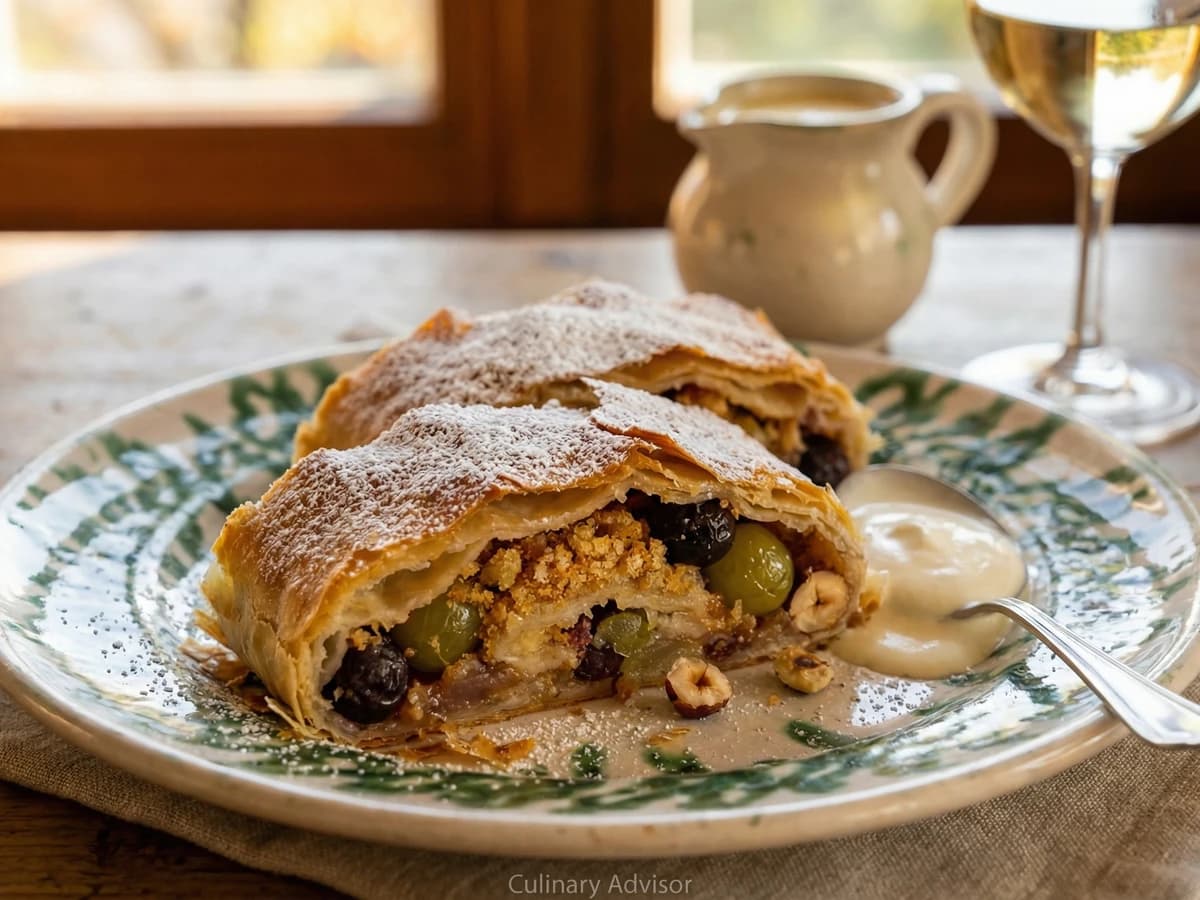
Hand-stretched strudel dough wrapped around late-summer Zwetschken plums with cinnamon, buttered breadcrumbs, and lemon zest, baked golden and dusted with powdered sugar while you can still smell August in the kitchen.
Pastries & Cookies
Austrian
Weeknight
Comfort Food
1 hr
Active Time
40 min cook•1 hr 40 min total
Yield6 servings
Every August, the Zwetschken arrive at the Grünmarkt in Salzburg in flat wooden crates, dark purple and dusty with bloom. The farmers stack them by the kilo and the whole market smells like stone fruit and warm pavement. That's when I know it's time to make this strudel. Not before. If the plums aren't in season, the dish doesn't exist yet. Austrian cooking is seasonal, and that's part of what makes it honest.
Gretel always said that Zwetschkenstrudel was the strudel she loved best, more than Apfelstrudel, more than Topfenstrudel. Apfelstrudel gets all the attention, but Zwetschken have a tartness and depth that apples can't match. The plums collapse in the oven, their juices soaking into the buttered breadcrumbs while the hand-stretched dough goes golden and shattering around them. You cut into it and the layers separate like pages of a book, with that dark, jammy filling running through the center.
The dough is the same one you use for every strudel: flour, water, oil, a splash of vinegar, kneaded until smooth and rested until it stops resisting. Then you stretch it on a floured cloth until it's thin enough to read a newspaper through. I know that sounds like a cliché. It's not. That's the actual test. If you can see the pattern of your tablecloth through the dough, it's ready. If you can't, keep stretching.
This is good Austrian home cooking. It takes a little time and a little courage the first time you pull that dough across your knuckles, but once you've done it, you'll understand why Austrians have been making strudel this way for three hundred years. Nothing else gets you layers like these.
Strudel dough came to Austria through the Ottoman Empire, likely adapted from the layered pastry traditions of Turkish and Middle Eastern baking. The oldest known strudel recipe dates to 1696, a handwritten manuscript now held in the Vienna City Library. Zwetschkenstrudel belongs to a family of filled strudels that vary by region and season: Apfelstrudel from Lower Austria's orchards, Topfenstrudel from the dairy country, Mohnstrudel from the Waldviertel's poppy fields. The Zwetschken version is tied to the brief late-summer plum harvest and has always been a way of preserving the season's fruit inside pastry before autumn arrives.
The technique, the tradition, and the story behind every dish.
griffiges Mehl (coarse flour)plus extra for dusting
250g
neutral oil (sunflower or rapeseed)
1 tablespoon
white wine vinegar
1 teaspoon
salt
pinch
warm water
120ml
Zwetschken (Italian prune plums)halved and stoned
1 kg
unsalted butter (for breadcrumbs)
80g
fine dry breadcrumbs
100g
granulated sugar
100g
ground cinnamon
1 teaspoon
Vanillezucker (vanilla sugar)
1 packet (8g)
lemonzested
1
walnuts (optional)roughly chopped
50g
unsalted butter (for brushing)melted
30g
powdered sugar
for dusting
vanilla sauce or Schlagobers (whipped cream)
for serving
Equipment Needed
•Large clean cotton cloth or tablecloth for stretching
•Rolling pin
•Wide pan for toasting breadcrumbs (28cm)
•Pastry brush
•Baking sheet lined with parchment
•Serrated knife for slicing
Instructions
1
Make the strudel dough
Mound the griffiges Mehl on a clean work surface and make a well in the center. Add the oil, vinegar, salt, and warm water. The vinegar isn't for flavor. It relaxes the gluten and makes the dough easier to stretch later, which is the difference between dough that pulls thin as tissue paper and dough that tears and makes you want to cry. Work everything together with your hands, scraping and folding, until a rough mass forms. Then knead. Knead for a full ten minutes. The dough should become completely smooth, soft, and elastic, almost tacky to the touch. If it feels tight and dry, wet your hands and keep going.
Use griffiges Mehl if you can find it. Austrian coarse flour has a slightly lower protein content and a grainier texture than standard all-purpose, which gives you a more supple, stretchable dough. If you can't find it, use all-purpose flour and add a teaspoon more oil.
2
Rest the dough
Shape the dough into a smooth ball, brush it lightly with oil so it doesn't form a skin, and cover it with a warm bowl turned upside down. Let it rest for at least thirty minutes. An hour is better. The gluten needs to relax completely or the dough will fight you when you try to stretch it. This is not a step you can skip or shorten. Walk away. Make coffee. Read something. The dough knows what it's doing.
Gretel always said that impatient hands make bad strudel. If you try to stretch the dough before it's rested, it will snap back like a rubber band and you'll tear holes in it.
3
Prepare the plum filling
While the dough rests, halve and stone the Zwetschken. Don't peel them. The skins hold the fruit together during baking and give the filling a slight tartness that balances all that sugar and cinnamon. In a bowl, toss the plum halves with 80g of the granulated sugar, the cinnamon, Vanillezucker, and lemon zest. Let them sit and macerate. The sugar will draw out the juices, which is exactly what you want: the breadcrumbs will soak them up inside the strudel and keep the dough from going soggy.
You need proper Zwetschken for this, the small, oval, dark-purple plums with firm flesh that come in late summer. Round red plums have too much juice and not enough structure. They'll turn your strudel into a swamp. If you can't find Zwetschken, use the firmest Italian prune plums your market has.
4
Toast the breadcrumbs
Melt 80g of butter in a wide pan over medium heat. When it foams, add the breadcrumbs and stir constantly. You're looking for an even golden color and a nutty, toasted smell, about four to five minutes. Don't walk away from this pan. Breadcrumbs go from golden to burnt in seconds and burnt breadcrumbs taste bitter. Stir in the remaining 20g of sugar and the chopped walnuts if you're using them. Set aside to cool slightly.
5
Stretch the dough
Preheat your oven to 190°C (375°F). Spread a clean cotton cloth over your table (a tablecloth or large tea towel works) and dust it generously with flour. Place the rested dough in the center and roll it out into a rough rectangle with a rolling pin, as thin as you can manage. Then put the rolling pin away. From here, you use your hands.
Slide your hands under the dough, knuckles up, palms down. Gently stretch the dough outward, working from the center to the edges, letting gravity help. Walk around the table. Keep moving. The dough should stretch to about 60 by 50 centimeters, thin enough that you can see the pattern of the cloth through it. If it tears a little, don't panic. Small tears are normal and the filling hides them. Thick edges won't stretch properly, so trim them off with scissors. They'll be tough after baking.
Take off any rings before you stretch the dough. A ring will punch through it before you've even started. Work with the backs of your hands, never your fingertips, because fingertips poke and pull while knuckles support and glide.
6
Fill and roll the strudel
Brush the stretched dough with half the melted butter. Scatter the toasted breadcrumb mixture evenly over the lower two-thirds of the dough, leaving a three-centimeter border on all sides. The breadcrumbs are your insulation. They absorb the plum juices during baking and keep the bottom of the strudel crisp instead of wet. Arrange the macerated plum halves in a line along the edge closest to you, spooning any accumulated juices over them.
Using the cloth underneath to help you, lift the edge of the dough over the plums and begin rolling away from you, tucking gently as you go. The cloth does the work. You're guiding, not forcing. Fold the open ends underneath like a parcel. Carefully transfer the strudel, seam side down, onto a lined baking sheet. Curve it slightly if it doesn't fit straight.
7
Bake the strudel
Brush the top and sides with the remaining melted butter. This is what gives you a golden, shattering crust. Place the strudel in the oven and bake for 35 to 40 minutes, until the pastry is deep golden brown and the filling is bubbling at the ends. Brush with butter once more halfway through if you have any left. The kitchen will smell like cinnamon and warm plums and you'll have to stop yourself from cutting into it too soon.
8
Rest, slice, and serve
Let the strudel cool for ten minutes on the baking sheet. It needs this time. The filling is volcanic when it first comes out and the layers need a moment to settle. Dust generously with powdered sugar, cut into thick slices with a serrated knife, and serve warm with a spoonful of vanilla sauce or a cloud of unsweetened Schlagobers on the side. Mahlzeit!
Chef Tips
•Buy your Zwetschken when they're ripe but still firm. If they're mushy at the market, they'll dissolve completely in the oven and you'll have plum soup in a pastry shell. You want halves that hold their shape while softening into something jammy.
•The breadcrumbs are doing critical work in this strudel. They absorb the plum juices during baking and keep the bottom layers crisp. Don't skip them and don't reduce the amount. Without enough breadcrumbs, the dough under the filling goes wet and leathery.
•Stretch the dough on a cotton cloth, never directly on the table. The cloth lets you roll the strudel without touching the dough with your hands, which would tear it. Lift the edge of the cloth and gravity does the rolling for you.
•If you're making strudel for the first time, invite a friend. One person stretches while the other holds the edges. Gretel and my grandmother Eva always made strudel together, and I think that's part of why it's such a good memory. It's a dish that likes company.
Advance Preparation
•The strudel dough can rest for up to two hours at room temperature under its warm bowl. Longer than that and it loses elasticity.
•The breadcrumb mixture can be toasted and prepared a day ahead. Store in an airtight container at room temperature.
•Zwetschkenstrudel is best eaten the day it's baked, warm from the oven. It can be reheated the next day in a 170°C oven for ten minutes, but the crust won't be quite as crisp. This is a strudel that rewards promptness.
Frequently Asked Questions
Nutrition Information
1 serving (about 250g)
Calories
575 calories
Total Fat
24 g
Saturated Fat
10 g
Trans Fat
0 g
Unsaturated Fat
12 g
Cholesterol
40 mg
Sodium
155 mg
Total Carbohydrates
84 g
Dietary Fiber
5 g
Sugars
37 g
Protein
9 g
Where cooking meets culture.
Culinary guides, cultural storytelling, and the editorial depth that makes cooking meaningful.