
Chef Graziella
Mostaccioli Napoletani
The ancient spice cookies of Naples, shaped like diamonds and cloaked in dark chocolate. Every Neapolitan nonna makes these for Christmas, and now you will too.
A cooking platform built around craft, culture, and the stories behind what we eat.
Created by
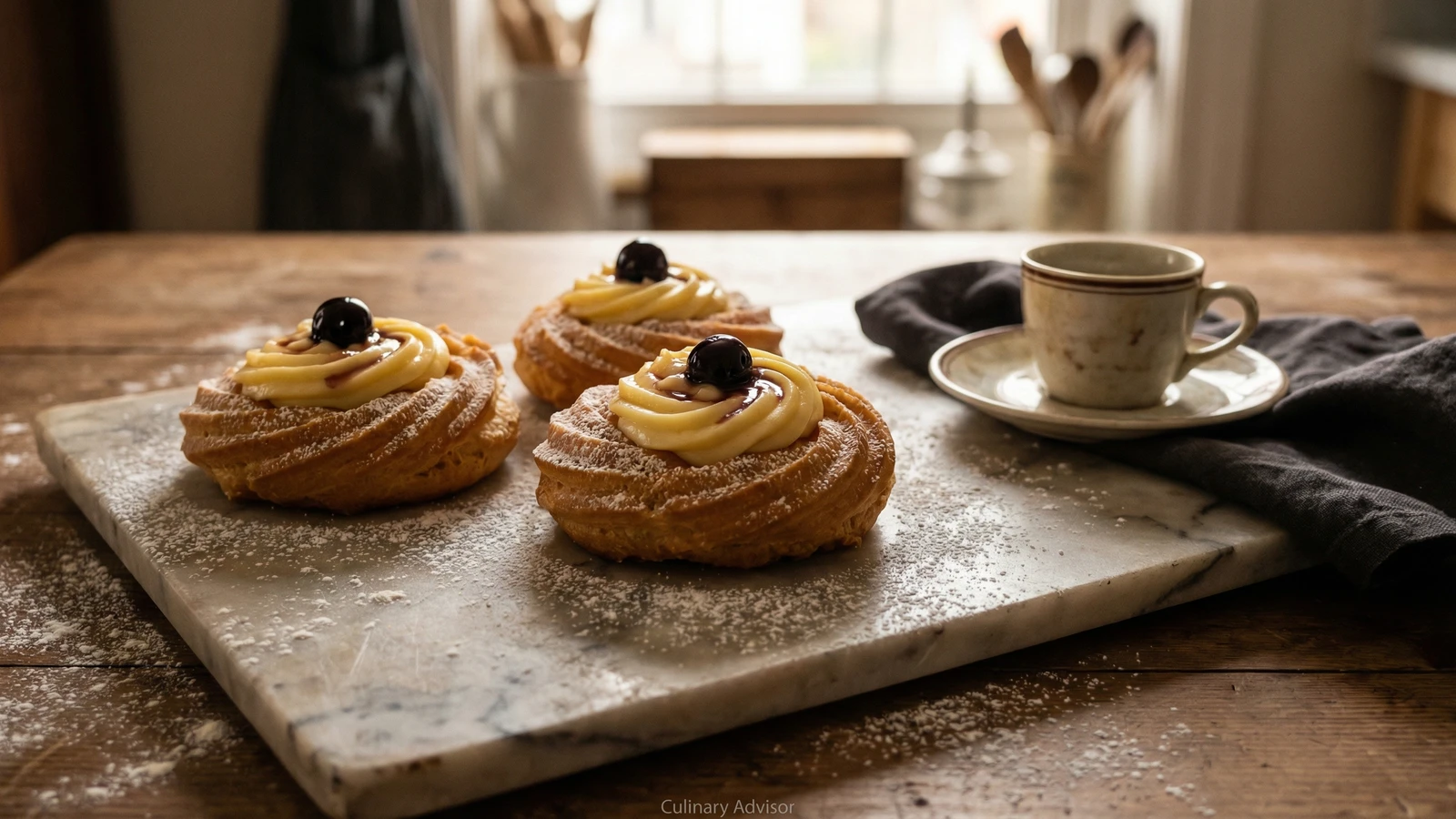
The fried choux rings of Naples, piped into golden crowns for Saint Joseph's Day, filled with silken pastry cream and crowned with a single amarena cherry. Fathers and saints deserve no less.
On the nineteenth of March, every pasticceria in Naples fills its windows with these golden rings. Saint Joseph's Day has been celebrated this way for generations, the feast day becoming inseparable from these fried pastries. In southern Italy, this is also Father's Day, and so the zeppola carries double meaning: devotion to the saint, and love for the men who raised you.
The dough is pasta choux, the same foundation as French éclairs and profiteroles, but here it is fried rather than baked. This is not a concession to laziness. Frying creates a particular texture: crisp and golden on the outside, impossibly light within. The Neapolitan method produces something baked versions cannot replicate, a shell that shatters against your teeth before yielding to air.
The cream must be crema pasticcera, Italian pastry cream scented with lemon zest in the traditional manner. Not whipped cream, not mascarpone, not anything from a can. Pipe it generously into the hollow center, crown it with a single amarena cherry, dust with powdered sugar. This is the complete zeppola, and anything else is compromise.
Zeppole di San Giuseppe trace to 19th-century Naples, where the fried version became the standard for celebrating Saint Joseph's feast day on March 19th. The name likely derives from the Latin 'serpula,' referring to the coiled, serpentine shape, though some scholars connect it to 'zeppa,' meaning wedge. The tradition of serving them on Saint Joseph's Day spread throughout southern Italy and eventually to Italian communities worldwide.
Quantity
1 cup
Quantity
8 tablespoons (1 stick)
cut into pieces
Quantity
1 tablespoon
Quantity
1/4 teaspoon
Quantity
1 cup
Quantity
4
at room temperature
Quantity
about 3 inches depth in pot
Quantity
2 cups
Quantity
1/2 cup
Quantity
4
Quantity
1/4 cup
Quantity
1
zested
Quantity
2 tablespoons
Quantity
12
Quantity
for dusting
| Ingredient | Quantity |
|---|---|
| water | 1 cup |
| unsalted buttercut into pieces | 8 tablespoons (1 stick) |
| granulated sugar (for dough) | 1 tablespoon |
| fine sea salt | 1/4 teaspoon |
| all-purpose flour | 1 cup |
| large eggsat room temperature | 4 |
| vegetable oil or lard | about 3 inches depth in pot |
| whole milk | 2 cups |
| granulated sugar (for cream) | 1/2 cup |
| large egg yolks | 4 |
| cornstarch | 1/4 cup |
| lemonzested | 1 |
| unsalted butter (for cream) | 2 tablespoons |
| amarena cherries in syrup | 12 |
| powdered sugar | for dusting |
In a medium saucepan, heat the milk with the lemon zest over medium heat until it just begins to steam. Do not boil. In a bowl, whisk the egg yolks with the sugar until pale and slightly thickened, about 2 minutes. Whisk in the cornstarch until smooth. Slowly pour the hot milk into the egg mixture, whisking constantly to prevent curdling. Return everything to the saucepan.
Cook the cream over medium heat, whisking constantly, until it thickens and begins to bubble. Continue cooking for one full minute after it bubbles, still whisking. The cream should be thick enough to mound on a spoon. Remove from heat and whisk in the butter until melted. Transfer to a bowl, press plastic wrap directly onto the surface to prevent a skin from forming, and refrigerate until completely cold, at least 2 hours.
In a medium saucepan, combine the water, butter pieces, sugar, and salt. Heat over medium heat until the butter melts and the mixture comes to a rolling boil. Remove from heat immediately. Add all the flour at once and stir vigorously with a wooden spoon until the mixture forms a smooth ball that pulls away from the sides of the pan. Return to medium heat and cook for one minute, stirring constantly, to dry the dough slightly. You will see a thin film form on the bottom of the pan. This is correct.
Transfer the dough to a bowl or stand mixer. Let it cool for 5 minutes. Beat in the eggs one at a time, incorporating each fully before adding the next. After adding all the eggs, the dough should be smooth, glossy, and thick enough to hold its shape when piped but soft enough to fall slowly from a spoon. If it seems too stiff, beat in a splash of water.
Line two baking sheets with parchment paper. Fit a piping bag with a large star tip (Ateco 846 or similar). Fill the bag with the warm dough. Pipe rings about 3 inches in diameter onto the parchment, going around twice to build height. Leave 2 inches between each ring. You should have 12 rings. If the dough has cooled too much and become stiff, it will not pipe smoothly. Work while it is still warm.
Pour oil into a heavy pot to a depth of 3 inches. Heat to 340°F. Use a thermometer. The temperature is critical. Too hot and the outside will burn before the inside cooks. Too cool and the zeppole will absorb oil and become greasy. Maintain this temperature throughout frying by adjusting the heat as needed.
Carefully slide the piped rings, parchment and all, into the hot oil, working in batches of 2 or 3. The parchment will release within seconds; remove it with tongs and discard. Fry the zeppole for 3 to 4 minutes per side, turning once, until deep golden brown and puffed. The ridges from the star tip should be visible. Transfer to a rack set over a baking sheet to drain. Let cool completely before filling.
Transfer the cold pastry cream to a piping bag fitted with a large round or star tip. Pipe a generous swirl of cream into the hollow center of each cooled zeppola. Place one amarena cherry with a little of its syrup in the center of the cream. Dust with powdered sugar. Serve within a few hours. Zeppole are best the day they are made.
1 serving (about 100g)
Culinary guides, cultural storytelling, and the editorial depth that makes cooking meaningful.
Discover Culinary ExplorerChef Graziella
The ancient spice cookies of Naples, shaped like diamonds and cloaked in dark chocolate. Every Neapolitan nonna makes these for Christmas, and now you will too.
Chef Graziella
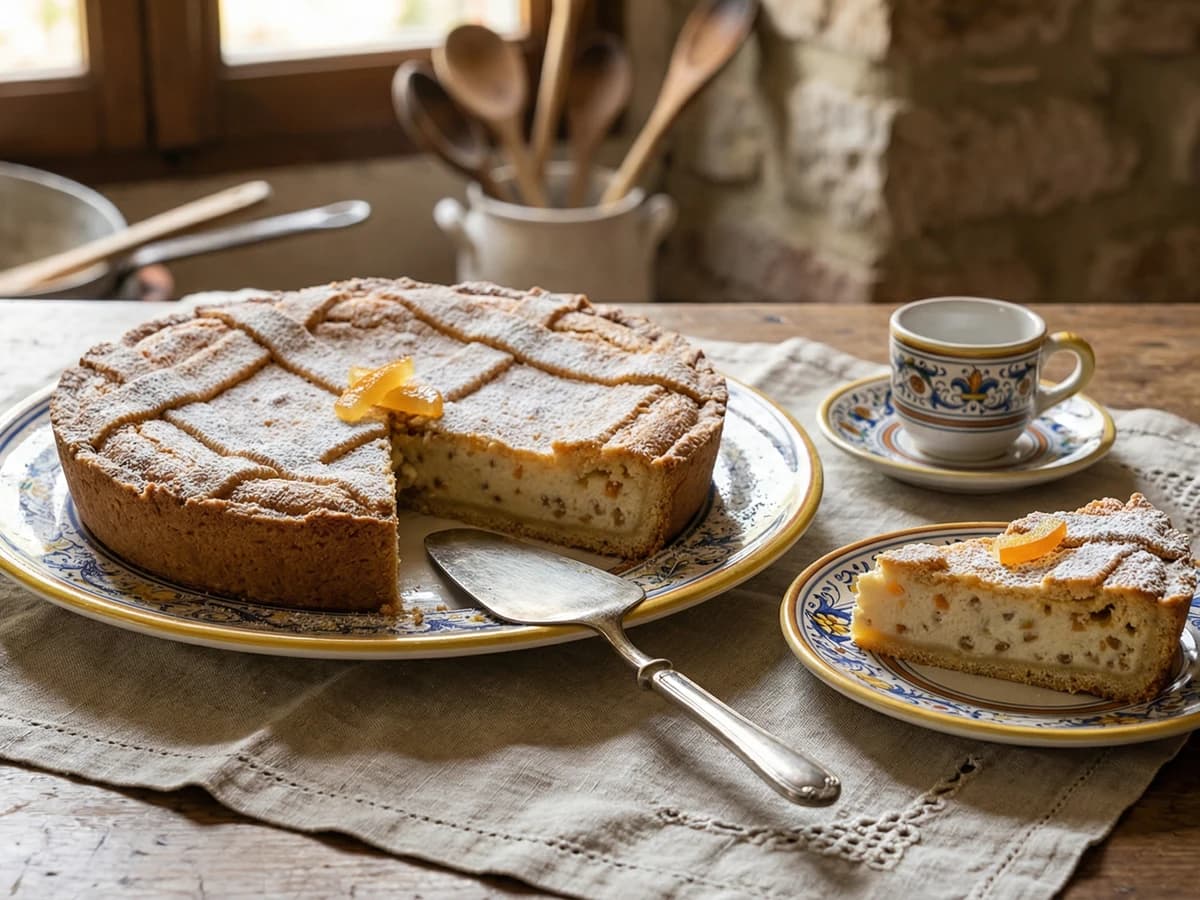
The ancient Easter tart of Naples, where cooked wheat, ricotta, candied citrus, and orange blossom water unite inside buttery pasta frolla. Made days ahead because patience is not optional.

Chef Graziella
The rock-hard almond rings of Naples, baked to withstand the Christmas season. Dunk them in vin santo or espresso, wait for the softening, and understand why Neapolitans have made these for three centuries.

Chef Graziella
The legendary ridged pastry of Naples, where paper-thin dough is stretched, laminated with lard, and shaped into shells that shatter at first bite. This is not a recipe for the impatient.