
Chef Joost
Bavarois met Frambozensaus
A French-Bavarian name, a Dutch party mould, and the quiet trick of gelatine: custard cooled just enough, cream folded gently, and a dessert made ahead like a host with sense.
A cooking platform built around craft, culture, and the stories behind what we eat.
Created by
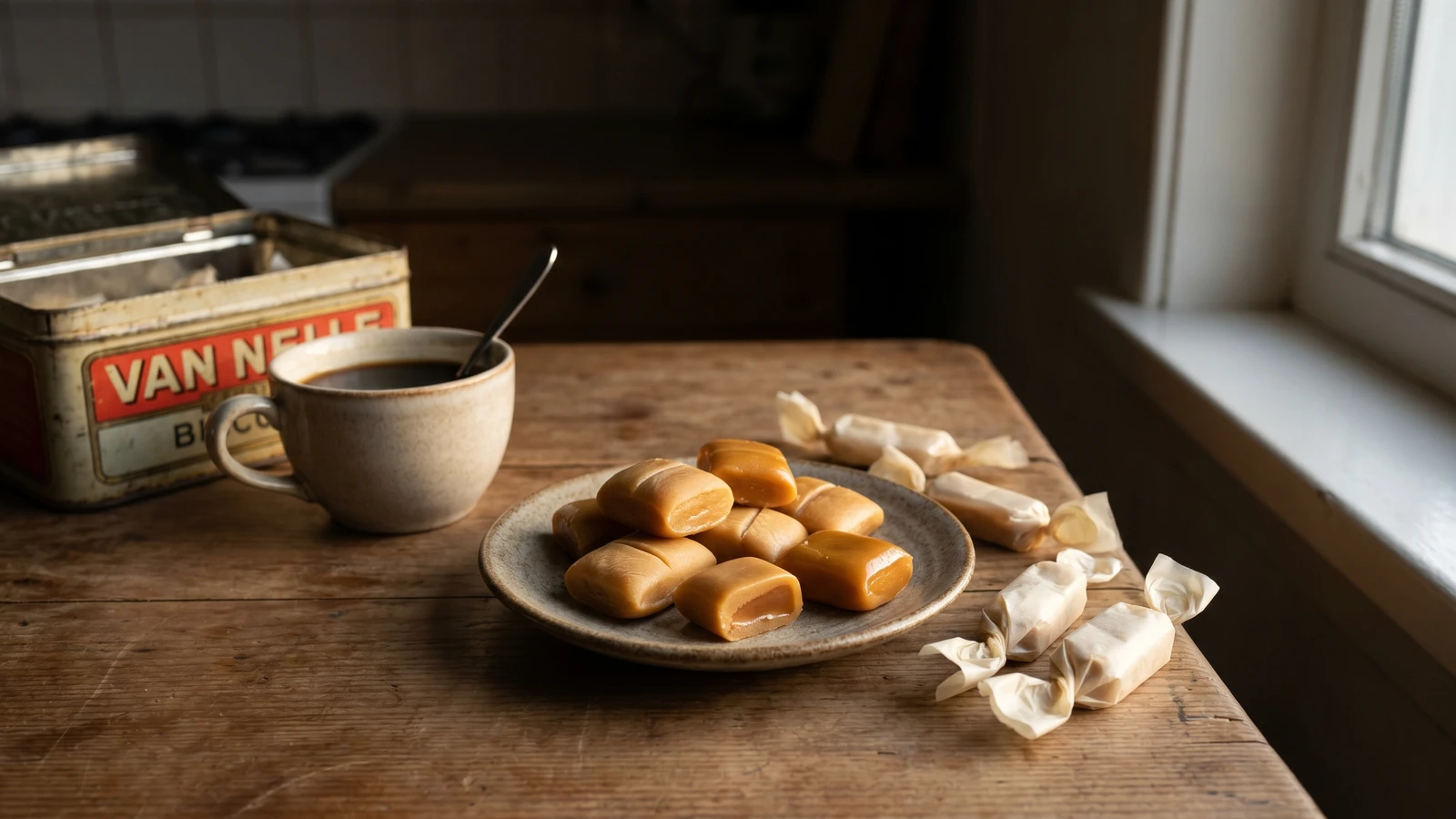
A Zeeland babbelaar is a small amber lesson in thrift: sugar, butter, and vinegar boiled hard, cut for the coffee table, and named for the talking it was meant to lengthen.
In my grandmother's second notebook, the recipe for babbelaars sits between preserved pears and the December speculaas, as if it were too modest to announce itself. Sugar, butter, water, a spoon of vinegar. That is all. Yet on cold Zeeland afternoons, when rain came sideways off the water and a second coffee was not indulgence but common sense, the tin came open and the room found its talk again.
The name already tells you: babbelen means to chatter, and a babbelaar is a chatterer. These little amber sweets do exactly that, not with words but with time. They melt slowly; they give hands something to do while neighbours compare weather, cousins, church sales, the price of butter, and everything else no historian should ignore. But let me tell you a secret: the vinegar is not a seaside superstition. It is the tidy chemistry of a frugal kitchen, a little acid to keep boiled sugar from turning grainy.
What matters here is courage at the pot and restraint everywhere else. Cook the syrup until it is properly hard, pale amber rather than dark bitter, then pour, score, and cut before it decides to become a pane of glass. Hou het altijd simpel, always keep it simple: a buttered tray, a thermometer if you have one, a tin for keeping, and enough patience not to touch molten sugar with a curious finger. History and cookery, they cannot be separated, but neither can candy and common sense.
Zeeuwse babbelaars belong to the nineteenth-century Zeeland coffee table, when boiled sugar sweets made with domestic butter and a spoon of acid were cheap enough for ordinary households and durable enough for tins. The name comes plainly from babbelen, to chatter: the candy was offered with coffee or tea and lasted long in the mouth, which made it useful at visits, market days, and the slow after-talk of holidays. By the twentieth century the butter babbelaar had become a provincial emblem in Zeeland shops, but its technique remains the older household method of boiling sugar to hard crack, enriching it with butter, and using vinegar to prevent graining.
Quantity
300g
Quantity
90ml
Quantity
1 tablespoon
Quantity
75g
cut into cubes
Quantity
1/4 teaspoon
Quantity
as needed
for greasing
| Ingredient | Quantity |
|---|---|
| granulated sugar | 300g |
| water | 90ml |
| natuurazijn (plain white vinegar), 5% acidity | 1 tablespoon |
| unsalted buttercut into cubes | 75g |
| fine sea salt | 1/4 teaspoon |
| extra butter or neutral oilfor greasing | as needed |
Butter a marble slab or a rimmed metal baking tray very lightly, then butter a bench scraper and a sharp knife. Lay out waxed paper for wrapping. Once the syrup is ready it will not wait while you search a drawer; hot sugar has the patience of a tax collector and a worse temper.
Put the sugar, water, vinegar, butter, and salt into a heavy saucepan with high sides. Set over low heat and stir gently only until the sugar is fully wet and the butter has melted. Brush any stray crystals from the side of the pan with a wet pastry brush; crystals on the wall of the pan are the little troublemakers that make candy grainy.
Raise the heat to medium-high and boil without stirring until the syrup reaches 150C on a candy thermometer. Swirl the pan once or twice if the colour develops unevenly, but keep the spoon out. The mixture will foam, then settle into a clear pale amber with a nutty smell. Without a thermometer, drop a little syrup into cold water; it should harden at once and break cleanly when fully cooled. Stop before dark mahogany. That is bitter pride, not Zeeland thrift.
Immediately pour the syrup onto the prepared tray. Do not scrape the sugary sides of the pan into it; they have already done their work. Let the sheet sit for 1 to 2 minutes, just until the edges thicken but the centre still moves slowly, then use the buttered scraper to push the edges inward once or twice so the sheet cools evenly. Score it into strips, then into small rectangles about 1.5 to 2 cm wide.
When the candy is firm enough to hold its shape but still yields to the knife, cut along the score lines. Let the babbelaars cool completely before wrapping them in waxed paper or layering them in a tin with parchment between the layers. If the sheet sets too quickly, warm the tray in a 120C oven for 2 minutes and try again. The broken bits belong to the cook, for obvious reasons.
1 serving (about 6g)
Culinary guides, cultural storytelling, and the editorial depth that makes cooking meaningful.
Discover Culinary ExplorerChef Joost
A French-Bavarian name, a Dutch party mould, and the quiet trick of gelatine: custard cooled just enough, cream folded gently, and a dessert made ahead like a host with sense.

Chef Joost
An old Dutch moulded toetje, where bitter-almond macaroons soften into milk pudding and turn thrift, patience, and one good puddingvorm into celebration.

Chef Joost
A bowl of vanillevla with bitterkoekjes folded through it is the quiet Dutch trick that turns milk, eggs, sugar, and a few almond biscuits into a proper toetje.

Chef Joost
Goat-hoof biscuits made into a whole taart: almond meringue, chocolate, advocaat, and cream, the Dutch bakery counter quietly becoming a dinner-party secret.