Culinary Explorer

A cooking platform built around craft, culture, and the stories behind what we eat.
Discover Culinary Explorer
Zacahuil Huasteco de Veracruz

Zacahuil Huasteco de Veracruz

Created by

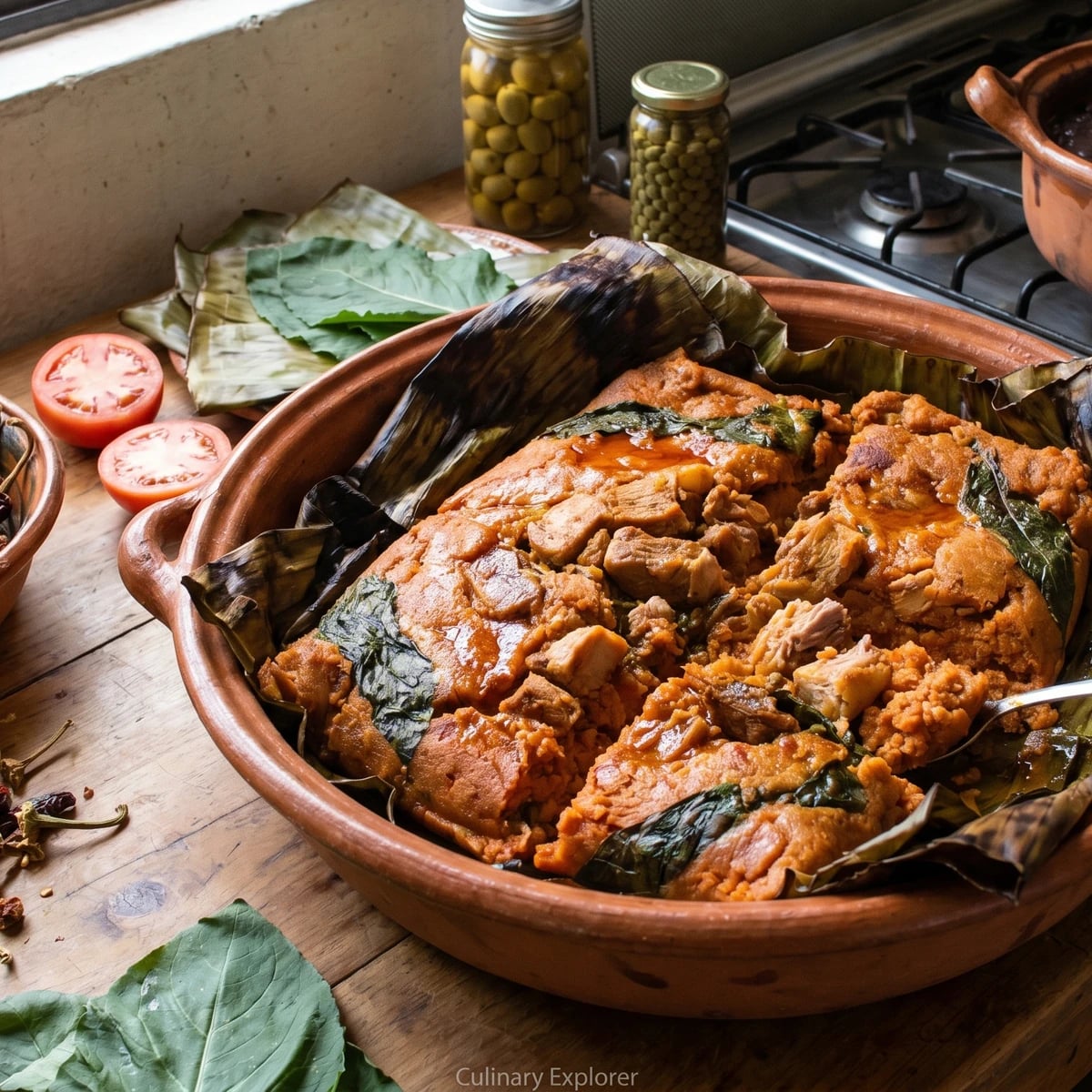
Veracruz's Huasteca zacahuil is a monumental tamal of coarse masa martajada, pork, turkey, chile ancho, chipotle seco, and acuyo, wrapped in banana leaves and slow-baked until it can feed the whole fiesta.

Main Dishes
Mexican
Special Occasion
Holiday
Celebration
2 hr
Active Time
6 hr 30 min cook8 hr 30 min total
Yield18 to 24 servings

Veracruz, in the Huasteca Veracruzana, is where this version of zacahuil lives: northern towns like Tantoyuca, Tempoal, Chicontepec, and Pánuco, where the state leans toward San Luis Potosí and Hidalgo and the cooking refuses neat borders. The Huasteca is bigger than Veracruz, yes, but this one carries Veracruz markers: acuyo, banana leaf, chile ancho with chipotle seco, black beans on the table, and the habit of feeding everyone who walks through the door.

Zacahuil is not a big tamalito. It is a monumental tamal, coarse masa martajada beaten with manteca de cerdo, stained red with toasted chiles, packed with pork and turkey, wrapped in banana leaves, then baked low until the masa sets around the meat. The texture should be grainy and generous, not smooth like a Mexico City tamal. If your masa looks like cake batter, you went the wrong direction.

I learned this version in northern Veracruz from women who had made zacahuil for weddings, wakes, baptisms, and patron-saint days longer than most restaurants survive. They did not talk about presentation. They talked about the molino grinding the corn coarse enough, the lard being fresh, the chile not burning, the leaves being flexible before wrapping. La cocina no es decoración, es trabajo.

My mother had no zacahuil in her Jalisco notebook. That is correct. Cada estado, su propia cocina. But she wrote one line that belongs here anyway: the market tells you what the pot can become. For zacahuil, the market must give you good masa, good chiles, acuyo, and leaves wide enough to hold abundance. This is a 32-state cuisine.

Zacahuil is the ceremonial tamal of La Huasteca, the cultural region that crosses northern Veracruz, eastern San Luis Potosí, Hidalgo, southern Tamaulipas, northern Puebla, and parts of Querétaro. Tamales predate the Spanish conquest by centuries, but the pork and lard in today's zacahuil came after pigs arrived in Mexico in the 16th century; older versions would have used turkey, wild game, and native fats. In towns of the Huasteca Veracruzana, especially around Tantoyuca and Chicontepec, the dish became a market and fiesta food because one wrapped masa bundle could feed a baptizing family, a wedding crowd, or a whole patron-saint table.

The technique, the tradition, and the story behind every dish.

Discover Culinary Explorer

Ingredients

pork shoulder with fat

Quantity

3 pounds

cut into 2-inch pieces

turkey thigh meat

Quantity

2 pounds

cut into 2-inch pieces

kosher salt

Quantity

2 tablespoons

divided

dried chile ancho

Quantity

12

stemmed and seeded

dried chile guajillo

Quantity

6

stemmed and seeded

dried chile chipotle seco or chile morita

Quantity

4

stemmed

jitomates de bola

Quantity

4

halved

white onion

Quantity

1 large

quartered

garlic cloves

Quantity

8

unpeeled

cumin seeds

Quantity

1 teaspoon

black peppercorns

Quantity

1 teaspoon

whole cloves

Quantity

4

allspice berries (pimienta gorda)

Quantity

4

dried Mexican oregano

Quantity

1 tablespoon

naranja agria juice

Quantity

1/2 cup

or 1/4 cup fresh orange juice mixed with 1/4 cup fresh lime juice

reserved hot chile soaking water

Quantity

1 cup

manteca de cerdo

Quantity

2 tablespoons

for frying the adobo

fresh coarse nixtamal masa (masa martajada para zacahuil)

Quantity

5 pounds

manteca de cerdo

Quantity

1 1/2 pounds

room temperature, for the masa

warm pork or turkey broth

Quantity

3 to 4 cups

large banana leaves

Quantity

12

thawed if frozen, wiped clean, and softened over a flame

hoja santa leaves (acuyo)

Quantity

12

rinsed and patted dry

frijoles negros de olla (optional)

Quantity

for serving

salsa de chile seco (optional)

Quantity

for serving

Equipment Needed

  • Large covered roasting pan, turkey roaster, or deep barro cazuela large enough for a 5-pound masa bundle
  • Cast iron comal for toasting chiles and softening banana leaves
  • High-powered blender
  • Medium-mesh strainer
  • Instant-read thermometer with a long probe
  • Kitchen twine and heavy foil for sealing the bundle

Instructions

  1. 1

    Salt the meat

    Put the pork and turkey in a large bowl. Sprinkle with 1 tablespoon of the salt and toss well. The pieces should be even, about 2 inches, so the heat reaches the center of the zacahuil without leaving raw pockets. Cover and refrigerate while you make the adobo, or overnight if you are working the way a fiesta kitchen works.

  2. 2

    Toast the chiles

    Heat a dry comal over medium. Toast the chile ancho, chile guajillo, and chipotle seco separately, about 20 to 30 seconds per side. The skins should puff and smell deep, not blacken. Ancho gives body, guajillo gives color, chipotle seco gives smoke and heat. Each chile has a job. Do not throw them all on the comal at once and hope for the best.

    Burned chile turns bitter. If a chile goes black, throw it out. You cannot hide that bitterness inside five pounds of masa.
  3. 3

    Soak and roast

    Place the toasted chiles in a bowl and cover with hot water, not boiling water. Let them soften for 20 minutes. On the same comal, roast the jitomates, onion, and unpeeled garlic until the tomatoes slump, the onion chars at the edges, and the garlic softens inside its skin. Peel the garlic. Reserve 1 cup of the chile soaking water.

  4. 4

    Blend the adobo

    Blend the softened chiles, roasted jitomates, onion, peeled garlic, cumin, black peppercorns, cloves, allspice, oregano, naranja agria juice, and 1 cup of chile soaking water until completely smooth. Strain through a medium-mesh sieve into a bowl, pressing hard on the solids. This is not a thin salsa. It should be thick, brick red, and smell like the chile stall before noon.

  5. 5

    Fry the adobo

    Melt 2 tablespoons of manteca de cerdo in a wide cazuela or heavy skillet over medium heat. Add the strained adobo carefully. It will sputter. Cook 10 to 12 minutes, stirring often, until the color darkens and the fat starts to shine at the edges. La manteca es el sabor. Reserve 1 cup of this fried adobo for the masa, then pour the rest over the salted meat and toss until every piece is coated.

  6. 6

    Prepare the leaves

    Pass each banana leaf over a gas flame or hot comal until it turns glossy and flexible. Do not skip this. A raw leaf cracks when you fold it, and then your zacahuil leaks. Line a large covered roasting pan or deep barro cazuela with overlapping leaves, leaving long overhangs on all sides. Lay 6 hoja santa leaves across the bottom. That acuyo perfume is Veracruz speaking.

  7. 7

    Work the masa

    Put the coarse masa in the largest bowl you own. Work in the 1 1/2 pounds of room-temperature manteca de cerdo by hand, squeezing and folding until the fat is evenly distributed. Add the reserved cup of adobo, the remaining 1 tablespoon salt, and 3 cups warm broth. Mix until the masa is red-orange, coarse, and spreadable, adding the last cup of broth only if it feels dry. It should hold ridges from your fingers but still spread without tearing the leaves.

    Ask the molino for masa martajada para zacahuil. Smooth tortilla masa gives the wrong texture. Zacahuil should be grainy and generous, not soft like cake batter.
  8. 8

    Fill the zacahuil

    Spread about two-thirds of the masa over the lined leaves in an even layer, pushing it slightly up the sides. Scatter the adobo-coated pork and turkey across the masa. Tuck the remaining hoja santa leaves among the meat. Cover with the remaining masa, patching any open spots with wet hands. This is not a neat little tamal. It is a wrapped table of food. No me vengas con atajos.

  9. 9

    Wrap and seal

    Fold the banana leaves over the top, one side at a time, until the zacahuil is fully enclosed. Add extra softened leaves over any weak spots. Cover the roaster tightly with its lid, or with two layers of heavy foil if your vessel has no lid. Tie with kitchen twine if the bundle wants to open. The seal matters because the masa needs steady enclosed heat to set around the meat.

  10. 10

    Bake low

    Heat the oven to 325F. Bake the covered zacahuil for 1 hour, then lower the heat to 275F and bake 5 to 5 1/2 hours more. In a wood-fired horno de barro, the fire should be burned down to a steady moderate heat before the zacahuil goes in. The zacahuil is ready when the center of the masa reads 190F to 200F and a piece of turkey from the center is at least 165F. The masa should be set, red, and fragrant, with the meat tender enough to pull apart.

  11. 11

    Rest and serve

    Let the zacahuil rest, still covered, for 45 minutes to 1 hour. Open the banana leaves at the table and spoon out portions with meat and masa together. Serve with frijoles negros de olla and salsa de chile seco. Do not slice it like a birthday cake. This is Huasteca food, built for a crowd, served from the leaves. Así se hace y punto.

Chef Tips

  • Ask at the molino for masa martajada para zacahuil. If they hand you smooth tortilla masa, correct them. Outside Mexico, masa harina for tamales is a compromise, not an upgrade. Hydrate it with warm broth and let it rest 30 minutes, but know that fresh nixtamal masa has a flavor the bag cannot give you.
  • Use fresh manteca de cerdo. If it smells stale, it is stale. Hydrogenated shortening is not manteca. La manteca es el sabor, and zacahuil without it tastes like punishment.
  • The meat goes in raw because it cooks for hours inside the sealed masa. That only works if the pieces are cut evenly and the heat is steady. Use a thermometer at the center. Pride is not a food safety method.
  • If you can find papatla leaves in a Huasteca market, use them with the banana leaves. Outside the region, banana leaves are the practical choice. Soften them over heat before wrapping or they will split.
  • Chile chipotle seco is not the canned chipotle in adobo. They are related, not identical. For this dish you want the dried chile because it toasts cleanly and gives smoke without making the adobo taste canned.

Advance Preparation

  • The adobo can be toasted, blended, fried, and refrigerated up to 2 days ahead. Warm it before mixing with the meat and masa so the lard loosens properly.
  • The pork and turkey can be salted and coated with adobo the night before. Keep them refrigerated and covered.
  • Banana leaves can be wiped, softened, folded, and refrigerated one day ahead. Keep them wrapped so they do not dry out.
  • Leftover zacahuil reheats well wrapped in banana leaf or foil in a 325F oven until the masa is hot through and the edges regain a little firmness.

Frequently Asked Questions

Nutrition Information

1 serving (about 300g)

Calories
760 calories
Total Fat
51 g
Saturated Fat
19 g
Trans Fat
0 g
Unsaturated Fat
29 g
Cholesterol
115 mg
Sodium
800 mg
Total Carbohydrates
49 g
Dietary Fiber
7 g
Sugars
5 g
Protein
26 g

Note: Chef personas and recipes are created with AI assistance. Cook with care: follow safe food-handling practices, check doneness with a thermometer when needed, and adapt for allergies and your kitchen.

Where cooking meets culture.

Culinary guides, cultural storytelling, and the editorial depth that makes cooking meaningful.

Discover Culinary Explorer

More from Veracruz Main Dishes

Browse the full collection