
Chef Jeong-sun
Agwi-jjim (Braised Monkfish with Bean Sprouts)
Firm monkfish buried under crisp soybean sprouts, minari, and a red gochugaru sauce thickened at the end; Masan's market dish asks for heat, timing, and a steady hand.
A cooking platform built around craft, culture, and the stories behind what we eat.

Created by
A stone pot of short-grain rice cooked with chestnut, jujube, ginseng, gingko, and beans, served with a measured soy sauce and finished with sungnyung from the crisp crust.
Autumn is the proper door for this rice. Chestnuts come heavy in the market, jujubes wrinkle red, and gingko nuts appear in little bags that make you remember they are precious and troublesome at the same time. Yeongyang-dolsotbap (nutritious stone pot rice) belongs to that season, though you can cook it any month if you keep the spirit: each topping should taste like itself, not like a sweet mixed porridge.
The technique is plain and unforgiving. Soak the rice long enough, drain it well, and cook it in a heated dolsot (stone pot) so the bottom forms nurungji (crisp rice crust) without burning. Too much water gives you soft rice and no crust. Too little gives you hard centers. Notebook 42 says 2 cups rice to 2 1/4 cups water after a 30-minute soak, and I have corrected many pots back to that number.
Do not stir the toppings through until serving. Let the chestnut, jujube, ginseng, and beans sit where they cook cleanly, then mix at the table with a little yangnyeom ganjang (seasoned soy sauce). Save the bottom crust. Pour hot water into the empty pot, cover it, and drink the sungnyung (scorched-rice tea) at the end. That last bowl is not a trick. It is the reward for cooking the rice properly.
Gyuhap-chongseo, the 1809 household encyclopedia compiled by Lady Bingheogak Yi of the late Joseon period, records a nourishing rice made with prized ingredients such as ginseng, chestnut, jujube, and gingko, and praises it as the finest kind of rice dish. This is not borrowed palace grandeur: it belongs to the well-provisioned Korean household table, where rice could be made festive by season, medicine, and careful pot work. Modern dolsotbap keeps that idea in a home kitchen, with the stone pot adding the crisp nurungji that later becomes sungnyung.
Quantity
2 cups
rinsed until the water runs mostly clear
Quantity
2 1/4 cups
for cooking the rice
Quantity
1/4 cup
soaked at least 4 hours and drained
Quantity
6
peeled and halved
Quantity
8
Quantity
6
rinsed, pitted, and sliced
Quantity
8
shelled and peeled
Quantity
1 small root (about 20g)
scrubbed and cut into thin strips
Quantity
1 tablespoon
Quantity
1 teaspoon
for coating the stone pot
Quantity
4 tablespoons
Quantity
1 tablespoon
for the seasoning sauce
Quantity
1 tablespoon
finely chopped
Quantity
1 teaspoon
for the seasoning sauce
Quantity
1 teaspoon
Quantity
1/2 teaspoon
Quantity
1 small clove
minced very fine
Quantity
2 cups
for sungnyung
| Ingredient | Quantity |
|---|---|
| Korean short-grain white ricerinsed until the water runs mostly clear | 2 cups |
| waterfor cooking the rice | 2 1/4 cups |
| dried black beans or mixed beanssoaked at least 4 hours and drained | 1/4 cup |
| fresh chestnutspeeled and halved | 6 |
| vacuum-packed peeled chestnuts (optional) | 8 |
| dried jujubes (daechu)rinsed, pitted, and sliced | 6 |
| gingko nutsshelled and peeled | 8 |
| fresh ginseng rootscrubbed and cut into thin strips | 1 small root (about 20g) |
| pine nuts (optional) | 1 tablespoon |
| toasted sesame oilfor coating the stone pot | 1 teaspoon |
| soy sauce | 4 tablespoons |
| waterfor the seasoning sauce | 1 tablespoon |
| scallionfinely chopped | 1 tablespoon |
| toasted sesame oilfor the seasoning sauce | 1 teaspoon |
| toasted sesame seeds | 1 teaspoon |
| gochugaru (Korean chili flakes) (optional) | 1/2 teaspoon |
| garlic (optional)minced very fine | 1 small clove |
| boiling waterfor sungnyung | 2 cups |
Rinse the rice in several changes of cold water, rubbing it gently with your hand, until the water turns from milky to only slightly cloudy. Soak the rice in fresh water for 30 minutes, then drain it in a sieve for 10 minutes. This soaking lets the grains cook evenly in the stone pot; without it, the outside softens before the center is done.
Drain the soaked beans. Halve the chestnuts, slice the pitted jujubes, strip the ginseng thinly, and have the gingko nuts ready. Keep the pieces large enough to recognize after cooking. This rice is called nutritious because of what each ingredient brings, so do not chop them into confusion.
Rub the inside bottom of a 2-quart dolsot with 1 teaspoon toasted sesame oil. Add the drained rice and 2 1/4 cups water, then scatter the beans, chestnuts, jujubes, gingko nuts, and ginseng over the top. Do not stir. The rice needs to sit evenly against the bottom to build nurungji, while the toppings cook gently above it.
Set the uncovered dolsot over medium heat until the water comes to a steady boil, about 6 to 8 minutes. Lower the heat to low, cover tightly, and cook 18 minutes. Turn the heat off and let the pot rest, still covered, for 10 minutes. The rest is not waiting for no reason; it lets the moisture settle back through the grains so the rice finishes tender instead of wet on top and hard below.
While the rice rests, stir together the soy sauce, 1 tablespoon water, scallion, sesame oil, sesame seeds, gochugaru if using, and the garlic if using. Keep the sauce salty and light, not thick or sweet. One tablespoon per bowl is enough at first, because the rice should still taste of chestnut, ginseng, jujube, and grain.
Open the pot at the table. Lift the rice gently from the sides and fold the toppings through without scraping up the bottom crust yet. Spoon rice into bowls and let each person add a small spoonful of yangnyeom ganjang. Taste before adding more. 손맛 is real; I measure it anyway, so the first spoon does not drown the whole pot.
Leave the crisp rice crust attached to the bottom of the dolsot. Pour in 2 cups boiling water, cover the pot, and let it sit 5 minutes. Scrape gently with a spoon and serve the pale toasted rice tea at the end of the meal. This is why you protected the crust from the beginning.
1 serving (about 400g)
Culinary guides, cultural storytelling, and the editorial depth that makes cooking meaningful.
Discover Culinary ExplorerChef Jeong-sun
Firm monkfish buried under crisp soybean sprouts, minari, and a red gochugaru sauce thickened at the end; Masan's market dish asks for heat, timing, and a steady hand.

Chef Jeong-sun
A quick Korean rice bowl built on contrast: warm rice, cold popping flying-fish roe, chopped vegetables, gim, sesame oil, and the crisp rice bottom a hot stone bowl gives you.
Chef Jeong-sun
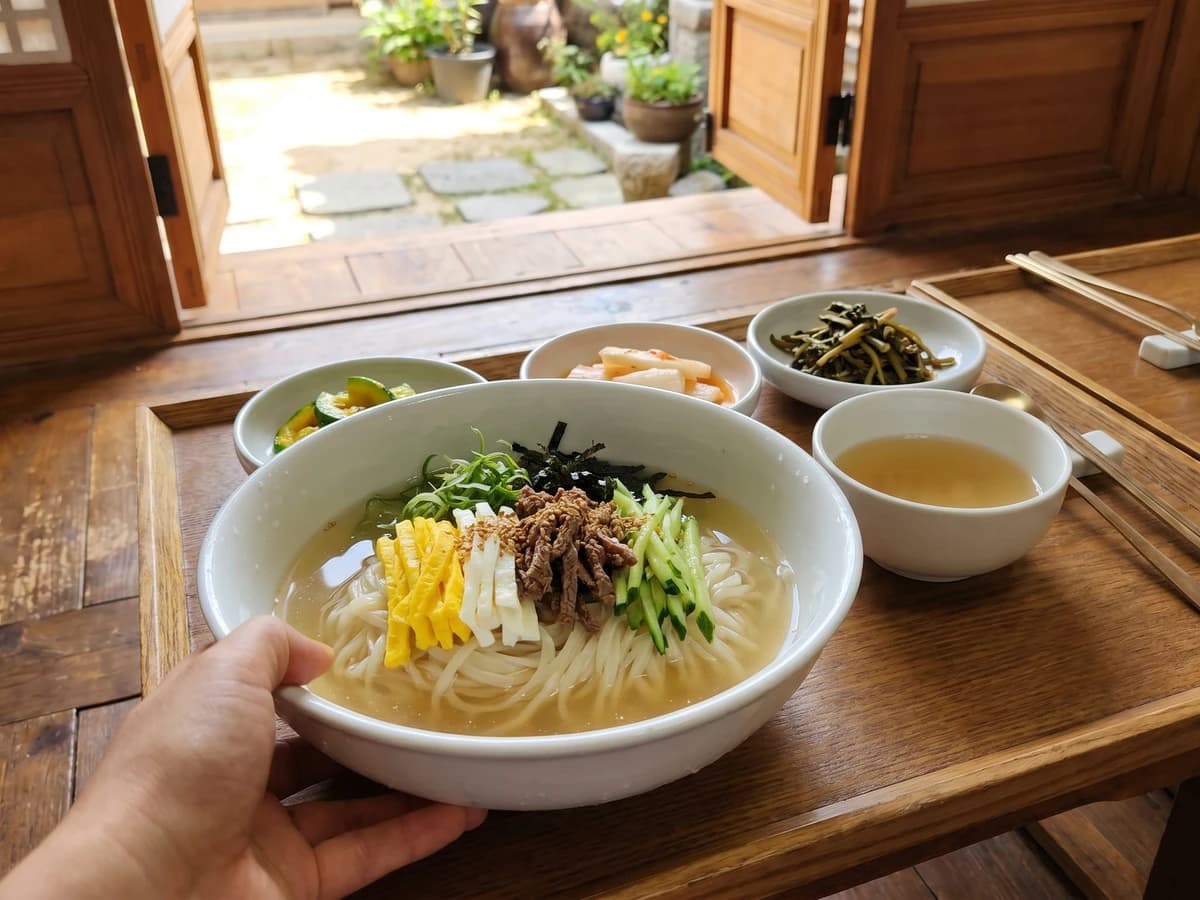
Andong's guest noodles, wheat and roasted soybean flour rolled thin, boiled and rinsed cold, then set in a clear chilled anchovy broth with careful strips of beef, egg, and cucumber.

Chef Jeong-sun
Andong's ritual-table rice served on an ordinary day: separate soy-sesame namul, warm rice, and clear radish soup, mixed without gochujang so every vegetable keeps its own voice.