
Chef Jeong-sun
Aehobak-bokkeum (Korean Stir-Fried Zucchini)
Tender Korean zucchini half-moons cooked quickly over real heat, seasoned with salted shrimp so the squash tastes deeper than oil and still clean enough for a weeknight table.
A cooking platform built around craft, culture, and the stories behind what we eat.
Created by
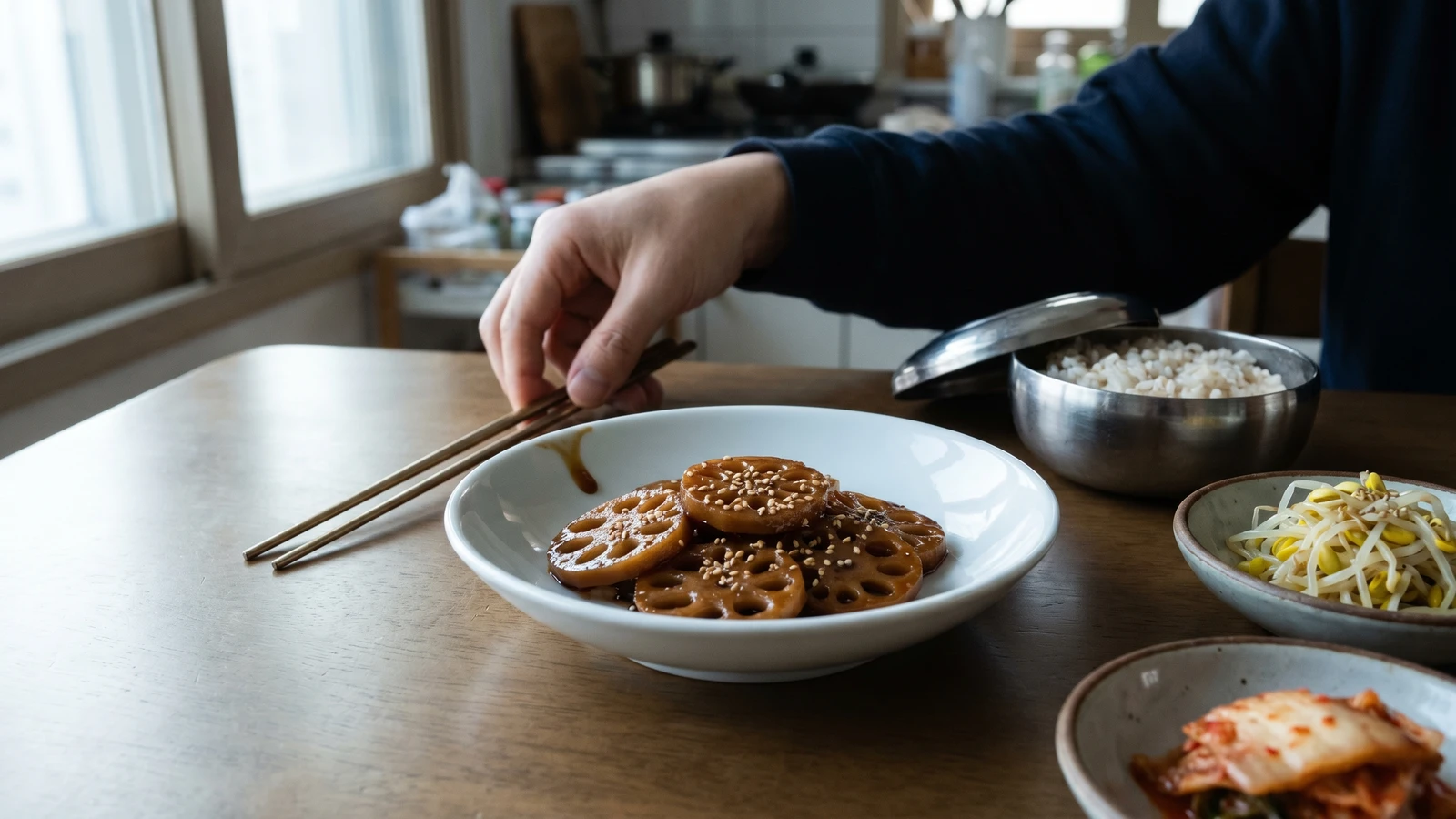
A make-ahead banchan of sliced lotus root kept pale with vinegar, simmered in soy until glossy, crisp under the teeth and sweet only enough to round the salt.
Lotus root comes into the market looking plain, mud still caught in its joints, and then the knife opens it into little wheels with seven or nine clean holes. That is the first lesson of yeongeun-jorim (soy-braised lotus root): don't rush the cutting. Even slices cook evenly, stay crisp, and take the glaze without collapsing.
This is mit-banchan (a stored side dish), the kind you make once and pull from the refrigerator for several meals. It asks for patience, not difficulty. A little vinegar in the first boil keeps the lotus root pale and tightens its bite. Then the soy braise reduces slowly until it shines. If you pour in too much syrup too early, you get candy. If you stop too soon, you get wet lotus root sitting in sauce. Neither one is the dish.
My teacher, Master Seong-nyeo, made us count the slices before they went into the pan, not because she loved arithmetic, though she did, but because size and quantity decide the seasoning. Notebook 18 says 400 grams lotus root, 3 tablespoons soy sauce, 2 tablespoons rice syrup. That amount coats without burying the root. Let it taste like itself.
Yeongeun-jorim belongs to Korea's mit-banchan tradition, side dishes seasoned strongly enough to keep for several meals before daily refrigeration became ordinary. Lotus root has long been tied to Buddhist temple ponds and cooking in Korea, but this soy-braised home version is an everyday table dish rather than a palace dish. Its season is late autumn into winter, when lotus roots are harvested from muddy fields and sold firm, pale, and heavy at the market.
Quantity
400g
peeled and sliced 1/4 inch thick
Quantity
4 cups
for soaking
Quantity
1 tablespoon
for soaking
Quantity
4 cups
for parboiling
Quantity
1 tablespoon
for parboiling
Quantity
1 teaspoon
Quantity
3 tablespoons
Quantity
2 tablespoons
Quantity
1 tablespoon
Quantity
1 tablespoon
Quantity
1 cup
for braising
Quantity
1 teaspoon
Quantity
1 teaspoon
| Ingredient | Quantity |
|---|---|
| fresh lotus root (yeongeun)peeled and sliced 1/4 inch thick | 400g |
| waterfor soaking | 4 cups |
| rice vinegarfor soaking | 1 tablespoon |
| waterfor parboiling | 4 cups |
| rice vinegarfor parboiling | 1 tablespoon |
| neutral oil | 1 teaspoon |
| soy sauce | 3 tablespoons |
| rice syrup (ssal-jocheong) or corn syrup | 2 tablespoons |
| sugar | 1 tablespoon |
| mirin or rice wine | 1 tablespoon |
| waterfor braising | 1 cup |
| toasted sesame oil | 1 teaspoon |
| toasted sesame seeds | 1 teaspoon |
Peel the lotus root and slice it into even 1/4 inch rounds. Put the slices straight into 4 cups water mixed with 1 tablespoon rice vinegar while you work. Lotus root darkens quickly once cut, and the vinegar water keeps the color clear without making it sour.
Bring 4 cups fresh water and 1 tablespoon rice vinegar to a boil. Drain the soaked lotus root, add it to the boiling water, and cook 5 minutes. Drain well. This step removes raw bitterness, sets the pale color, and keeps the bite crisp through the braise.
Heat a wide skillet or shallow pot over medium heat and add 1 teaspoon neutral oil. Add the drained lotus root and stir 1 minute, just until the surfaces look lightly glossy. Add the soy sauce, sugar, mirin, and 1 cup water. Keep the rice syrup out for now so it does not scorch before the root is seasoned through.
Bring the pan to a steady simmer, then lower the heat to medium-low and cook 18 to 22 minutes, turning the slices now and then. The liquid should reduce by more than half, and the lotus root should be tan at the edges but still crisp when you bite a slice. Taste one before adding sweetness. The soy has to enter first.
Add the rice syrup and keep simmering 5 to 7 minutes, stirring often, until the sauce thickens and clings in a thin shiny coat. Stop while a spoonful of sauce still moves slowly across the pan. If you cook it until dry, the glaze turns hard as it cools.
Turn off the heat and stir in the sesame oil and toasted sesame seeds. Let the lotus root cool in the pan for 10 minutes so the glaze settles. Serve at room temperature or chilled as banchan with rice. Write it down. Memory is a borrowed bowl, and this is exactly the kind of small dish people forget to measure.
1 serving (about 95g)
Culinary guides, cultural storytelling, and the editorial depth that makes cooking meaningful.
Discover Culinary ExplorerChef Jeong-sun
Tender Korean zucchini half-moons cooked quickly over real heat, seasoned with salted shrimp so the squash tastes deeper than oil and still clean enough for a weeknight table.

Chef Jeong-sun
Tender Korean summer zucchini softened gently in the pan with saeujeot for salt and depth, finished with sesame so the vegetable stays sweet, green, and plainly itself.

Chef Jeong-sun
A bittersweet spring green from the southern shore, blanched just until pliant, then seasoned lightly so its clean coastal bitterness stays alive on the rice table.

Chef Jeong-sun
Torn king oyster or shiitake mushrooms, browned until their own water disappears, then finished with soy, garlic, sesame oil, and onion for a quiet banchan that earns its place.