
Chef Dimitra
Agrafa Batzina (Μπατζίνα), Courgette and Feta Pie
Agrafa's batzina is the no-phyllo pie of Karditsa: grated courgette, feta, eggs, milk, and flour poured thin into a hot oiled tapsi.
A cooking platform built around craft, culture, and the stories behind what we eat.
Created by
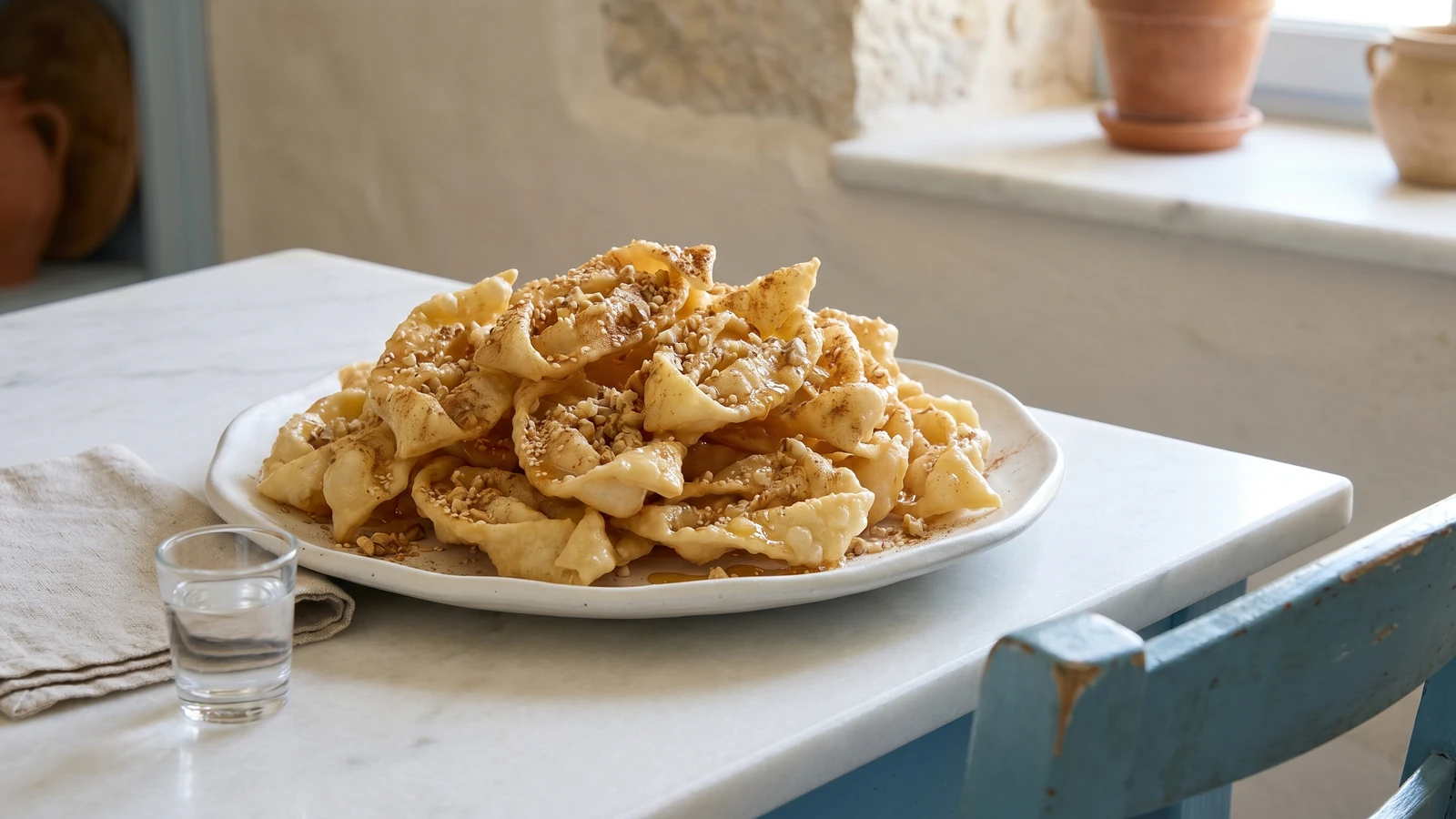
Xerotigana Kritis are Crete's celebration spirals: eggless ribbons of dough fried crisp, dipped in thyme-honey syrup, and scattered with sesame, walnuts, and cinnamon.
Xerotigana Kritis are Crete's wedding pastry, thin ribbons of eggless dough coiled in hot oil until pale gold and crisp, then dipped in honey syrup and dressed with sesame, walnuts, and cinnamon. They are not doughnuts, not biscuits, and not the mainland's diples. The region is the dish's surname.
The whole pastry depends on thinness. Roll the dough until you can almost see the work surface through it, then cut long ribbons and coil them as they fry. Too thick, and the center turns bready before the outside crisps. Thin enough, and each spiral drinks the honey while keeping its dry crackle under your teeth.
I like them made with tsikoudia, the Cretan grape spirit, because it keeps the dough lean and fragrant without making it sweet. The sweetness belongs to the honey afterward. Make them patiently, one or two at a time, and don't crowd the pot. This is celebration food, but a home cook can do it with a rolling pin, a fork, and a little nerve.
Xerotigana belong especially to western and central Crete, where they are made for weddings, baptisms, Christmas, and large family feasts. Their name means roughly dry-fried, a clue to their texture: a lean dough fried crisp before honey is added. Unlike egg-rich diples in parts of the Peloponnese, the Cretan version is commonly eggless and scented with tsikoudia, linking the pastry to the island's grape-harvest distilling tradition.
Quantity
500g
plus extra for rolling
Quantity
1/2 tsp
Quantity
80ml
Quantity
120ml
Quantity
120ml
Quantity
1 tbsp
Quantity
1 tsp
finely grated
Quantity
1.5 litres
Quantity
350g
Quantity
180g
Quantity
180ml
Quantity
1
Quantity
1 strip
Quantity
1 tbsp
Quantity
70g
finely chopped
Quantity
35g
lightly toasted
Quantity
1 tsp
| Ingredient | Quantity |
|---|---|
| all-purpose flourplus extra for rolling | 500g |
| fine sea salt | 1/2 tsp |
| extra virgin olive oil | 80ml |
| tsikoudia or raki | 120ml |
| fresh orange juice | 120ml |
| lemon juice | 1 tbsp |
| orange zestfinely grated | 1 tsp |
| olive oil or light olive oil, for frying | 1.5 litres |
| Greek thyme honey | 350g |
| sugar | 180g |
| water | 180ml |
| cinnamon stick | 1 |
| orange peel | 1 strip |
| lemon juice, for the syrup | 1 tbsp |
| walnutsfinely chopped | 70g |
| sesame seedslightly toasted | 35g |
| ground cinnamon | 1 tsp |
Put the flour and salt in a wide bowl. Make a well and add the olive oil, tsikoudia, orange juice, lemon juice, and orange zest. Mix with your hand until shaggy, then knead for 6 to 8 minutes, until the dough is smooth, firm, and no longer sticky. It should feel like pasta dough, not bread dough.
Cover the dough and let it rest at room temperature for 30 minutes. This little rest matters. It relaxes the dough so you can roll it thin without it snapping back like a stubborn strap.
While the dough rests, put the honey, sugar, water, cinnamon stick, and orange peel in a small saucepan. Bring to a gentle boil, lower the heat, and simmer for 5 minutes. Stir in the lemon juice, remove from the heat, and keep the syrup warm, not boiling. Remove the cinnamon and orange peel before dipping.
Divide the dough into 4 pieces and keep the pieces covered. Roll one piece at a time on a lightly floured surface into a very thin sheet, about 1mm thick. You should almost see the table through it. This is the step that decides the pastry: thick dough fries heavy, thin dough crisps cleanly and holds the honey without going soft.
Cut the sheet into long ribbons about 3cm wide and 35 to 45cm long, using a fluted pastry wheel if you have one. Cover the cut ribbons with a clean towel while you roll and cut the rest, so they don't dry into brittle strips before frying.
Heat the frying oil in a deep, wide pot to 170C. Slide one ribbon into the oil, catch one end between the tines of a long fork, and turn the fork slowly so the ribbon wraps into a loose spiral. Hold it in place for a few seconds, then let it fry until pale gold and crisp, 45 to 70 seconds. Turn once if needed, lift out carefully, and drain on a rack. Repeat with the remaining ribbons, one or two at a time.
When all the xerotigana are fried, dip them one at a time into the warm syrup for 8 to 10 seconds, turning gently so the folds are coated. Lift with a slotted spoon and let the extra syrup drip back into the pan. They should glisten, not sit in a puddle.
Arrange the xerotigana on a large platter. Mix the walnuts, sesame, and ground cinnamon, then scatter the mixture over the sticky spirals while the syrup is still tacky. Let them stand for at least 20 minutes before serving, so the honey settles into the folds.
1 serving (about 55g)
Culinary guides, cultural storytelling, and the editorial depth that makes cooking meaningful.
Discover Culinary ExplorerChef Dimitra
Agrafa's batzina is the no-phyllo pie of Karditsa: grated courgette, feta, eggs, milk, and flour poured thin into a hot oiled tapsi.

Chef Dimitra
Zagori's flour pie skips phyllo completely: a loose egg-and-flour batter, crumbled feta, and a hot buttered tapsi that makes the edges crisp.

Chef Dimitra
Hydra and Andros give amygdalota their island surname: ground almond, sugar, egg white, and rosewater, baked pale so the center stays soft as marzipan.

Chef Dimitra
Asia Minor ekmek kataifi is built in three clear layers: crisp syruped kataifi, thick semolina custard, and cold kaimaki cream under pistachios.