Culinary Explorer

A cooking platform built around craft, culture, and the stories behind what we eat.
Discover Culinary Explorer
Wiener Erdäpfelsalat

Wiener Erdäpfelsalat

Created by

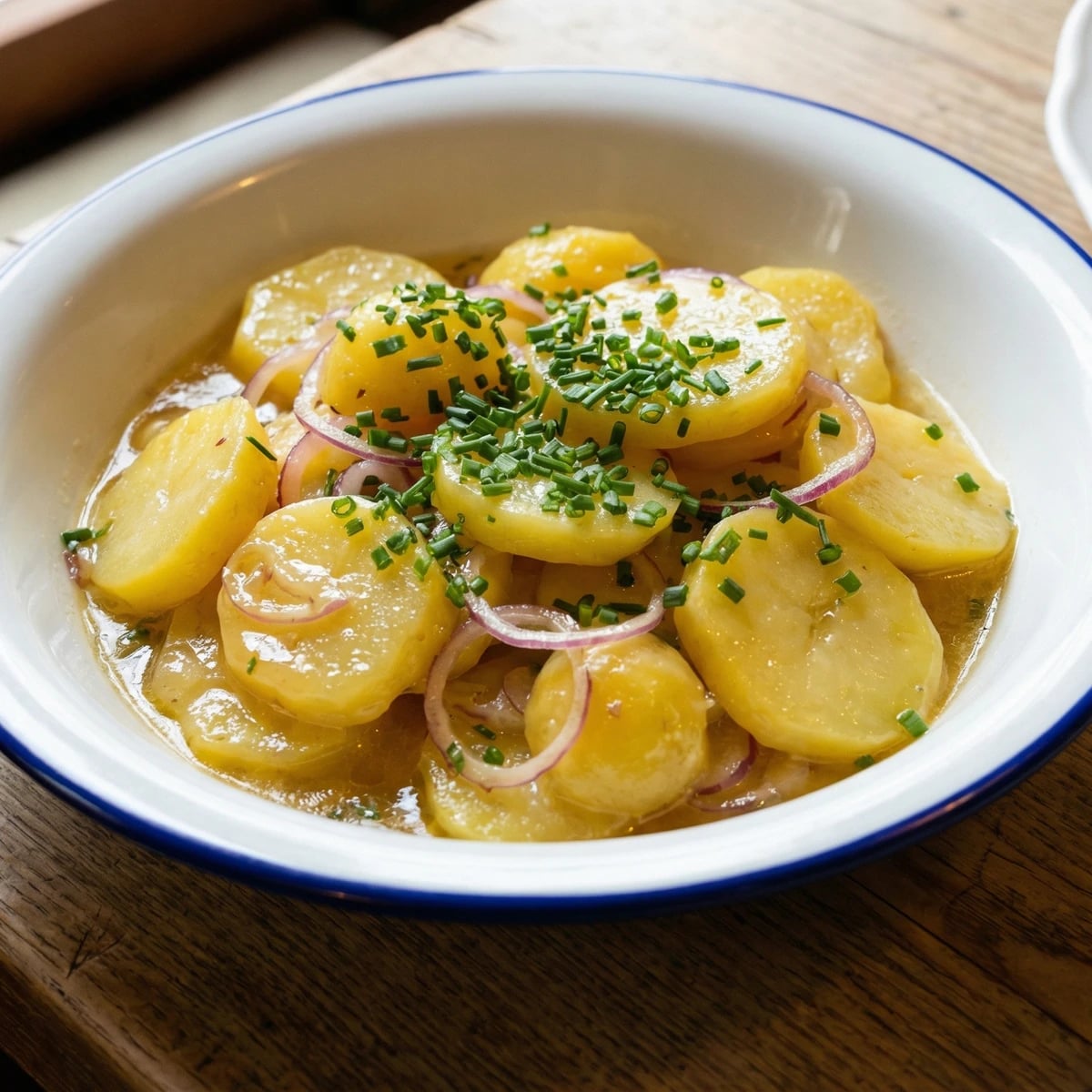
Warm Viennese potato salad dressed with hot beef broth and sharp wine vinegar, the side dish every Austrian Gasthaus puts next to Wiener Schnitzel and the quiet test of whether a cook understands Austrian food.

Salads
Austrian
Weeknight
Comfort Food
15 min
Active Time
25 min cook1 hr 10 min total
Yield4 servings

Gretel always said you can judge an Austrian cook by their Erdäpfelsalat. Not by their Torte, not by their Schnitzel. By their potato salad. Because there's nowhere to hide. Five ingredients, no cream, no mayonnaise, nothing between you and the question of whether you understand how to dress a warm potato properly.

I watched Gretel make this in my grandmother Eva's kitchen more times than I can count. She'd boil the potatoes in their skins, peel them while they were still almost too hot to handle, and slice them straight into a bowl. Then the hot beef broth went over. Not warm broth, not room temperature. Hot. The potatoes have to be warm and the broth has to be hot, because that's when the starch on the cut surface is open and ready to absorb. It drinks the broth right in. If you let everything cool down first, the liquid just pools around the outside and you end up with soggy coins sitting in a puddle. The whole dish depends on this one moment of timing.

The dressing is vinegar, mustard, a little oil, and finely sliced red onion. You season it, you toss it gently so the slices don't break, and you leave it alone for half an hour. When you come back, the salad has transformed. The broth is gone, absorbed into every slice. The vinegar has sharpened everything. The onion has softened just enough. It glistens. It smells like a Beisl kitchen at noon.

This is what goes next to Wiener Schnitzel. Not chips, not rice, not a green salad. Erdäpfelsalat, slightly warm, vinegar-forward, rich with beef broth underneath. The acidity cuts through the butter and the breading, and the soft potato balances the crunch. Austrians have known this for generations, and once you've had it right, you'll understand why they refuse to eat Schnitzel with anything else.

Erdäpfel is the Austrian word for potato, literally 'earth apple,' a calque from the French pomme de terre. While German speakers say Kartoffel, Austrians have used Erdapfel since the tuber arrived in Habsburg lands in the late 16th century. The broth-dressed potato salad became a fixture of Viennese Beisl cooking in the 19th century, when beef bones simmered all morning for Tafelspitz and Rindssuppe produced broth in abundance. Thrifty Viennese cooks used that broth to give body to their potato salad, creating something entirely different from the mayonnaise-dressed versions common in Germany and the United States.

The technique, the tradition, and the story behind every dish.

Discover Culinary Explorer

Ingredients

festkochende (waxy) potatoes

Quantity

750g

such as Kipfler, Charlotte, or Annabelle

good beef broth (Rindsuppe)

Quantity

200ml

hot

white wine vinegar or Hesperidenessig

Quantity

3 tablespoons

smooth mustard (Estragonsenf or Dijon)

Quantity

1 level teaspoon

sunflower oil or mild rapeseed oil

Quantity

3 tablespoons

red onion

Quantity

1 small

finely sliced into thin rings

sugar (optional)

Quantity

1 pinch

salt

Quantity

to taste

freshly ground black pepper

Quantity

to taste

fresh chives

Quantity

for serving

finely cut

Equipment Needed

  • Large pot for boiling potatoes
  • Small saucepan for heating broth
  • Sharp knife for slicing
  • Wide, shallow serving bowl

Instructions

  1. 1

    Boil the potatoes

    Place the potatoes, whole and unpeeled, in a large pot. Cover with cold water and add a generous pinch of salt. Bring to a boil, then reduce to a steady simmer. Cook until a knife slides into the center with just a little resistance, about twenty to twenty-five minutes depending on size. You want them tender but holding their shape. Overcooked potatoes fall apart when you slice them and you'll end up with mash instead of salad. Drain and let them sit just long enough that you can handle them, two or three minutes, no more.

    Festkochende means 'firm-cooking' in Austrian. These are waxy potatoes with low starch that hold their shape when sliced. If you can't find Kipfler or Charlotte, use any waxy variety. Floury potatoes like Russets will dissolve on you. This is not negotiable.
  2. 2

    Prepare the dressing

    While the potatoes cook, heat the beef broth until it's properly hot. Not simmering, not boiling, just very hot. In a small bowl, whisk together the vinegar, mustard, oil, sugar, and a good grinding of black pepper. Slice the red onion into the thinnest rings you can manage. Set everything within arm's reach. When the potatoes are ready, you need to move quickly.

    Hesperidenessig is a Viennese citrus vinegar with a bright, clean acidity that's ideal for Erdäpfelsalat. If you can't find it, a good white wine vinegar or Austrian Apfelessig (apple cider vinegar) works well. What you want is sharpness without harshness.
  3. 3

    Peel and slice while hot

    Hold each potato in a clean tea towel and peel off the skin with a small knife. It should slip away easily when the potato is still hot. Slice into rounds about three to four millimeters thick, letting them fall directly into a wide, shallow bowl. Work quickly. The potatoes must be warm when the broth hits them. This is the moment that makes or breaks the salad. Warm starch absorbs liquid. Cold starch repels it. If your potatoes cool down before you dress them, the broth will sit on the surface instead of soaking in, and no amount of stirring will fix it.

    If your potatoes are different sizes, start slicing the smallest ones first and keep the larger ones in the warm pot with the lid on. They'll hold their heat while you work.
  4. 4

    Dress with hot broth

    Pour the hot beef broth evenly over the sliced potatoes. Don't stir. Tilt the bowl gently a few times so the broth reaches every slice, then leave it alone. Let the potatoes sit for ten minutes. When you come back, most of the broth will be gone, absorbed into the warm starch. The slices will look plump and glossy. This is exactly what you want.

  5. 5

    Add the vinaigrette and onion

    Pour the vinegar-mustard dressing over the potatoes. Scatter the sliced red onion across the top. Season generously with salt. Now toss, but gently. Use a wide spatula or your hands, lifting from the bottom and folding over. You're coating the slices, not breaking them. Two or three folds is enough. If you see crumbling, stop. The salad should look like intact, glistening rounds dressed in a thin, glossy coating, not a bowl of broken potato pieces.

    Gretel always said the Marinade should be vinegar-forward, not oily. If it tastes flat, it needs more vinegar or more salt, not more oil. The broth provides the richness. The vinegar provides the life.
  6. 6

    Rest and serve

    Cover the bowl loosely and let the salad rest at room temperature for thirty minutes. Don't refrigerate it. Cold kills this salad. After thirty minutes, taste and adjust. It almost always needs more salt than you think. The vinegar should be bright and present but not aggressive. Add a splash more if it tastes muted. Scatter the chives across the top and serve slightly warm or at room temperature. This is how every Gasthaus in Austria serves it, and there's a reason they haven't changed. Mahlzeit!

Chef Tips

  • Use homemade beef broth if you have it. The broth is doing real work here, not just adding moisture but giving the potatoes a savory depth that carries the whole dish. If you're using store-bought, taste it first. If it's salty, use less salt in the dressing.
  • Never refrigerate Erdäpfelsalat if you can avoid it. Cold firms up the starch and dulls the vinegar. Make it the day you serve it and keep it at room temperature. If you must make it ahead, bring it back to room temperature and add a splash of fresh vinegar and a little warm broth to wake it up.
  • The red onion should be sliced thin enough that you can almost see through the rings. Thick onion chunks taste raw and aggressive. Paper-thin rings soften in the warm dressing and become sweet and mild within thirty minutes.
  • At my restaurant in Salzburg, this goes next to every Wiener Schnitzel we serve. When I see customers order the Schnitzel with a side of chips instead, I send the Erdäpfelsalat anyway. They always understand once they've tried it.

Advance Preparation

  • The beef broth can be made days ahead and refrigerated or frozen. Homemade Rindsuppe makes a noticeable difference here.
  • Erdäpfelsalat is best made fresh and served within two hours. If you must prepare ahead, dress the salad and leave it covered at room temperature for up to three hours. Add the chives just before serving.
  • Do not make this the day before. Overnight refrigeration changes the texture and flattens the vinegar. If you're cooking Schnitzel for guests, time the potatoes to finish thirty minutes before you start frying.

Frequently Asked Questions

Nutrition Information

1 serving (about 235g)

Calories
255 calories
Total Fat
11 g
Saturated Fat
1 g
Trans Fat
0 g
Unsaturated Fat
10 g
Cholesterol
1 mg
Sodium
490 mg
Total Carbohydrates
34 g
Dietary Fiber
3 g
Sugars
3 g
Protein
5 g

Note: Chef personas and recipes are created with AI assistance. Cook with care: follow safe food-handling practices, check doneness with a thermometer when needed, and adapt for allergies and your kitchen.

Where cooking meets culture.

Culinary guides, cultural storytelling, and the editorial depth that makes cooking meaningful.

Discover Culinary Explorer

More from Austrian Salads

Browse the full collection