Culinary Explorer
A cooking platform built around craft, culture, and the stories behind what we eat.
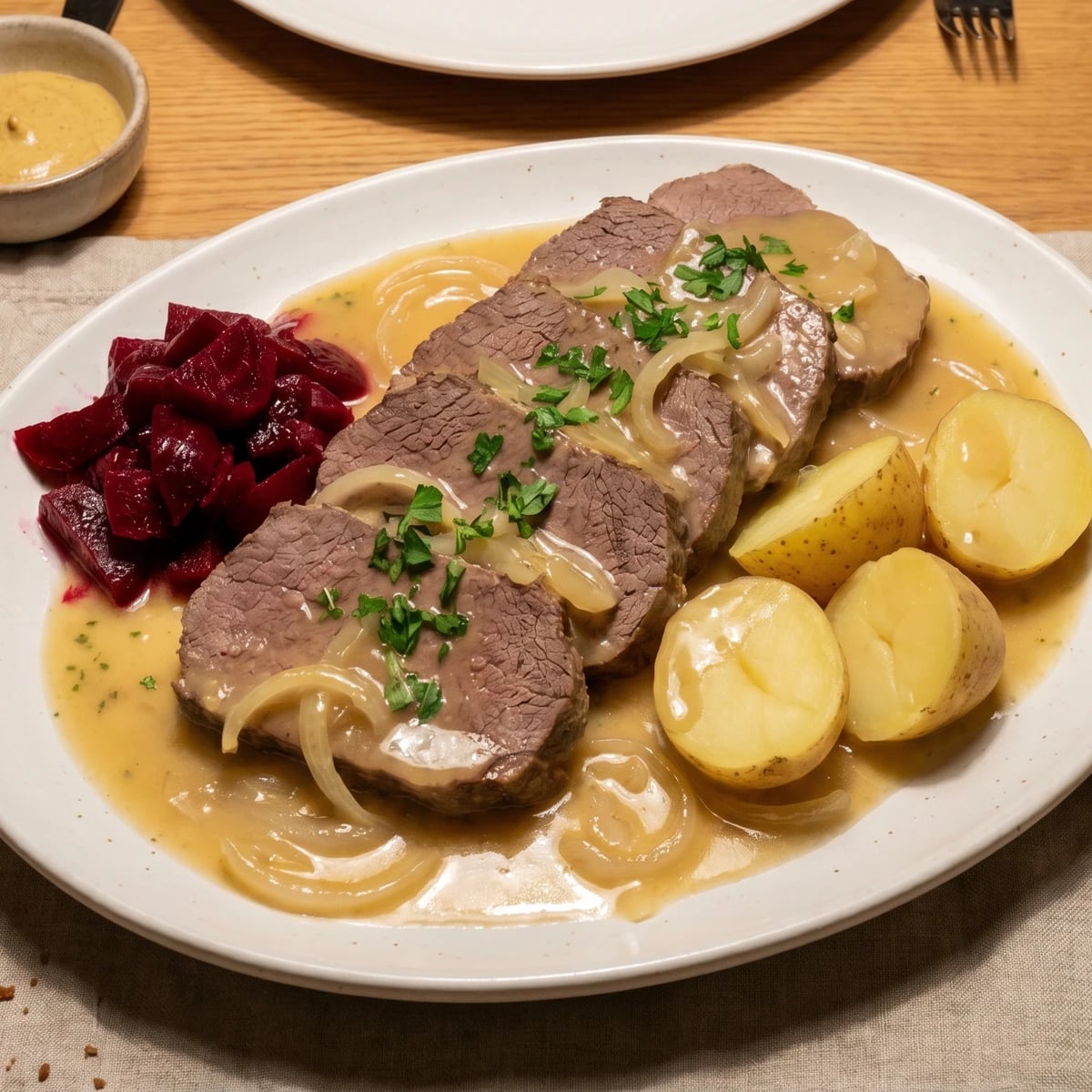
Westfälisches Zwiebelfleisch
Created by Chef Klaus
The Münsterland wedding course lives in the sauce: tender Tafelspitz sliced across the grain, pale onions cooked sweet, then mustard and vinegar sharpened at the end.
Westfälisches Zwiebelfleisch belongs to the Münsterland wedding table before it belongs to the weeknight table. A piece of Tafelspitz, the rump cap, or a good brisket is cooked tender in its own broth, sliced, and covered with a pale sweet-sour onion sauce. The beef is generous, but the sauce is the point. At a wedding it follows the clear soup; at home it sits well beside boiled potatoes and pickled beet on a Sunday.
Im Norden anders, im Süden anders. Westphalia sharpens the onions with mustard, vinegar, and a little sugar; farther south the same boiled beef is more likely to meet horseradish or chive sauce, and the Rhineland takes sweet-sour into darker gravies and raisins. This is not that. Das ist kein Bierzelt, and it is not Sauerbraten. Keep the onions pale, and let the broth speak.
The technique is quiet heat. Let the meat barely tremble in the pot and sweat the onions without browning, because hard boiling squeezes the beef dry and browned onions drag the sauce into roast gravy. You want a clear stock with body, pale onion sweetness, and vinegar that wakes it up at the end. Nicht aus dem Glas. The sauce comes from the cooking liquor, the bones, and the onions you've taken the time to cook.
Watch the spoon at the stove. If the sauce tastes flat, it wants salt; if it tastes heavy, it wants vinegar; if it tastes sharp alone, it wants a little sugar and another minute. Würzen, Fett, Salz zum Schluss. Learn that balance and you can make this with no card in front of you.
Ingredients
beef Tafelspitz (rump cap) or brisket
Quantity
1.4kg
in one piece
beef marrow bones or soup bones (optional)
Quantity
500g
carrots
Quantity
2
cut into chunks
| Ingredient | Quantity |
|---|---|
| beef Tafelspitz (rump cap) or brisketin one piece | 1.4kg |
| beef marrow bones or soup bones (optional) | 500g |
| carrotscut into chunks | 2 |
Where cooking meets culture.
Culinary guides, cultural storytelling, and the editorial depth that makes cooking meaningful.
Discover Culinary Explorer