
Chef Klaus
Badische Dinnele
The Baden flatbread that keeps its bread body: sour cream, onion, and Speck on a yeast dough baked hard and hot until the edges blister.
A cooking platform built around craft, culture, and the stories behind what we eat.
Created by
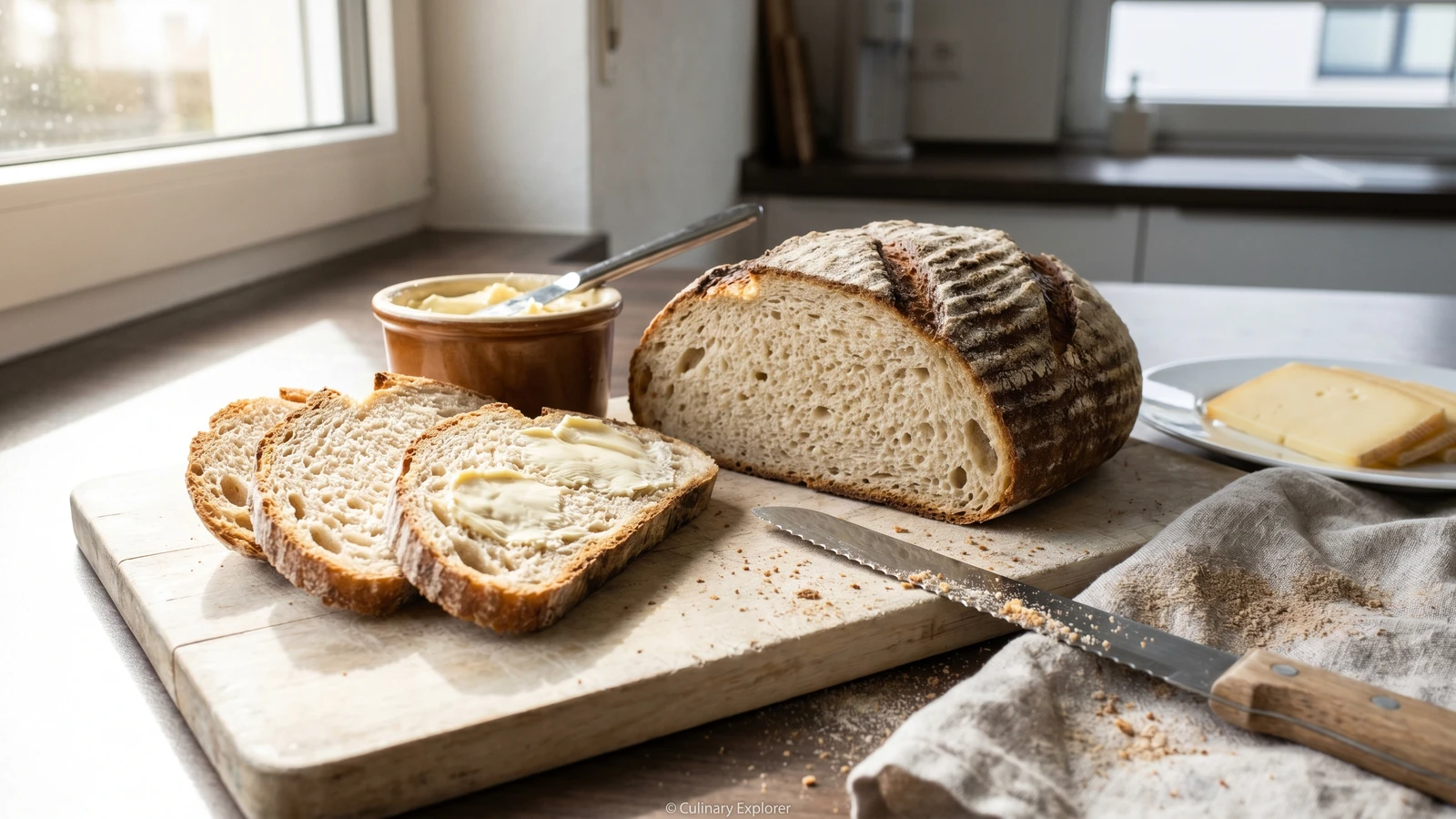
The wheat-leaning mixed loaf of the German bread board: lighter than rye Mischbrot, sour enough to stand up to cheese, ham, butter, and tomorrow's supper.
Weizenmischbrot is weekday bread, the loaf that sits under butter and jam in the morning, cheese at supper, and cold roast on Sunday night. More than half the flour is wheat, so the crumb stays lighter and milder; the rye is there for backbone, keeping quality, and the quiet sour note that makes German bread taste like bread, not cake.
The best-known one is Kasseler, from the Hesse and northern-central bread table, often baked as a round or long loaf with a strong crust and a soft, wheat-led crumb. Im Norden anders, im Süden anders: the north pushes darker and rye-heavy, the south often likes the loaf lighter and softer. This one stays in the middle, where a mixed bread earns its name.
The technique that decides it is not kneading harder. It is building a rye sourdough and giving it time before the wheat dough comes together. Rye needs acid so its starches hold in the oven instead of turning gummy; wheat brings the gluten and the lift. Rush the sour and you've made a pale loaf with rye flour in it. Give it the night. Das braucht seine Zeit.
Watch the dough, not the clock. It should feel tacky, not dry, and it should rise until it looks alive but not exhausted. Bake it hot at the start, then runter mit der Temperatur, down with the temperature, so the crust sets first and the middle has time to finish. Erst verstehen, dann kochen.
German bread classifications distinguish Mischbrot by flour balance: Weizenmischbrot contains more wheat than rye, Roggenmischbrot contains more rye than wheat, and both belong to a baking culture shaped by regional grain growing rather than one national loaf. Kasseler Brot became the best-known Weizenmischbrot style around Kassel in Hesse, where central German bakers worked between the darker rye traditions of the north and the lighter wheat breads of the south. The sourdough is not decoration; before modern improvers, acidity was the practical way to make rye bake cleanly and keep well.
Quantity
150g
100% hydration
Quantity
150g
Quantity
150g
lukewarm
Quantity
450g
Quantity
100g
Quantity
230g
lukewarm
Quantity
12g
Quantity
5g fresh / 2g instant
Quantity
1 teaspoon
Quantity
as needed
for dusting
| Ingredient | Quantity |
|---|---|
| active rye sourdough starter100% hydration | 150g |
| wholegrain rye flour | 150g |
| water for sourdoughlukewarm | 150g |
| strong white bread flour | 450g |
| medium rye flour | 100g |
| water for final doughlukewarm | 230g |
| fine sea salt | 12g |
| fresh yeast or instant yeast | 5g fresh / 2g instant |
| malt syrup or honey (optional) | 1 teaspoon |
| rye flourfor dusting | as needed |
Mix the rye starter, wholegrain rye flour, and 150g lukewarm water until no dry flour remains. Cover it and leave it at cool room temperature for 10 to 12 hours, until it smells cleanly sour and looks swollen. Rye needs that acid to bake properly; without it, the starch weakens in the oven and the crumb turns sticky.
Put the ripe sourdough into a bowl with the bread flour, medium rye flour, 230g lukewarm water, yeast, salt, and malt syrup if using. Mix until the dough comes together rough and tacky. Do not chase a dry dough with extra flour; rye keeps drinking water as it rests, and a stiff dough bakes into a tight loaf.
Knead by hand for 8 to 10 minutes, or 5 to 6 minutes on low speed, until the wheat flour has built enough strength to stretch and the dough starts to smooth out. It will never feel like a pure white loaf, because rye cuts the gluten short. Cover it and rest for 60 to 75 minutes, until risen by about half.
Turn the dough onto a lightly floured board, flatten it gently, and shape it into a tight round or long loaf. Keep the seam firm because tension on the outside gives the bread height; a loose shape spreads before it can lift. Set it seam side up in a floured proofing basket, or seam side down on baking paper.
Proof for 45 to 60 minutes, until the loaf looks puffed and a fingertip pressed into the side leaves a slow mark. If the mark springs back at once, it needs time; if it collapses, you waited too long. Heat the oven to 240C with a baking stone or heavy tray inside, and score the top with one long cut so the loaf opens where you choose.
Slide the loaf onto the hot stone or tray and bake at 240C for 10 minutes, then lower to 210C and bake 30 to 35 minutes more. The hard heat at the start sets the crust and gives lift; the lower heat finishes the middle without burning the shell. The loaf is done when it is deep brown, sounds hollow underneath, and the centre reads about 96C.
Cool the bread on a rack for at least 2 hours before slicing. Hot mixed bread still has moisture moving through the crumb; cut too early and the knife drags it into paste. Weggeworfen wird nichts: stale slices become breadcrumbs, bread soup, or a pan of poor knights, Arme Ritter, the German answer to leftover bread.
1 serving (about 75g)
Culinary guides, cultural storytelling, and the editorial depth that makes cooking meaningful.
Discover Culinary ExplorerChef Klaus
The Baden flatbread that keeps its bread body: sour cream, onion, and Speck on a yeast dough baked hard and hot until the edges blister.

Chef Klaus
The farmhouse loaf that made sense of a weekly oven firing: rye for keeping, wheat for lift, sourdough for the crumb, and a dark crust that earns its crack.

Chef Klaus
The Bavarian pretzel lives by its lye bath: a pale dough goes in, a dark glossy Breze comes out, with thin arms, a proud belly, and salt that bites clean.

Chef Klaus
A Bavarian wheat-rye loaf for the Brotzeit board, mild from ripe sourdough, dark-crusted from a fierce first heat, and firm enough to carry cold cuts without sagging.