
Chef Lupita
Aguascalientes Beef Tongue Pozole (Pozole de Lengua)
Aguascalientes' Bajio pozole de lengua, built with cacahuazintle hominy, tender beef tongue, chile ancho and guajillo, with xoconostle brightness and table garnishes.
A cooking platform built around craft, culture, and the stories behind what we eat.
Created by
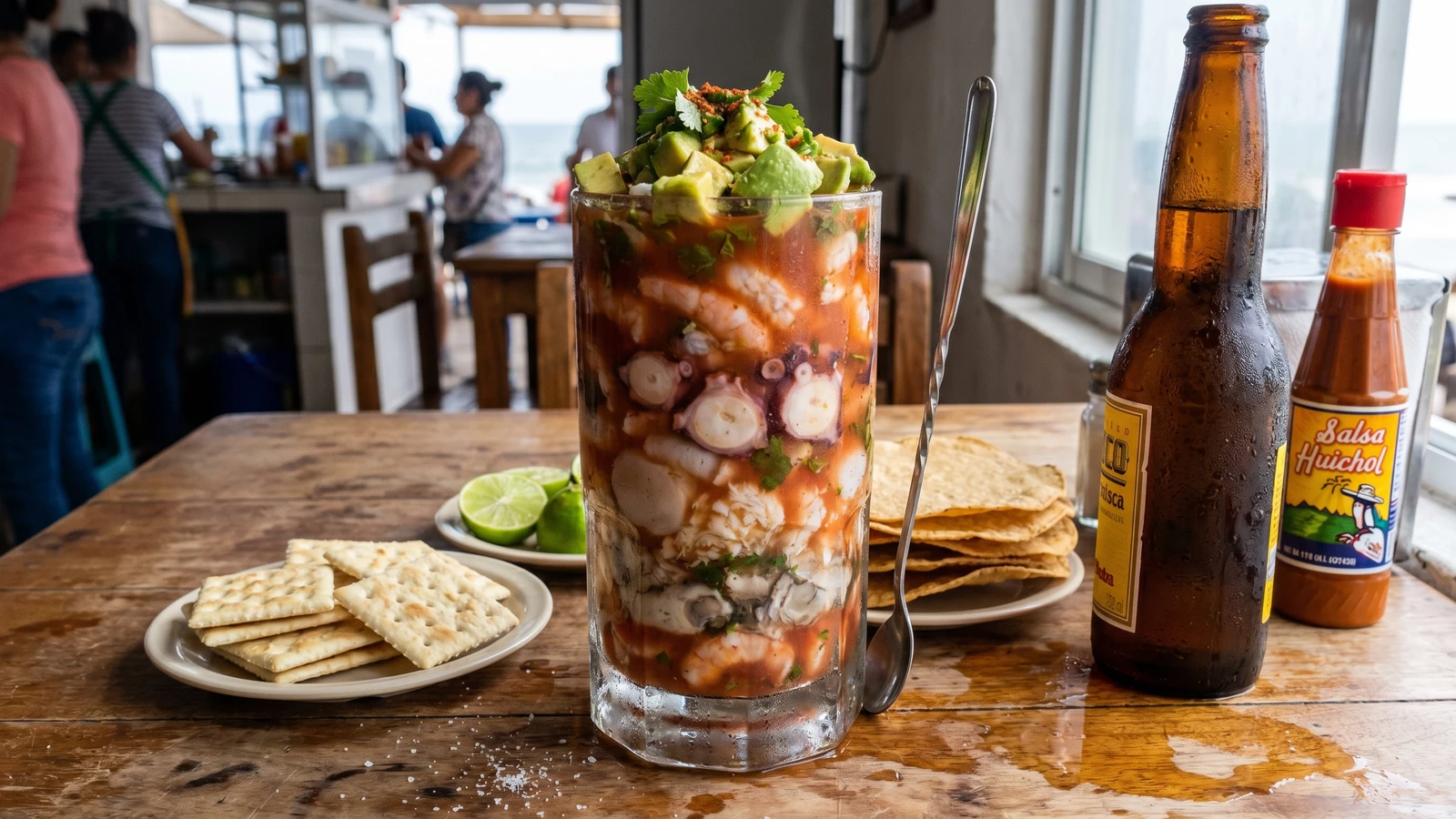
Mazatlan's chilled seafood cocktail of shrimp, octopus, oyster, and crab in a Clamato base sharpened with lime, Maggi, and Worcestershire. Served cold in a tall chabela, the cure for everything that ails you.
This is from Mazatlan. Specifically from the malecon and the marisquerias along the Sinaloa coast where the boats come in early and the cocteleros are working by ten in the morning. The name tells you everything: vuelve a la vida. Come back to life. The dish was built for the morning after, the long lunch in the heat, the moment when only something cold, sour, and full of seafood will fix you.
The base is Clamato, ketchup, lime, Maggi, Worcestershire, and a few drops of Salsa Huichol. Do not call it ceviche and do not call it cocktail sauce. It is its own thing. The Maggi and the Worcestershire are not garnishes. They are structural. They give the base the salty-savory weight that holds up to four or five different kinds of seafood in the same glass. Skip them and you have a thin, sweet tomato juice. Use them and you have what they serve at El Tunel and Mariscos El Toro and every honest marisqueria from Mazatlan to Topolobampo.
The seafood is layered, not blended. Octopus poached until the knife slides through. Shrimp poached for 90 seconds. Scallops for 60. Sierra cured in lime. Oysters and crab raw. Each one cooked to its own clock. Si no conoces el mercado, no conoces la cocina, and Sinaloa knows the mercado better than any state on the Pacific. Serve it in a tall chabela glass with saltines and a cold Pacifico on the side. That is the ritual. Saber cocinar es saber vivir.
Vuelve a la vida emerged in Mazatlan and Veracruz in the mid-20th century as a coctelero specialty, with each Gulf and Pacific port claiming its own version. The Sinaloa version is built on Clamato, the tomato-and-clam-juice blend introduced commercially in the 1960s, which the marisquerias adopted as the structural backbone of their cocteles within a decade of its arrival in Mexico. The dish's reputation as a hangover cure tracks back to the morning shrimp boats: cocteleros set up before dawn to feed the dock workers and the night-shift fishermen coming off the water, and the cold, salty, citrus-heavy preparation became coastal folk medicine codified into a menu item. The chabela glass, a tall flared tumbler, became the signature vessel because it lets the eater layer broth, seafood, and avocado in visible strata.
Quantity
1/2 pound
cleaned
Quantity
1/2 pound
peeled and deveined, tails on
Quantity
1/2 pound
cut in half if using sea scallops
Quantity
12
shucked, liquor reserved
Quantity
1/2 pound
picked over for shells
Quantity
1/2 pound
cut into 1/2-inch cubes
Quantity
1 medium
halved
Quantity
1
halved crosswise
Quantity
2
Quantity
1 tablespoon, plus more to taste
Quantity
1 cup (about 12 to 14 Mexican limes), divided
Quantity
3 cups
Quantity
1 cup
Quantity
3 tablespoons
Quantity
2 tablespoons
Quantity
1 tablespoon
Quantity
1
finely diced
Quantity
1
seeded and finely diced
Quantity
1
peeled, seeded, and finely diced
Quantity
1/2 cup, plus more for serving
chopped
Quantity
2
finely chopped
Quantity
2
diced
Quantity
for serving
Quantity
for serving
Quantity
for serving
Quantity
for serving
| Ingredient | Quantity |
|---|---|
| small octopuscleaned | 1/2 pound |
| medium raw shrimppeeled and deveined, tails on | 1/2 pound |
| bay scallops or sea scallopscut in half if using sea scallops | 1/2 pound |
| fresh oystersshucked, liquor reserved | 12 |
| lump crab meatpicked over for shells | 1/2 pound |
| fresh sierra or firm white fishcut into 1/2-inch cubes | 1/2 pound |
| white onionhalved | 1 medium |
| head of garlichalved crosswise | 1 |
| bay leaves | 2 |
| kosher salt | 1 tablespoon, plus more to taste |
| fresh lime juice | 1 cup (about 12 to 14 Mexican limes), divided |
| Clamato | 3 cups |
| ketchup | 1 cup |
| Maggi seasoning | 3 tablespoons |
| Worcestershire sauce | 2 tablespoons |
| Salsa Huichol or Tamazula | 1 tablespoon |
| small white onionfinely diced | 1 |
| large tomatoseeded and finely diced | 1 |
| cucumberpeeled, seeded, and finely diced | 1 |
| fresh cilantrochopped | 1/2 cup, plus more for serving |
| fresh chile serranofinely chopped | 2 |
| ripe avocadosdiced | 2 |
| saltine crackers (optional) | for serving |
| tostadas (optional) | for serving |
| lime halves (optional) | for serving |
| Salsa Huichol (optional) | for serving |
Bring a large pot of water to a boil with half the white onion, half the garlic head, the bay leaves, and a tablespoon of salt. Lower the octopus into the boiling water by the head three times, dipping and lifting, before letting it sink in completely. The Sinaloa cooks call this 'asustar al pulpo,' scaring the octopus, and it sets the skin so it does not slough off. Reduce to a simmer and cook for 35 to 45 minutes, until a knife slides into the thickest part of a tentacle without resistance. Cooking time varies with size. The octopus tells you when it is ready, not the clock.
Lift the octopus out of the broth and set it aside. Keep the broth at a low simmer. Drop the shrimp in for 90 seconds, just until they turn pink and curl. Lift them out with a slotted spoon. Drop the scallops in for 60 seconds, until barely opaque. Lift them out. Move both immediately to a bowl of ice water to stop the cooking. Overcooked shrimp turns rubbery and overcooked scallops turn into erasers. Watch them like you mean it.
Place the cubed sierra in a glass bowl and cover with half the lime juice. Stir to coat. Refrigerate for 15 minutes, until the fish turns opaque around the edges but is still translucent at the center. This is the only piece of seafood in the cocktail that is cured rather than cooked. The lime does the work.
In a large bowl, whisk together the Clamato, ketchup, Maggi, Worcestershire, Salsa Huichol, and the remaining lime juice. Stir in the reserved oyster liquor. Taste it. The base should be aggressive: salty from the Maggi, sour from the lime, with a savory backbone from the Worcestershire. If it tastes shy, add another splash of Maggi. The base sets the volume of the whole dish.
Cut the cooked octopus into bite-sized pieces, slicing the tentacles into rounds and the head into strips. Drain the cured fish from its lime. Combine the octopus, shrimp, scallops, cured fish, oysters, and crab in a large bowl. Add the diced onion, tomato, cucumber, cilantro, and chile serrano. Pour the Clamato base over the top. Fold gently with a wooden spoon. The crab and oysters break apart if you stir too hard.
Cover and refrigerate for 20 to 30 minutes. The flavors marry and the temperature drops to where it needs to be. This dish is meant to wake you up after a long night, and a vuelve a la vida that is not properly cold has failed at the only job it has.
Spoon the seafood and base into tall glass chabelas. Top each with diced avocado and a generous pinch of cilantro. Set lime halves, saltines, tostadas, and a bottle of Salsa Huichol on the table. Each person fixes their own to taste. The name says it all: vuelve a la vida. Come back to life. Asi se hace y punto.
1 serving (about 850g)
Culinary guides, cultural storytelling, and the editorial depth that makes cooking meaningful.
Discover Culinary ExplorerChef Lupita
Aguascalientes' Bajio pozole de lengua, built with cacahuazintle hominy, tender beef tongue, chile ancho and guajillo, with xoconostle brightness and table garnishes.

Chef Lupita
Veracruz's Gulf coast rice from Alvarado, built with seafood stock, tomato, chile chipotle, epazote, shrimp, fish, jaiba, and pulpo, served loose and brothy in a clay cazuela.

Chef Lupita
Costa Chica's wet salt-beef stew, built from chile costeño, guajillo, tomato, manteca, yuca, plantain, and masa dumplings, the ranching pot of Cuajinicuilapa and Pinotepa.

Chef Lupita
Michoacán's P'urhépecha atápakua is a masa-thickened sauce and stew at once, built with pork, chile guajillo, and hierbabuena added only at the end.