
Chef Klaus
Bethmännchen
Frankfurt's Advent marzipan ball is small, pale gold, and exacting: real almond paste, rosewater, three almond halves pressed on firmly, then a short bake for gloss.
A cooking platform built around craft, culture, and the stories behind what we eat.
Created by
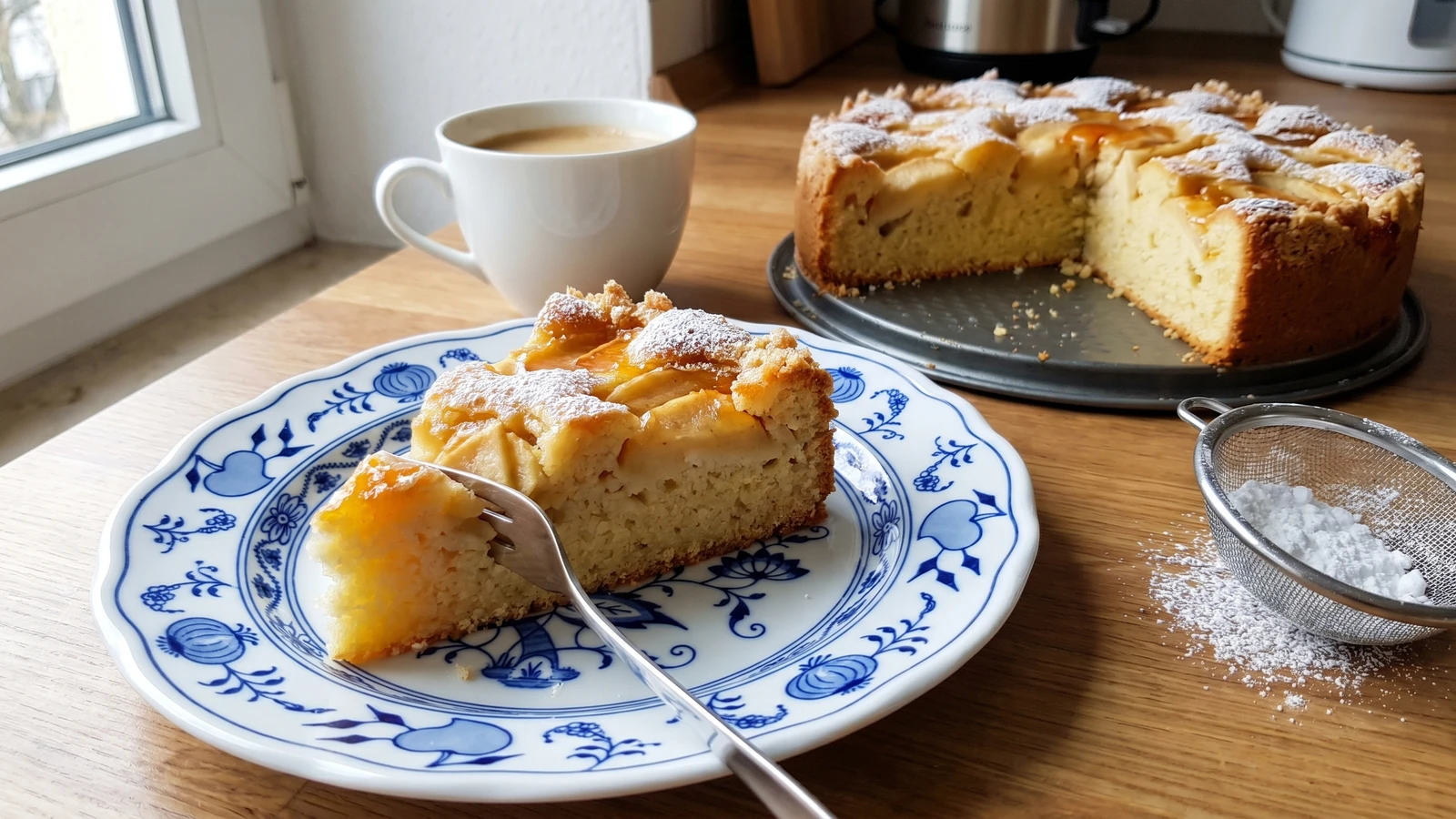
Tart Boskop apples, scored deep and pressed into properly creamed Rührteig, make the everyday cake of Kaffee und Kuchen: light crumb, sharp fruit, no packet mix doing the work.
Versunkener Apfelkuchen is the apple cake of Kaffee und Kuchen, the afternoon coffee table, and it earns its place in autumn when the stored apples are still sharp. It is strongest in the German home kitchen rather than one court or one monastery: Rhineland, Hesse, Saxony, Swabia, everyone has a springform version. No saint's day owns it. You bake it on a Wednesday if the apples are sitting there, and on Sunday nobody complains.
The regions disagree in the quiet home-baker way. In the north and west I want Boskop, firm and sour enough to stay alive against the butter crumb; in the south you see more almonds or a thin apricot glaze; sheet-cake bakers stretch the same idea onto a Blech, a baking tray, when the table is full. Im Norden anders, im Süden anders, different in the north, different in the south. I am keeping the round Rührteig, the stirred butter batter, because that is the version that shows the sunken apples best.
The cake works or fails in the stirring. Beat softened butter and sugar until pale because that trapped air is the first lift, and add room-temperature eggs one at a time because cold eggs harden the butter and break the batter. The baking powder helps, but it doesn't save a heavy batter. A packet mix gives you sweetness without structure. Five honest minutes with a mixer gives you cake.
Score the apple halves almost through and press them halfway into the batter, rounded side up. The cuts let the Boskop open as it softens, and the batter rises around the fruit instead of being flooded by it. Watch the centre between the apples, not the apple itself, because fruit stays wet even when the crumb is done. Erst verstehen, dann kochen, understand first, then cook.
Versunkener Apfelkuchen belongs to the German Rührkuchen family, stirred cakes that became reliable household baking after chemical baking powder entered the kitchen in the late 19th century. In 1891, August Oetker in Bielefeld began selling Backin in sachets measured for 500g flour, which made this kind of quick cake predictable for home cooks. The apple many German bakers still choose, Boskop, is the Dutch Boskoop, found as a seedling in 1856 and taken up in German orchards because its sharp, firm flesh keeps its shape in the oven; the regional argument is mostly over finish, powdered sugar in one house, almonds or apricot glaze in the next.
Quantity
180g
softened, plus more for the tin
Quantity
160g
Quantity
1 packet (8g) or 2 teaspoons
Quantity
1
finely zested, plus 1 tablespoon juice
Quantity
1 pinch
Quantity
3
room temperature
Quantity
220g
Quantity
2 teaspoons
Quantity
60ml
room temperature
Quantity
3 to 4, about 700g
Quantity
1 tablespoon
for sprinkling over the apples
Quantity
2 tablespoons
warmed
Quantity
to dust
| Ingredient | Quantity |
|---|---|
| unsalted buttersoftened, plus more for the tin | 180g |
| sugar | 160g |
| vanilla sugar | 1 packet (8g) or 2 teaspoons |
| lemonfinely zested, plus 1 tablespoon juice | 1 |
| fine salt | 1 pinch |
| large eggsroom temperature | 3 |
| plain flour | 220g |
| baking powder | 2 teaspoons |
| whole milkroom temperature | 60ml |
| tart baking apples, preferably Boskop | 3 to 4, about 700g |
| sugarfor sprinkling over the apples | 1 tablespoon |
| apricot jam (optional)warmed | 2 tablespoons |
| powdered sugar (optional) | to dust |
Heat the oven to 180C, or 160C fan, and butter a 26cm springform pan. Line the base with baking paper and dust the sides with flour. Get the tin ready before you mix, because Rührteig starts losing its lift once the flour and baking powder are in; a batter waiting on the counter bakes lower.
Peel, halve, and core the apples, then rub the cut sides with lemon juice so they stay pale while you mix. Score the rounded side of each half in close lines, cutting deep but not through, because the cuts open in the oven and let the apple soften without dumping all its juice into the crumb. Save the peels for compote or tea. Weggeworfen wird nichts, nothing gets thrown away.
Beat the softened butter with the sugar, vanilla sugar, lemon zest, and salt for 4 to 5 minutes, until the mixture turns pale and looks lighter on the beaters. This is not decoration. The air beaten into the butter is what gives the cake its fine crumb before the baking powder does any work.
Beat in the eggs one at a time, giving each one about 30 seconds before the next goes in. Room-temperature eggs join the butter cleanly; cold eggs tighten the fat and make the batter split. If it looks slightly grainy, beat in a spoonful of the measured flour and carry on. Panic helps nobody.
Whisk the flour with the baking powder, then fold it into the butter mixture in two additions, alternating with the milk. Stop as soon as the last dry streak is gone. Overmixed flour builds gluten, and gluten gives you a tight cake that pushes the apples up instead of letting them sink into a tender crumb.
Scrape the batter into the prepared pan and level it without pressing out all the air you just made. Set the apple halves rounded side up on the batter and press each one halfway in, leaving a little space between them, then sprinkle with the tablespoon of sugar. Do not bury them to the bottom; the batter needs room to rise around the fruit, and the apples will settle as they soften.
Bake for 40 to 45 minutes, until the edge is golden, the centre springs back lightly, and a skewer pushed into the crumb between the apples comes out without wet batter. Test the cake, not the fruit. An apple will always make a skewer damp, and that is how people overbake a good cake into dryness.
Let the cake stand in the tin for 10 minutes, then release the ring and move it to a rack. The crumb sets as it cools; cut it straight from the oven and you compress what you worked to lighten. Brush the apple tops with warm apricot jam for shine, or leave it plain and dust with powdered sugar once cool. Schön ist, was schmeckt, what tastes good is what looks good.
1 serving (about 175g)
Culinary guides, cultural storytelling, and the editorial depth that makes cooking meaningful.
Discover Culinary ExplorerChef Klaus
Frankfurt's Advent marzipan ball is small, pale gold, and exacting: real almond paste, rosewater, three almond halves pressed on firmly, then a short bake for gloss.

Chef Klaus
Bienenstich works when the almond top caramelises without burning and the yeast cake cools before the cream goes in. Rush either one and the bee has stung you.

Chef Klaus
North Germany's Freud-und-Leid-Kuchen, the cake for joy and sorrow both: a yeast sheet pressed full of cold butter, sugar, and almonds until the top turns crisp.

Chef Klaus
A German coffee-table cake built in layers: pale and cocoa batter, sour cherries sinking into the wave, cool buttercream, and dark chocolate combed like the Danube.