Culinary Explorer

A cooking platform built around craft, culture, and the stories behind what we eat.
Discover Culinary Explorer
Verduras en Escabeche Conventuales

Verduras en Escabeche Conventuales

Created by

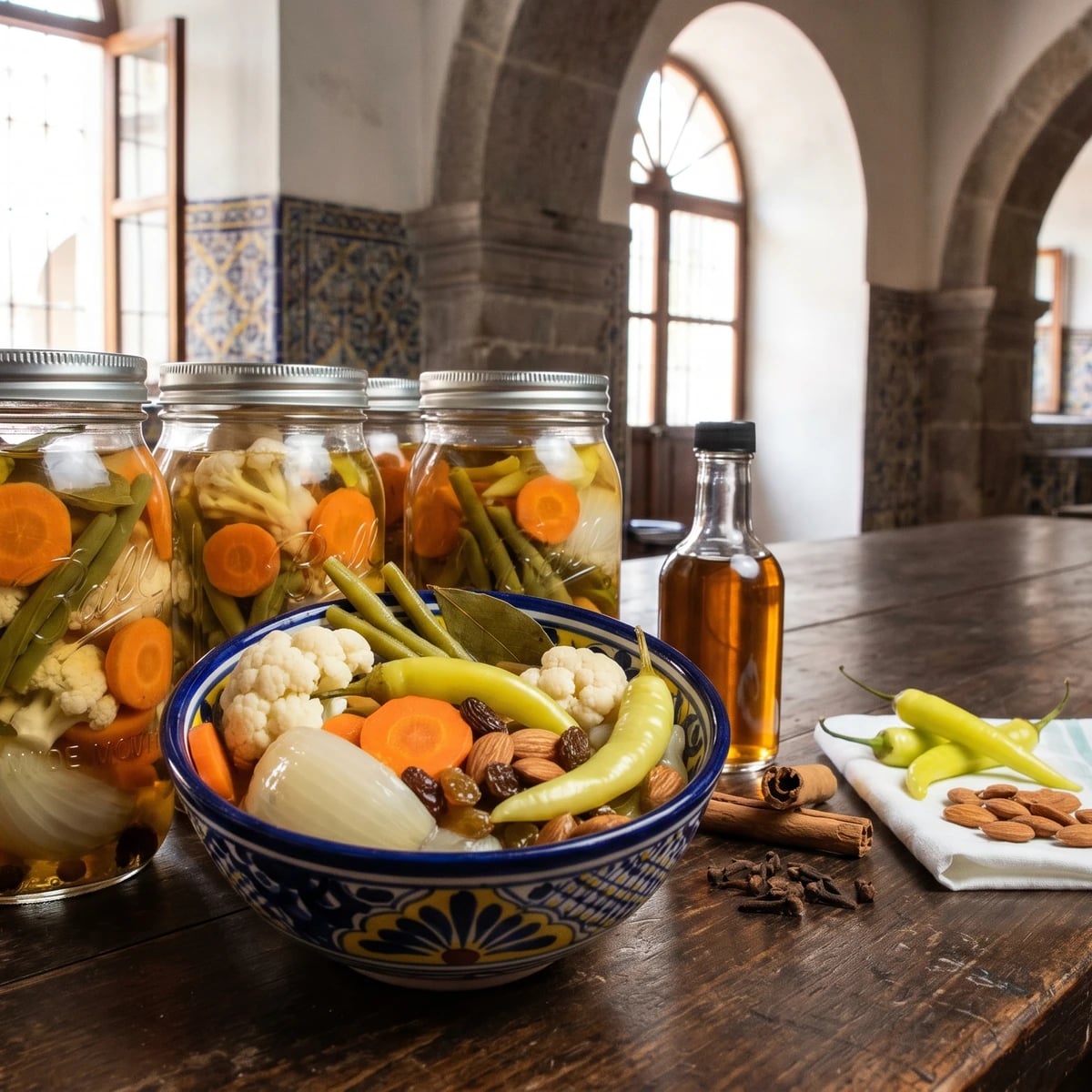
Puebla's convent pantry escabeche, carrots, cauliflower, ejotes, onion, and chiles güeros held in olive oil, jerez vinegar, canela, clavo, and herbs until the jar tastes like Lent and feast day together.

Sauces & Condiments
Mexican
Make Ahead
Easter
Picnic
35 min
Active Time
30 min cook13 hr 5 min total
YieldAbout 2 quarts, 12 condiment servings

Puebla, the Angelópolis, is where this jar belongs, in the convent pantry behind the Talavera-tiled kitchens of Santa Rosa and Santa Mónica. Verduras en escabeche is not a plate. It is the bright, acid thing you set next to tortitas de camarón in Lent, roasted fish on a picnic table, cold chicken after Mass, or beans that need waking up. The dish it dresses lives elsewhere. This is the companion that makes it speak.

The geography is in the vegetables: carrots, cauliflower, ejotes, white onion, and fresh chiles güeros from the highland markets around Puebla. The convent register is in the olive oil, wine vinegar, vinagre de jerez, canela, clavo, laurel, thyme, marjoram, almonds, and raisins. Old World ingredients, New World chiles, and women behind walls who learned how to make scarcity elegant without making it weak.

The technique is not difficult, but it is strict. Blanch each vegetable only as long as it needs. Sweat the garlic, onion, and chiles güeros in olive oil without browning them. Simmer the vinegar with the spices, then let the jar rest overnight. No metate here because this is not mole. El metate es la regla for moles; here the rule is acid, timing, and patience.

In my Puebla notebook I wrote one line from a señora near Mercado La Acocota: "el chile se queda entero". The chile stays whole. She was right. Cut it into rings and you lose the look of the jar, the bite of the chile, and half the dignity. Cada estado, su propia cocina. Saber cocinar es saber vivir.

Escabeche comes to Spanish through the Arabic al-sikbaj, a vinegar-based preparation from medieval al-Andalus, and arrived in New Spain as a preservation method for fish, poultry, chiles, and vegetables. Puebla's convent kitchens, especially the former Convent of Santa Rosa de Lima, associated with Dominican nuns, and the Augustinian Convent of Santa Mónica, became landmarks of criollo-conventual cooking in the 17th and 18th centuries. Their pantry work joined imported oil, vinegar, jerez, cloves, cinnamon, and bay with Mexican chiles and market vegetables, making preserves like this useful for Lent, travel, refectory meals, and feast tables.

The technique, the tradition, and the story behind every dish.

Discover Culinary Explorer

Ingredients

water

Quantity

2 quarts

for blanching

kosher salt

Quantity

2 tablespoons

for blanching water

cauliflower

Quantity

1 small head, about 1 1/4 pounds

cut into 1-inch florets

carrots

Quantity

4 medium

peeled and cut on the bias into 1/4-inch coins

ejotes

Quantity

8 ounces

trimmed and cut into 2-inch lengths

white onion

Quantity

1 large

cut into thick wedges

fresh chiles güeros

Quantity

8

stems on, slit lengthwise

garlic cloves

Quantity

10

peeled and lightly crushed

Spanish-style olive oil

Quantity

3/4 cup

bay leaves

Quantity

3

black peppercorns

Quantity

1 teaspoon

whole cloves

Quantity

4

Mexican cinnamon stick

Quantity

1 small

dried Mexican oregano

Quantity

1 teaspoon

dried thyme

Quantity

1/2 teaspoon

dried marjoram

Quantity

1/2 teaspoon

white wine vinegar

Quantity

1 cup

vinagre de jerez

Quantity

1/2 cup

reserved blanching liquid or water

Quantity

1/2 cup

dry jerez

Quantity

2 tablespoons

grated piloncillo

Quantity

1 tablespoon

kosher salt

Quantity

1 1/2 teaspoons, plus more to taste

blanched almonds

Quantity

1/4 cup

lightly toasted

golden raisins

Quantity

2 tablespoons

Equipment Needed

  • Wide nonreactive stainless-steel pot or lead-free glazed cazuela
  • Kitchen spider or slotted spoon
  • Two 1-quart glass frascos with nonreactive lids
  • Clean kitchen towels for draining vegetables
  • Small Puebla Talavera bowl for serving

Instructions

  1. 1

    Prepare the jars

    Wash two 1-quart glass frascos and their lids with hot soapy water, rinse well, and dry completely. This is refrigerator escabeche, not shelf-stable canning. Clean jars matter because the vegetables will rest in acid and oil for days.

  2. 2

    Cut the vegetables

    Cut the cauliflower into firm florets, the carrots on the bias, the ejotes into short lengths, and the onion into thick wedges. Slit each chile güero lengthwise from shoulder to tip without removing the stem. The slit lets the vinegar enter while the chile keeps its shape in the jar. El chile se queda entero.

  3. 3

    Blanch by texture

    Bring the water and 2 tablespoons salt to a boil in a nonreactive pot. Blanch the carrots for 3 minutes, lift them out with a spider, then blanch the cauliflower for 2 minutes, and the ejotes for 90 seconds. Spread each vegetable on a clean towel to drain. Do not cook them soft. The vinegar will finish the work overnight.

    If the cauliflower smells sulfurous, you cooked it too long. It should still look white and hold its edges.
  4. 4

    Perfume the oil

    In a wide stainless-steel pot or lead-free glazed cazuela, warm the olive oil over medium-low heat. Add the garlic, onion wedges, and chiles güeros. Cook 6 to 8 minutes, turning gently, until the onion turns glossy and the chiles soften slightly. Do not brown the garlic. Browned garlic fights the vinegar and turns bitter.

    The fat here is olive oil. La manteca es el sabor where the dish asks for pork fat. This preserve asks for the Spanish pantry, oil and vinegar, así se hace y punto.
  5. 5

    Add the spices

    Add the bay leaves, black peppercorns, cloves, cinnamon stick, oregano, thyme, and marjoram to the oil. Stir for 30 seconds, just until the spices smell awake. This is the conventual register: canela, clavo, laurel, herbs, and restraint. Do not turn it into mole. This is escabeche.

  6. 6

    Simmer the vinegar

    Pour in the white wine vinegar, vinagre de jerez, reserved blanching liquid, dry jerez, piloncillo, and 1 1/2 teaspoons salt. Bring to a gentle simmer and cook for 5 minutes, stirring until the piloncillo dissolves. The liquid should taste sharp, salted, faintly sweet, and perfumed with clove and bay. If it tastes timid now, it will taste flat tomorrow.

  7. 7

    Finish the escabeche

    Add the blanched carrots, cauliflower, and ejotes to the simmering escabeche. Fold gently so the vegetables are coated without breaking. Add the toasted almonds and raisins, then simmer 3 minutes more. The almonds should stay firm and the raisins should plump, not fall apart.

  8. 8

    Jar and rest

    Pack the vegetables, chiles, onion, garlic, almonds, raisins, and spices into the clean frascos. Pour the hot vinegar and oil mixture over them, making sure the vegetables are covered. Tap the jars gently to release trapped air. Cool uncovered for 30 minutes, then close and refrigerate at least 12 hours, preferably 24. The first day tastes like ingredients. The second day tastes like escabeche.

    Keep the vegetables under the liquid. If a piece rises above the surface, press it down with a clean spoon before refrigerating.
  9. 9

    Serve as condiment

    Serve cool or at room temperature in a small Puebla Talavera bowl, with a little of the oil-vinegar liquid spooned over the top. Set it beside tortitas de camarón, pescado, roasted poultry, cold meats, beans, or picnic sandwiches. This is a sauce in the old sense: it dresses the plate, it does not pretend to be the plate. Recetas probadas y garantizadas.

Chef Tips

  • Use fresh chiles güeros, the pale yellow-green ones, not dried mole chiles. Chilhuacle negro, chilhuacle rojo, ancho, mulato, pasilla, and guajillo belong to other conventual sauces. This jar needs a whole fresh chile that can sit in vinegar and keep its shape.
  • If you cannot find chiles güeros, fresh jalapeño cuaresmeño will work, but it is a compromise. The flavor will be greener and sharper, and the jar will look less poblano.
  • Do not cook vinegar in copper or aluminum. Acid pulls metal. Copper cazos are for chocolate, cajeta, and some sweet work, not this escabeche.
  • The vegetables must be firm. If the market cauliflower is tired and spotted, do not make this today. Pregúntale a las señoras del mercado and cook what is actually good.
  • This is not a shelf-stable canning recipe. Keep it refrigerated and use a clean spoon every time. Vinegar plus confidence is not food safety.

Advance Preparation

  • Make the escabeche at least 12 hours ahead. Twenty-four hours is better because the chiles, onion, herbs, and vinegar settle into one flavor.
  • The escabeche keeps refrigerated for up to 2 weeks as long as the vegetables stay covered by the liquid and you use a clean spoon.
  • For a picnic or Easter table, transport the jar cold and let it sit at room temperature for 20 minutes before serving so the olive oil loosens.

Frequently Asked Questions

Nutrition Information

1 serving (about 165g)

Calories
190 calories
Total Fat
15 g
Saturated Fat
2 g
Trans Fat
0 g
Unsaturated Fat
13 g
Cholesterol
0 mg
Sodium
460 mg
Total Carbohydrates
11 g
Dietary Fiber
3 g
Sugars
6 g
Protein
3 g

Note: Chef personas and recipes are created with AI assistance. Cook with care: follow safe food-handling practices, check doneness with a thermometer when needed, and adapt for allergies and your kitchen.

Where cooking meets culture.

Culinary guides, cultural storytelling, and the editorial depth that makes cooking meaningful.

Discover Culinary Explorer

More from Moles, Pipianes & Escabeches Conventuales

Browse the full collection