
Chef Klaus
Aachener Printen
Aachen's Advent biscuit is dark, hard, and spiced, with beet syrup doing the deep work and a closed tin finishing what the oven only starts.
A cooking platform built around craft, culture, and the stories behind what we eat.
Created by
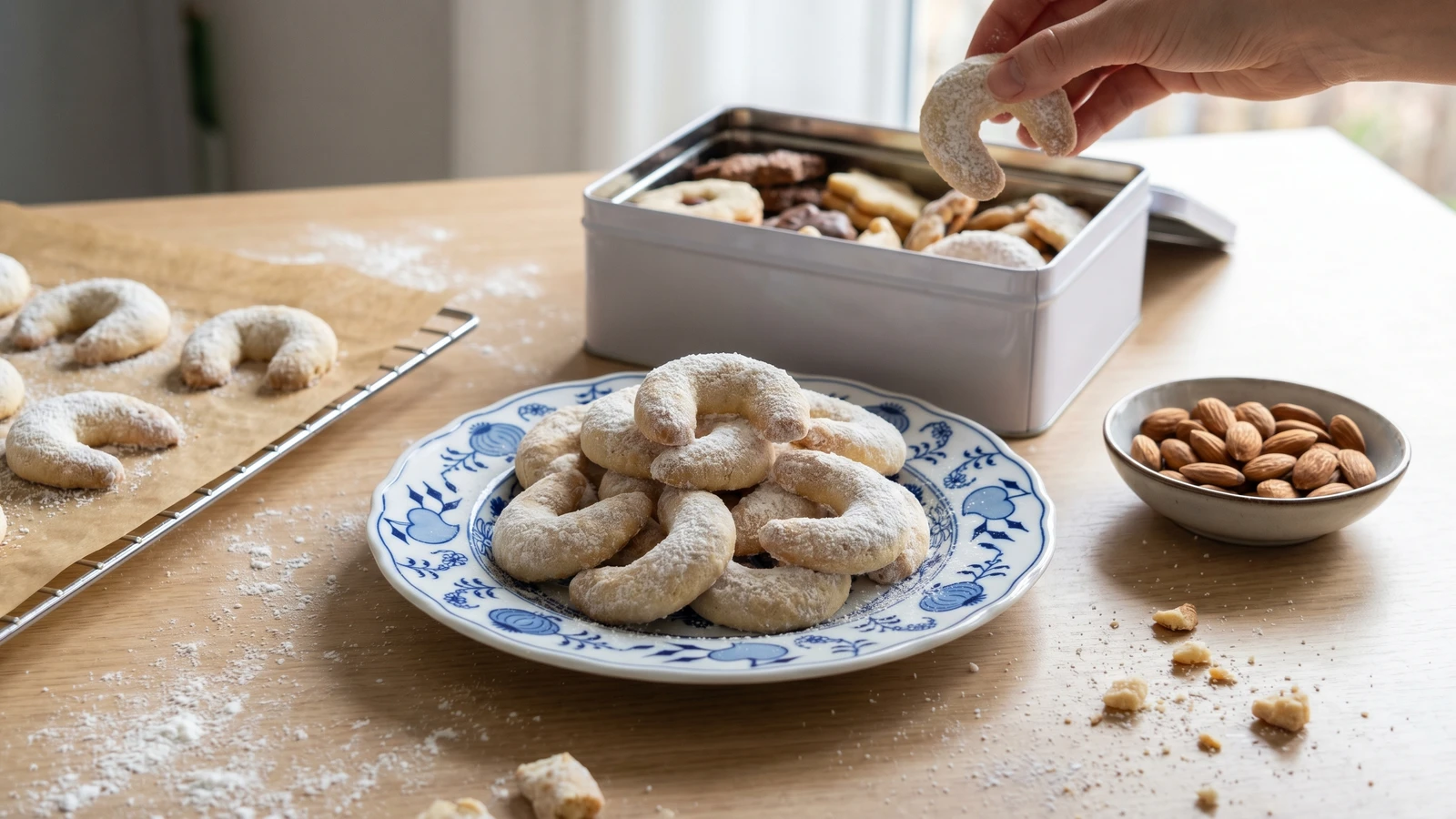
The Advent tin's pale crescent, short with butter and almonds, works only if the dough stays cold and the cookies meet vanilla sugar while still warm.
Vanillekipferl belong to Advent, the weeks when the tins come out and the house smells of butter, nuts, and vanilla before anyone has earned the first candle. They sit strongest in Austria, Bohemia, Bavaria, and Swabia, then they travel north with the Christmas Plätzchen, the German Christmas-cookie plate. Im Norden anders, im Süden anders: some bake them with almonds, some with hazelnuts, some swear by walnuts. I use almonds here because they give the cleanest pale crumb and let the vanilla speak.
This is Mürbeteig, short pastry, and it has one rule: keep it cold. Warm butter smears into the flour and nuts, so the crescents crack in your hands and slump in the oven. Cold butter coats the flour, the dough cuts clean, and the baked Kipferl breaks tender under the teeth instead of turning greasy. Erst verstehen, dann kochen.
The sugar is not decoration. Roll the cookies while they're warm, not hot enough to fall apart and not cool enough to reject the coating. Warm butter on the surface catches the vanilla sugar and holds it. Do it too late and the sugar sits loose in the tin like snow no one asked for. Das braucht seine Zeit, but not fuss.
Vanillekipferl are tied to the old Habsburg baking world, especially Vienna and Bohemia, before they became standard Advent Plätzchen across southern Germany and beyond. The crescent shape is often linked in popular story to Vienna after the Ottoman siege of 1683, but the safer record is pastry practice: crescent-shaped nut cookies appear in central European baking long before modern Christmas tins made them a seasonal fixture. Vanilla itself became a wider middle-class baking flavour in the 19th century as colonial trade and later vanillin made the once costly pod more available, which is why the cookie's name belongs to a later sweet table than its crescent shape.
Quantity
250g
Quantity
100g
Quantity
70g
sifted
Quantity
1 packet or seeds from 1 bean
Quantity
1 pinch
Quantity
200g
cut into small cubes
Quantity
100g
for coating
Quantity
2 packets
for coating
| Ingredient | Quantity |
|---|---|
| plain flour | 250g |
| blanched ground almonds | 100g |
| icing sugarsifted | 70g |
| vanilla sugar or vanilla bean seeds | 1 packet or seeds from 1 bean |
| fine salt | 1 pinch |
| cold unsalted buttercut into small cubes | 200g |
| icing sugarfor coating | 100g |
| vanilla sugarfor coating | 2 packets |
Whisk the flour, ground almonds, icing sugar, vanilla sugar or vanilla seeds, and salt in a bowl. Break up any almond lumps now, because the dough is barely worked later; overworking wakes the gluten and makes a tough Kipferl.
Add the cold butter cubes and rub them into the flour with your fingertips until the mixture looks like damp sand, then press it together into a dough. Stop as soon as it holds. Warm hands melt the butter, and melted butter gives you greasy crescents that spread instead of keeping their shoulders.
Divide the dough in two, shape each piece into a flat log, wrap it, and chill for at least 90 minutes. The rest firms the butter and lets the flour hydrate, so the dough rolls without crumbling at the edges. Das braucht seine Zeit.
Heat the oven to 175C and line two baking sheets with parchment. Cut the chilled dough into small pieces, about 10g each, roll each into a short rope with tapered ends, and bend it into a crescent. Keep the unshaped dough in the refrigerator while you work; if it warms, the crescents crack now and slump later.
Bake one tray at a time for 10 to 12 minutes, until the tips are just pale gold and the centres still look light. Don't brown them hard. Vanillekipferl are butter and almond cookies, not toast, and too much colour makes the flavour coarse.
Mix the icing sugar and vanilla sugar in a shallow bowl. Let the baked Kipferl sit on the tray for 3 minutes so they don't break in your fingers, then roll them gently through the sugar while still warm. Warm butter catches the sugar; cold cookies throw it off. Cool completely before packing into a tin.
1 cookie (about 15g)
Culinary guides, cultural storytelling, and the editorial depth that makes cooking meaningful.
Discover Culinary ExplorerChef Klaus
Aachen's Advent biscuit is dark, hard, and spiced, with beet syrup doing the deep work and a closed tin finishing what the oven only starts.

Chef Klaus
The Baden-Wuerttemberg apple fritter that lives between weeknight dessert and Sunday coffee, built on tart rings, a light batter, and oil kept steady.

Chef Klaus
The Carnival doughnut lives by proofing and fat temperature: a light yeast round floats high, cooks through with one pale belt, then takes its jam without turning greasy.

Chef Klaus
A cold Mürbeteig ball, one clean hollow, and a spoon of tart jelly: Engelsaugen are Advent cookies that fail only when the dough gets warm.