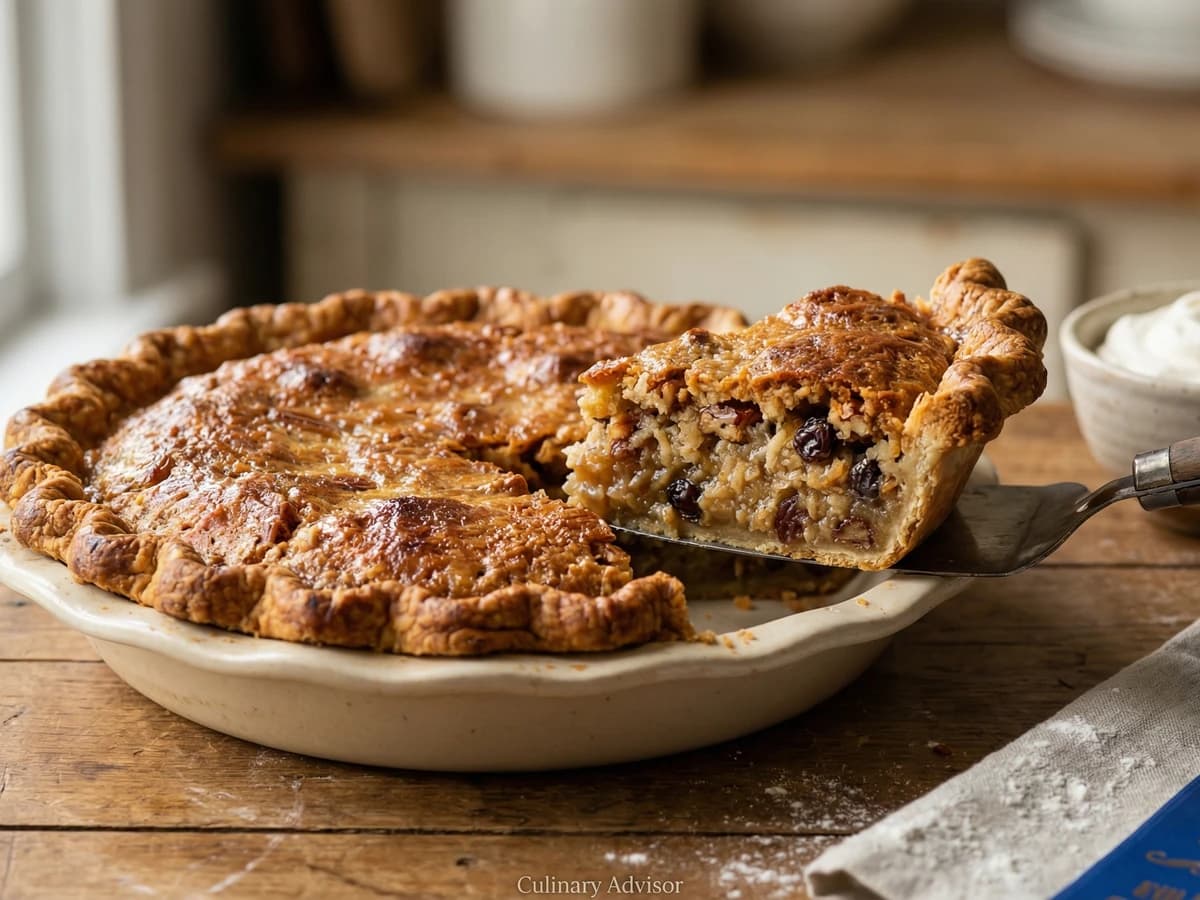
A creamy, custard-style pie studded with tender bread-and-butter pickles, sweetened with brown sugar, and kissed with warm spices. Utah's best-kept secret tastes like skepticism turning into seconds.
Pastries & Cookies
American
Comfort Food, Special Occasion
45 min
Active Time
55 min cook•1 hr 40 min total
Yield8 servings
Every state has a pie that makes outsiders raise an eyebrow. Utah has pickle pie. Before you dismiss it, understand its origins: pioneer women crossing the Great Basin with limited supplies and unlimited ingenuity. They preserved everything. Cucumbers became pickles. Pickle brine became too valuable to discard. Someone, probably tired and hungry and determined to make something sweet from what remained, stirred that brine into a custard filling. The result was strange, then surprising, then beloved.
The pie survives because it works. Bread-and-butter pickles, with their brown sugar and warm spices, already live halfway between vegetable and confection. Suspended in a silky custard, baked until just set, they transform into something that tastes like curiosity rewarded. The tang cuts the sweetness. The texture plays soft against tender. Your first bite confuses you. Your second convinces you.
I first encountered this pie at a roadside stand outside Provo, served by a woman whose grandmother had carried the recipe across the plains. She watched my face as I took the first forkful, waiting for the reaction she'd seen a thousand times: confusion, then pleasure, then the request for another slice. This is that recipe, refined through dozens of batches in my own kitchen, honest to its humble origins.
The technique, the tradition, and the story behind every dish.
cold unsalted butter (for crust)cut into 1/2-inch cubes
1/2 cup (1 stick/113g)
ice water
4 to 6 tablespoons
bread-and-butter picklesdrained and chopped into 1/4-inch pieces
1 cup
bread-and-butter pickle brine
1/4 cup
large eggsat room temperature
3
light brown sugarpacked
1/2 cup (100g)
granulated sugar (for filling)
1/4 cup (50g)
heavy cream
1 cup
unsalted butter (for filling)melted and cooled slightly
4 tablespoons (57g)
pure vanilla extract
1 teaspoon
ground cinnamon
1/4 teaspoon
freshly grated nutmeg
1/8 teaspoon
fine sea salt (for filling)
pinch
lightly sweetened whipped cream (optional)
for serving
Equipment Needed
•9-inch pie plate (glass or ceramic preferred for even browning)
•Rolling pin
•Pastry blender or cold fingers
•Wire cooling rack
•Rimmed baking sheet
Instructions
1
Make the pie dough
Whisk flour, salt, and one tablespoon sugar in a large bowl. Add the cold butter cubes and work them into the flour using your fingertips or a pastry blender, pressing and smearing until the mixture resembles coarse meal with some pea-sized butter pieces remaining. These larger bits create the flaky layers you want. Drizzle four tablespoons of ice water over the mixture and stir with a fork until the dough just begins to clump. Squeeze a handful: if it holds together, you have enough water. If it crumbles, add more water one tablespoon at a time.
Cold butter is essential. If your kitchen runs warm, freeze the cubes for fifteen minutes before starting.
2
Chill the dough
Turn the shaggy dough onto a clean surface and press it together into a disk about one inch thick. Don't knead it. The less you handle pie dough, the more tender the result. Wrap tightly in plastic and refrigerate for at least one hour, or overnight. The gluten needs time to relax and the butter to firm up again.
3
Roll and fit the crust
On a lightly floured surface, roll the chilled dough into a circle roughly twelve inches across and an eighth-inch thick. Roll from center outward, rotating the dough a quarter turn after each pass to maintain an even circle. Transfer to a nine-inch pie plate by rolling it loosely around your pin, then unrolling it over the dish. Ease the dough into the corners without stretching. Trim the overhang to one inch, then fold the edge under itself and crimp decoratively. Refrigerate while you prepare the filling.
4
Prepare the pickles
Drain the pickles thoroughly, reserving a quarter cup of the brine. Spread the drained pickles on paper towels and blot them dry. Excess moisture makes soggy pie. Chop them into pieces no larger than a quarter inch. Too large and they sink; too small and they disappear. You want distinct pockets of pickle throughout the custard.
5
Build the custard filling
Preheat oven to 350°F. In a large bowl, whisk the eggs until smooth. Add both sugars and whisk vigorously until the mixture lightens slightly, about one minute. Pour in the heavy cream, melted butter, vanilla, reserved pickle brine, cinnamon, nutmeg, and salt. Whisk until completely combined. The brine gives the custard its signature tang. Taste it now: you should detect sweetness, a subtle bite, and the warmth of spice.
6
Assemble the pie
Scatter the chopped pickles evenly across the bottom of the chilled pie crust. Pour the custard mixture slowly over the pickles. Some will float, some will settle. This is correct. The filling should come within a half inch of the crimped edge.
Place the pie plate on a rimmed baking sheet before filling. This makes transfer to the oven safer and catches any drips.
7
Bake until just set
Bake on the center rack for fifty to fifty-five minutes. The pie is done when the edges are puffed and set but the center still wobbles slightly, like gelatin, when you gently shake the pan. A knife inserted two inches from the edge should come out clean. The center will continue to set as it cools. An overbaked custard pie weeps and turns rubbery. When in doubt, pull it early.
8
Cool completely before serving
Transfer to a wire rack and let cool at room temperature for at least three hours. The custard needs this time to set fully. Rushing it means runny slices. Serve at room temperature or slightly chilled, with a modest dollop of lightly sweetened whipped cream. Let the pie speak for itself. Watch your guests' faces as they take their first bite. The confusion. The surprise. The reach for a second forkful.
Chef Tips
•The quality of your pickles matters more than any other ingredient. Seek out bread-and-butter pickles made with real sugar and spices, not corn syrup. Many grocery store brands disappoint. Farmers market pickles or homemade are ideal. If you can't find good bread-and-butter, sweet gherkins work, though the spice profile changes slightly.
•This pie improves overnight. The flavors meld and the custard sets more firmly. Make it the day before you plan to serve, refrigerate covered, and let it come to room temperature for thirty minutes before slicing.
•For a more pronounced pickle flavor, increase the brine to one-third cup and reduce the cream by two tablespoons. Taste your brine first: some are sweeter, some more acidic. Adjust accordingly.
•If your crust edges brown too quickly, tent them loosely with foil after thirty minutes of baking. Don't cover the whole pie or the center won't set properly.
•Serve this pie after a hearty meal. It's rich. Small slices satisfy. A strong cup of coffee makes an ideal companion.
Advance Preparation
•Pie dough can be made up to three days ahead and refrigerated, or frozen for up to three months. Thaw overnight in the refrigerator before rolling.
•The fully baked pie keeps refrigerated for up to four days. Cover loosely with plastic wrap once completely cooled to prevent the top from drying out.
•The custard filling cannot be made ahead. The eggs and cream must be combined fresh and baked promptly for proper texture.
Frequently Asked Questions
Nutrition Information
1 serving (about 140g)
Calories
430 calories
Total Fat
29 g
Saturated Fat
18 g
Trans Fat
0 g
Unsaturated Fat
9 g
Cholesterol
68 mg
Sodium
150 mg
Total Carbohydrates
37 g
Dietary Fiber
1 g
Sugars
22 g
Protein
4 g
Where cooking meets culture.
Culinary guides, cultural storytelling, and the editorial depth that makes cooking meaningful.