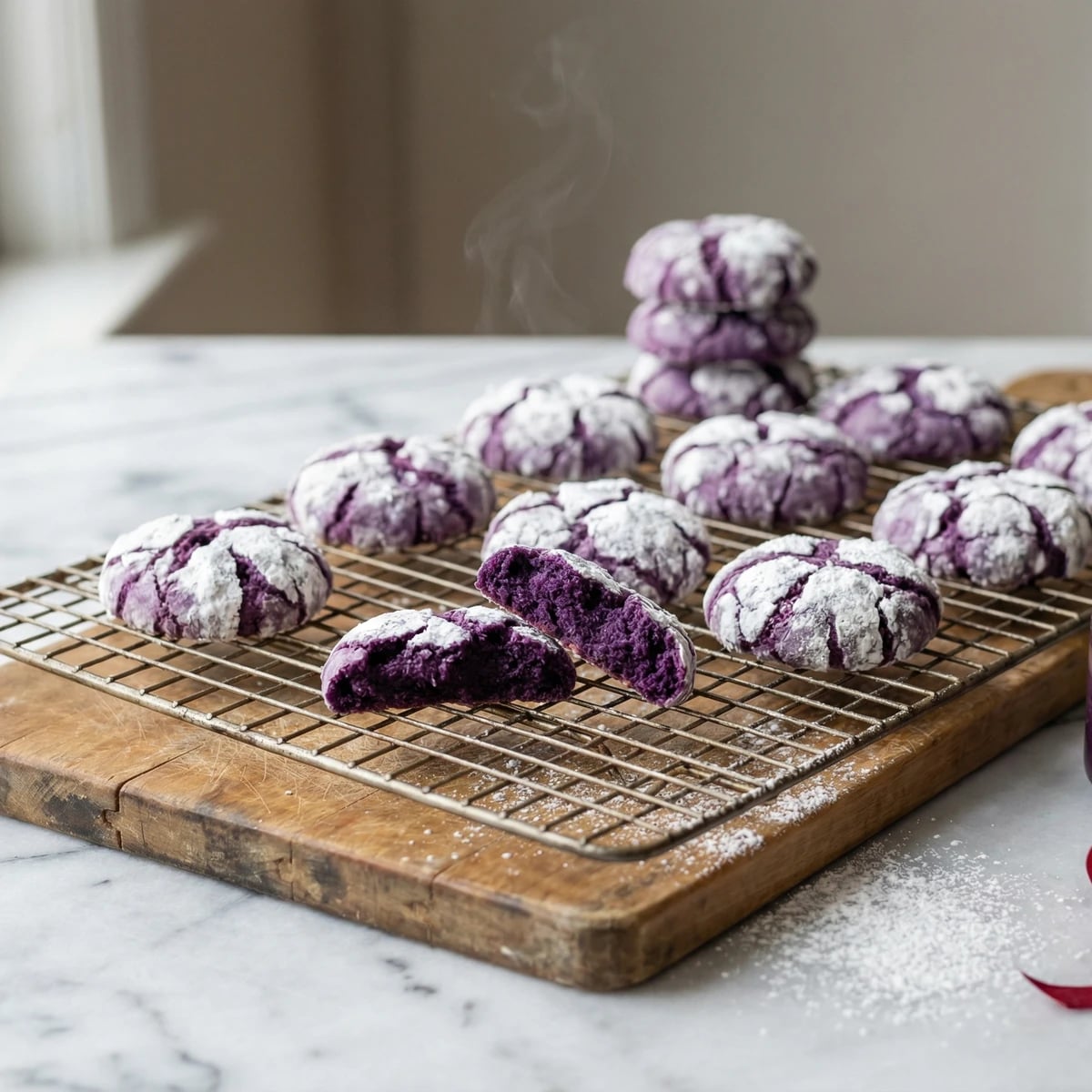
Brilliantly purple cookies that crack open to reveal fudgy, earthy-sweet centers, marrying Filipino ube tradition with the American crinkle cookie in one stunning, giftable treat.
Pastries & Cookies
Fusion
Holiday
Make Ahead
25 min
Active Time
12 min cook•3 hr total
Yield36 cookies
The crinkle cookie is an American invention, born from chocolate brownie batter rolled in powdered sugar and baked until the surface cracks like dried earth after rain. It's theatrical. The dark interior pushing through white powder creates drama on any cookie tray. Now imagine that same technique applied to ube, the purple yam that Filipino bakers have transformed into one of the world's most visually stunning ingredients.
Ube has been central to Filipino desserts for generations. The yam grows in the volcanic soil of the Philippines, developing an earthy sweetness and that remarkable violet color no food dye can replicate. Filipino-American bakers, homesick for the flavors of their grandmothers' kitchens, began incorporating ube into American desserts. The crinkle cookie was a natural match. The dense, fudgy texture showcases ube's subtle flavor while the powdered sugar coating creates contrast that stops people mid-conversation.
This recipe uses ube halaya, the sweetened purple yam jam available in Asian grocery stores. Don't substitute fresh ube unless you're prepared for a day-long project of boiling, mashing, and sweetening. The jarred version delivers consistent results and saves you considerable effort. A small amount of ube extract intensifies both color and flavor. The result is a cookie that tastes like nothing else in your holiday tin.
These cookies demand attention. Set them on a platter and watch guests reach for the purple ones first, every single time. They photograph beautifully, ship well, and keep for days in an airtight container. For holiday baking, they represent exactly what fusion cuisine should accomplish: honoring two traditions while creating something neither culture had imagined alone.
The technique, the tradition, and the story behind every dish.
Whisk together the flour, baking powder, and salt in a medium bowl. Set aside. This takes thirty seconds but ensures even distribution of leavening throughout your dough. Clumps of baking powder create bitter spots in the finished cookie.
2
Cream butter and sugar
In a large bowl or stand mixer fitted with the paddle attachment, beat the softened butter and granulated sugar on medium speed until light and fluffy, about 3 minutes. The mixture should turn pale and increase noticeably in volume. This aeration creates the tender interior you're after.
Truly softened butter yields to gentle pressure but holds its shape. If your finger sinks through to the counter, the butter is too soft. Refrigerate for 10 minutes and try again.
3
Add ube and eggs
Add the ube halaya to the butter mixture and beat until fully incorporated. The batter will turn a gorgeous purple. Add the eggs one at a time, beating well after each addition until the mixture is smooth. Scrape down the sides of the bowl to ensure even mixing. Add both extracts and beat briefly to combine.
4
Form the dough
Add the flour mixture in two additions, mixing on low speed just until no dry streaks remain. The dough will be soft and sticky, almost like thick frosting. This is correct. Resist the urge to add more flour. The high moisture content from the ube halaya creates the fudgy texture that defines these cookies.
Overmixing develops gluten and produces tough cookies. Stop the mixer the moment the flour disappears into the dough.
5
Chill the dough
Cover the bowl tightly with plastic wrap, pressing it directly onto the surface of the dough to prevent a skin from forming. Refrigerate for at least 2 hours, or overnight. The dough must be thoroughly chilled and firm enough to roll into balls. This step is not optional. Warm dough spreads flat and won't develop crinkles.
For faster chilling, divide the dough in half and flatten into disks before wrapping. The increased surface area speeds cooling considerably.
6
Prepare for baking
When ready to bake, position racks in the upper and lower thirds of your oven and preheat to 350°F (175°C). Line two baking sheets with parchment paper. Place the granulated sugar in one shallow bowl and the powdered sugar in another. These two coatings work in sequence to create the signature crackle pattern.
7
Shape and coat cookies
Using a small cookie scoop or tablespoon measure, portion the dough into 1-inch balls. Roll each ball first in granulated sugar, coating completely, then immediately roll in powdered sugar until thickly coated. The granulated layer prevents the powdered sugar from absorbing into the dough. Place cookies 2 inches apart on prepared baking sheets. Work quickly. If the dough softens, return it to the refrigerator for 15 minutes.
The powdered sugar coating should be generous and opaque. Thin coatings produce disappointing crinkles. Don't shake off excess.
8
Bake the cookies
Bake for 10 to 12 minutes, rotating the pans front to back and switching racks halfway through. The cookies are done when the edges are set but the centers still look slightly underdone and the surface has cracked dramatically. The purple dough will have pushed through the white coating in jagged fissures. Remove from oven immediately. Overbaked crinkle cookies lose their fudgy centers.
9
Cool completely
Let cookies cool on the baking sheets for 5 minutes. They're fragile when hot. Transfer to a wire rack to cool completely. The texture firms as they cool, developing that characteristic chewy-fudgy bite. Once cooled, the cookies hold their dramatic appearance for days. Store in an airtight container at room temperature.
Chef Tips
•Ube halaya varies by brand. Look for versions with minimal ingredients: purple yam, sugar, coconut milk. Avoid those with excessive food coloring or corn syrup. Good Earth and Giron are reliable brands found in most Asian markets.
•Ube extract amplifies both color and flavor. McCormick makes a widely available version. Without it, your cookies will still taste delicious but may appear more muted in color.
•These cookies photograph beautifully against white surfaces. If you're gifting them, consider clear cellophane bags or white boxes to showcase that purple.
•The dough freezes exceptionally well. Scoop into balls, freeze on a sheet pan until solid, then transfer to a freezer bag. Bake from frozen, adding 2 minutes to the bake time. No need to thaw.
Advance Preparation
•Dough can be refrigerated for up to 3 days before shaping and baking. The flavor actually deepens with time.
•Shaped dough balls can be frozen for up to 2 months. Coat in sugars while still frozen, then bake directly from freezer.
•Baked cookies keep at room temperature in an airtight container for up to 5 days. They do not require refrigeration.
•For shipping, pack cookies in single layers separated by parchment paper. They travel well due to their dense, fudgy texture.
Frequently Asked Questions
Nutrition Information
1 cookie (about 31g)
Calories
96 calories
Total Fat
3 g
Saturated Fat
2 g
Trans Fat
0 g
Unsaturated Fat
1 g
Cholesterol
14 mg
Sodium
32 mg
Total Carbohydrates
16 g
Dietary Fiber
0 g
Sugars
15 g
Protein
1 g
Where cooking meets culture.
Culinary guides, cultural storytelling, and the editorial depth that makes cooking meaningful.