
Chef Fai
Sticky Rice Dumplings in Coconut Cream (Bua Loi)
Glutinous rice flour, palm sugar, coconut cream, and a pinch of salt. Thai dessert follows the same governing rules as every savory dish. The system doesn't stop at the sweet course.
A cooking platform built around craft, culture, and the stories behind what we eat.
Created by
Thai desserts prove the system governs everything: palm sugar for sweetness, coconut cream for body, pandan for fragrance, and a tapioca shell that shatters into crunch against cold coconut milk. The four pillars don't stop at savory.
Most people think Thai cuisine is about curries and stir-fries. They forget that the system governs dessert too. Palm sugar for sweetness. Coconut cream for richness. Pandan for fragrance. Salt to make the sweet sing. Those are the rules. Every khanom thai (Thai sweet) follows them, and tub tim grob is no exception.
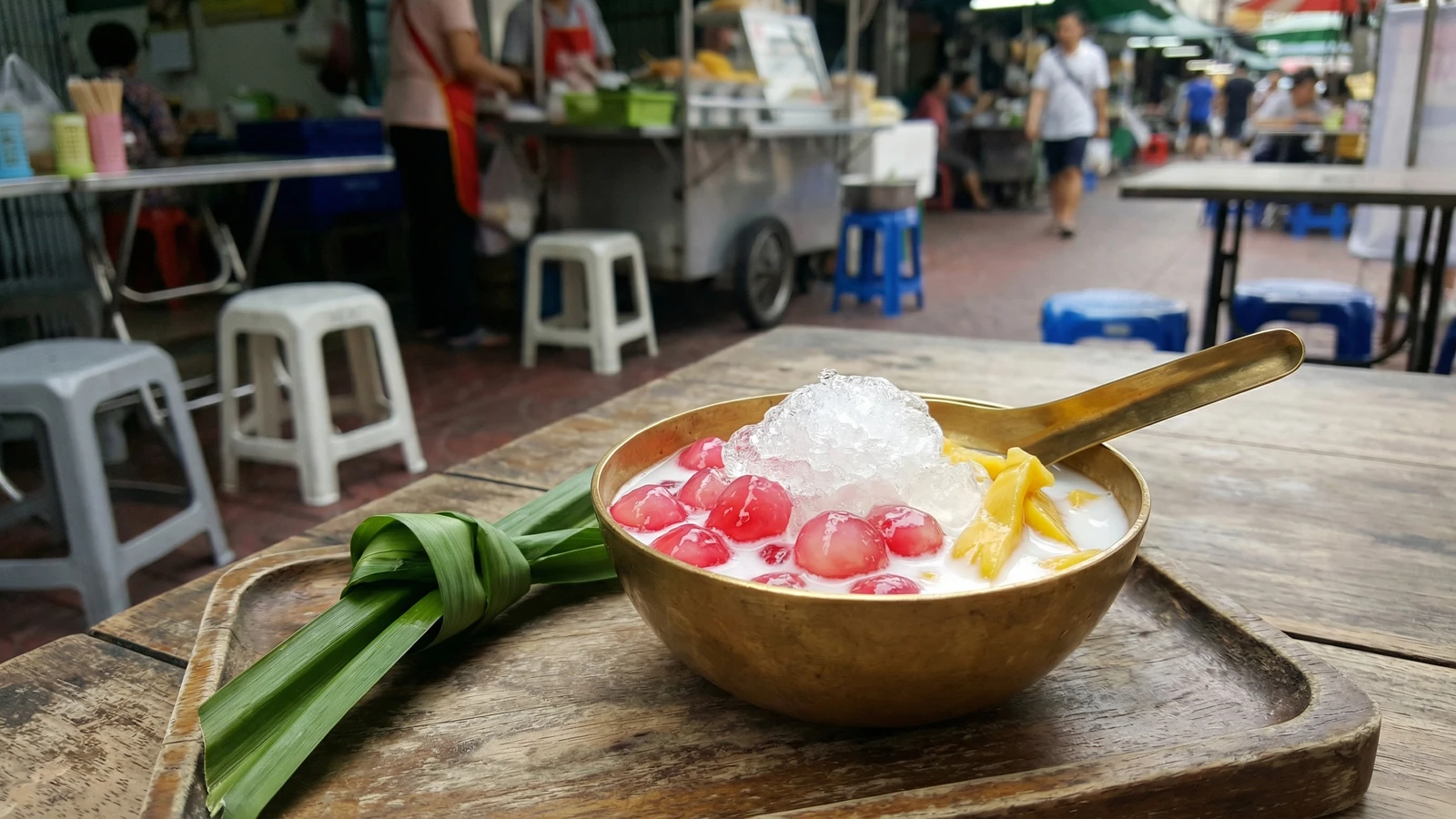
But this dish adds a fifth principle that Ajarn rarely had to spell out because every Thai grandmother already knew it: texture. Thai desserts are obsessed with mouthfeel. Chewy against smooth. Crunchy against creamy. Tub tim grob is the purest expression of that obsession. You take a water chestnut, already crunchy, and you coat it in tapioca starch. When that starch hits boiling water, the outside turns translucent and chewy while the inside stays crisp. Then you drop the whole thing into ice-cold coconut milk sweetened with palm sugar and perfumed with pandan. Your teeth break through the soft, jewel-like shell and hit the snap of the chestnut. That contrast is the entire point.
The name means "crispy rubies." Tub tim is the Thai word for pomegranate and for the gemstone ruby. The red-tinted tapioca coating looks like a handful of rough-cut gems sitting in a pool of white coconut cream. At temple fairs and dessert stalls across Bangkok, this is the dish that disappears first. It's simple. It's cold. It's perfect.
Ajarn always said that Thai desserts are not afterthoughts. They're proof that the system is complete. If you can understand why palm sugar behaves differently from white sugar, why fresh coconut cream feels different from canned, why pandan does what vanilla can never do in a tropical kitchen, then you understand the sweet pillar. And tub tim grob is the easiest way in.
Tub tim grob (ทับทิมกรอบ, literally "crispy rubies" or "crispy pomegranate") is a Central Thai dessert that became a staple of temple fair stalls and street dessert carts in Bangkok during the mid-20th century. The technique of coating ingredients in colored tapioca starch and boiling until translucent is shared across several Thai and Southeast Asian sweets, but the use of water chestnuts for their signature crunch is distinctly Thai. Unlike many Thai desserts influenced by Portuguese egg-based techniques introduced by Maria Guyomar de Pinha in the Ayutthaya period, tub tim grob is purely rooted in the Thai coconut-and-starch tradition.
Quantity
450g (2 cans drained, or fresh)
diced into 1cm cubes
Quantity
1 cup, plus extra for coating
Quantity
1/2 teaspoon coloring or 2 tablespoons beetroot juice
Quantity
400ml
fresh-pressed preferred
Quantity
200ml
thick first press
Quantity
100g
shaved or chopped
Quantity
3
knotted
Quantity
1/4 teaspoon
Quantity
2 cups
Quantity
6 pieces
cut into small strips
| Ingredient | Quantity |
|---|---|
| water chestnuts (haew)diced into 1cm cubes | 450g (2 cans drained, or fresh) |
| tapioca starch (paeng man sampalang) | 1 cup, plus extra for coating |
| red food coloring or beetroot juice | 1/2 teaspoon coloring or 2 tablespoons beetroot juice |
| coconut milk (gati)fresh-pressed preferred | 400ml |
| coconut cream (hua gati)thick first press | 200ml |
| palm sugar (nam tan pip)shaved or chopped | 100g |
| pandan leaves (bai toey)knotted | 3 |
| salt | 1/4 teaspoon |
| crushed ice | 2 cups |
| ripe jackfruit (khanun) (optional)cut into small strips | 6 pieces |
Drain and rinse the water chestnuts. Dice them into small cubes, roughly 1cm. They don't have to be perfect. Irregular edges actually grab more starch, which means more of that translucent chewy shell later. Toss the cubes in a bowl with the red food coloring or beetroot juice. Mix until every piece is stained a deep, even red. Let them sit for 5 minutes so the color soaks in. If you're using beetroot juice, the color will be more muted but natural. Either works.
This is the step that makes or breaks the dish. Add the tapioca starch to the tinted water chestnuts, about a third at a time, tossing with your hands to coat every cube generously. You want a thick, even layer of starch clinging to each piece. Shake off any loose excess, but don't be shy with the coating. Too thin and the shell won't form properly. Too thick and it gets gummy. You're looking for each cube to be visibly powdered with a solid layer of white starch over the red. The starch absorbs the surface moisture and adheres. That's the science: tapioca starch gelatinizes in boiling water and turns translucent. The thicker the coat, the chewier the shell.
Bring a large pot of water to a rolling boil. Drop the coated water chestnuts in, working in two batches so you don't overcrowd the pot. The moment the starch hits boiling water, it starts to gelatinize. Within 2 to 3 minutes, the white powder transforms into a translucent, glossy shell. You'll see it happen: the cubes go from opaque and dusty to glistening and jewel-like. They'll float to the surface when they're ready. Give them another 30 seconds after they float, then scoop them out with a slotted spoon or spider strainer. Don't let them sit in the hot water. Overcooked tapioca gets mushy and the crunch inside dies.
Transfer the boiled rubies immediately into a large bowl of ice water. This does two things. It stops the cooking so the water chestnut stays crunchy inside. And it firms up the tapioca shell, giving it that satisfying bite. Let them sit in the ice water for at least 5 minutes. They should feel bouncy and firm when you squeeze one gently between your fingers. The shell is chewy. The center snaps. That's the texture you want.
In a saucepan, combine the coconut milk, coconut cream, palm sugar, knotted pandan leaves, and salt. Heat over medium-low, stirring until the palm sugar dissolves completely. Don't boil it. You're dissolving and infusing, not cooking. The pandan should perfume the coconut within 5 minutes. Taste it. The sweetness should be gentle and rounded, not aggressive. Palm sugar does this naturally because it contains minerals and a caramel depth that white sugar can never replicate. That's why the rule exists. The salt is there to make the sweet pop. A quarter teaspoon. It sounds wrong but it's essential. Every Thai dessert vendor adds salt to coconut cream. Every single one.
Remove the pandan leaves and let the sweetened coconut milk cool to room temperature, then refrigerate until cold. Tub tim grob is served cold. The coconut milk should be chilled, the rubies should be cold from their ice bath, and crushed ice goes on top. This is a Thai dessert built for a tropical afternoon. The cold is part of the design.
Drain the rubies from the ice water. Divide them among small bowls or glasses. Ladle the chilled sweetened coconut milk over the top. Add a generous handful of crushed ice. If you're using jackfruit, tuck a few strips alongside the rubies. The presentation should look like a bowl of gemstones in a pool of white. Red jewels, white cream, shards of ice catching light. Eat it immediately. The tapioca shell softens over time. Within 30 minutes, the crunch starts to fade. Tub tim grob waits for no one.
1 serving (about 350g)
Culinary guides, cultural storytelling, and the editorial depth that makes cooking meaningful.
Discover Culinary ExplorerChef Fai
Glutinous rice flour, palm sugar, coconut cream, and a pinch of salt. Thai dessert follows the same governing rules as every savory dish. The system doesn't stop at the sweet course.

Chef Fai
Portuguese fios de ovos arrived in Ayutthaya and Thailand rewrote the rules: palm sugar replaced white, jasmine water replaced plain, and a foreign technique became Thai the moment it followed the system.

Chef Fai
Palm sugar and coconut cream frozen on a street cart with nothing but salted ice and strong arms. The sweet pillar of Thai cuisine in its coldest, purest form. Three ingredients in the base. A lifetime of principle behind them.

Chef Fai
Two layers, one principle: palm sugar for sweet, coconut cream for richness, pandan for fragrance, salt on top to prove that Thai cuisine balances even its desserts. The system governs everything, including sweets.