
Chef Fai
Southern Cucumber Relish (Ajad)
The one Thai condiment where vinegar replaces lime as the sour pillar, and the system still holds. Palm sugar for sweet, nam pla for salt, prik for heat. Ajad is the four pillars in a jar.
A cooking platform built around craft, culture, and the stories behind what we eat.
Created by
The Lanna mountains don't have ocean shrimp or river fish in abundance, so the North fermented soybeans instead. Same principle, different protein. The system adapts to what the land gives you.
Every region of Thailand has a fermented protein source that provides the umami backbone of its cooking. Central Thailand has kapi (shrimp paste). Isan has pla ra (fermented fish). The South has budu (fish sauce from anchovies). And the Lanna North has tua nao: soybeans, boiled soft, wrapped in banana leaves, left to ferment until bacteria turn simple legumes into something that smells like a punch and tastes like the foundation of an entire cuisine.
Ajarn always said the four pillars define Thai food: fish sauce for salt, palm sugar for sweet, tropical acids for sour, and the paste foundation. But he also taught me that the brilliance of the system is its regional flexibility. In the mountains of Chiang Mai, Chiang Rai, and Mae Hong Son, fresh seafood was scarce. So Lanna cooks solved the umami problem with what they had: soybeans. Tua nao slots into the same structural role as kapi or nam pla. It provides salinity, depth, and that fermented complexity that makes Thai food Thai. Remove tua nao from Northern cooking and you've ripped out its spine.
The process is almost absurdly simple. Boil soybeans until they're falling apart. Wrap them in banana leaves. Leave them in a warm spot for two to three days. Bacillus subtilis, a bacterium naturally present on the banana leaves and in the air, does the rest. It breaks down soy proteins into free amino acids, especially glutamic acid, which is the molecule your tongue reads as umami. Same science as Japanese natto. Same bacterial family. Different tradition, different continent, same principle: let microbes do what heat cannot.
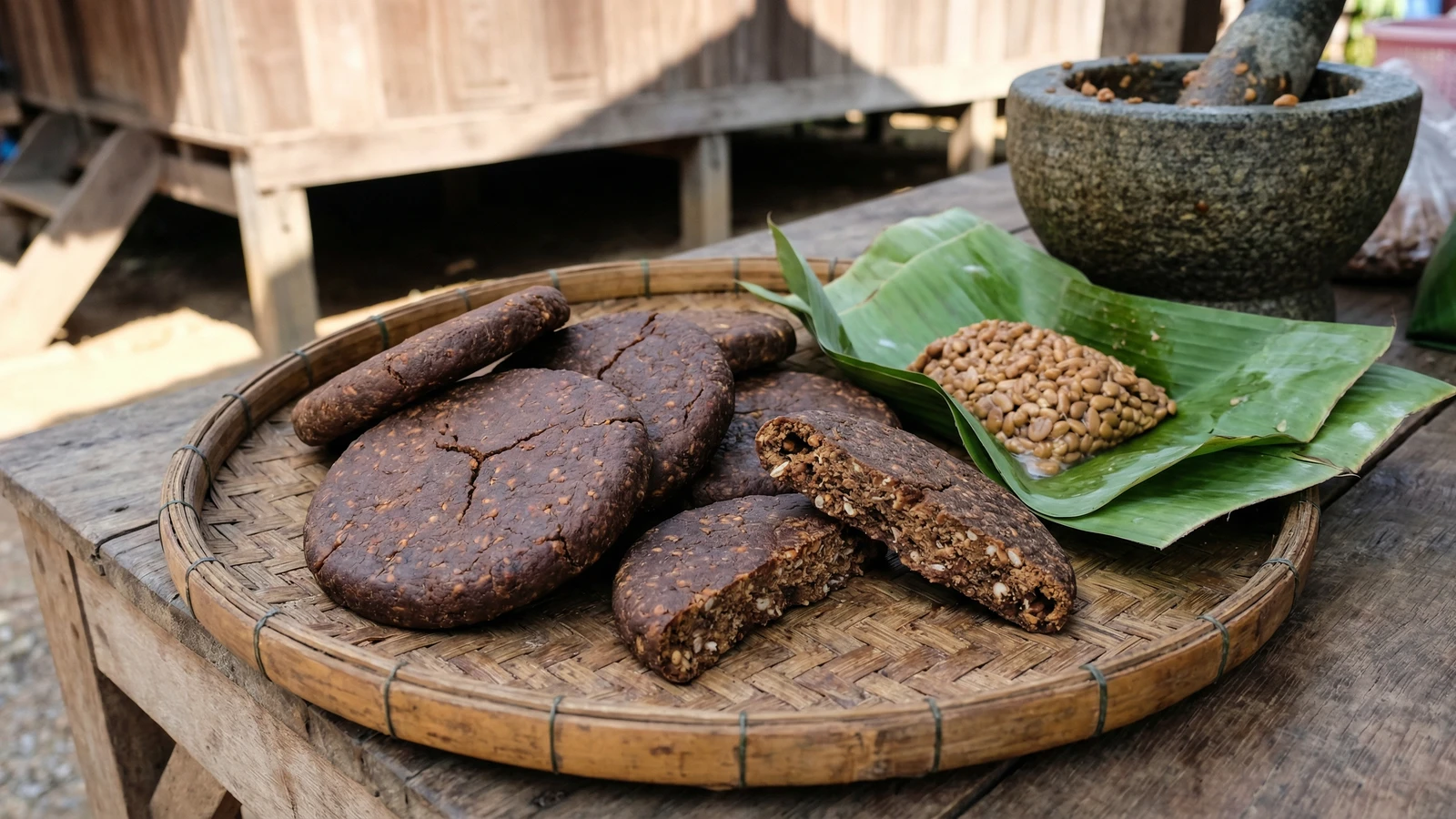
Once the beans are sticky, pungent, and strung through with those telltale threads, you pound them flat into thin discs and dry them in the sun. The sun does two things: it halts fermentation by removing moisture, and it concentrates every gram of flavor into a shelf-stable disc you can store for months. Snap off a piece, toss it into a nam prik or a bowl of gaeng khae, and you've got the Lanna pantry working for you. This isn't a recipe. It's a preservation technology that fed mountain communities through seasons when nothing else was available.
Tua nao (ถั่วเน่า, literally 'rotten beans') is a fermented soybean product unique to the Lanna kingdom's historical territory across Northern Thailand, Shan State Myanmar, and northern Laos. The technique likely arrived via ancient trade routes from Yunnan, China, where similar soybean ferments (doubanjiang precursors) have existed for over a thousand years. Tua nao predates Thailand's widespread adoption of fish sauce as a national condiment, and in remote Northern villages it remains the primary umami source, used where Central and Southern Thais would reach for kapi or nam pla. Its closest relatives in the fermented soybean family are Japanese natto, Korean cheonggukjang, and Nepali kinema, all relying on Bacillus subtilis fermentation rather than the mold-based fermentation of miso or soy sauce.
Quantity
500g
soaked overnight in water for 8-12 hours, drained
Quantity
4-6 large leaves
cleaned and passed over flame to soften
Quantity
1 teaspoon
for seasoning before drying
Quantity
as needed
for tying banana leaf parcels
| Ingredient | Quantity |
|---|---|
| dried soybeans (tua lueang)soaked overnight in water for 8-12 hours, drained | 500g |
| banana leaves (bai kluay)cleaned and passed over flame to soften | 4-6 large leaves |
| salt (optional)for seasoning before drying | 1 teaspoon |
| kitchen twine or bamboo stripsfor tying banana leaf parcels | as needed |
Put the dried soybeans in a large bowl and cover with water by at least three inches. They'll double in size overnight. Soak for a minimum of eight hours, up to twelve. When you split a bean with your fingernail, the interior should be uniformly pale and hydrated with no dry core. Drain and rinse. This step isn't optional and it isn't negotiable. Under-soaked beans won't soften properly in the pot, and under-softened beans won't ferment evenly.
Transfer the soaked beans to a large pot. Cover with fresh water by two inches. Bring to a boil, then drop to a steady simmer. Cook for three to four hours. Yes, hours. You're not cooking beans for a salad. You're breaking down cell walls so that Bacillus subtilis can access the proteins inside. The beans are done when you can crush one between your thumb and finger with zero resistance. They should be mushy, almost falling apart, with skins splitting and separating. If there's any firmness at all, keep going. Drain completely and let them cool until they're warm but not hot, around 40-45°C. The bacteria need warmth to activate, but temperatures above 50°C will slow them down.
Pass each banana leaf over a gas flame or hot coil for a few seconds per side. The leaf should turn from matte to glossy and become pliable without tearing. This does two things: it sterilizes the surface of unwanted mold spores, and it makes the leaf flexible enough to wrap tightly. Pile the warm, drained beans onto the center of a banana leaf in a mound about two inches thick. Fold the leaf over to create a sealed parcel, tucking the edges underneath. Tie it shut with kitchen twine or bamboo strips. You want it snug but not airtight. The beans need some air exchange for the aerobic bacteria to work, but the enclosure traps heat and moisture. Make two or three parcels rather than one massive one. Even distribution means even fermentation.
Place the parcels in a warm spot. In Lanna villages, this means under the stilted house or near the kitchen hearth where ambient temperature sits around 30-40°C. At home, find the warmest corner of your kitchen, near the stove, on top of the refrigerator, or in an oven with just the light on. The target temperature is 30-40°C. Below 25°C and fermentation stalls. Above 45°C and you start killing the bacteria. After 24 hours, open one parcel and check. The beans should be starting to smell: sharp, pungent, like strong cheese or overripe fruit. By 48 hours, you'll see sticky, mucilaginous threads stretching between the beans when you pull them apart. That's the Bacillus subtilis producing polyglutamic acid. Those threads are proof that fermentation is working. At 72 hours, the smell will be intense, the threads thick, and the beans will have darkened to a deep brown. Taste a bean. It should be salty-savory with a deep, almost meaty umami. If it tastes only sour or bitter, the fermentation has gone wrong, likely contamination from other bacteria. Trust your nose and your tongue. Fermented: pungent but savory. Spoiled: acrid and sharp.
Unwrap the fermented beans. They'll be sticky, dark, and intensely aromatic. If you want to add a small amount of salt for preservation, mix it in now. Using a mortar and pestle or your hands (oiled lightly to prevent sticking), pound or mash the beans into a rough paste. You're not making it smooth. You want a thick, chunky mass with some texture remaining. Take a golf-ball-sized portion and press it flat between your palms or onto a banana leaf into a disc about 8-10 centimeters across and half a centimeter thick. The thinner the disc, the faster and more evenly it dries. Repeat until all the paste is shaped.
Lay the discs on a bamboo tray, a wire rack, or clean banana leaves set in direct sunlight. You need strong sun and good airflow. In Northern Thailand, this takes one to two full days of sun exposure, flipping the discs once halfway through. The discs are done when they're hard, dry, and snap cleanly when you bend them. They should feel like a firm cracker, not a flexible wafer. If they're still bendy, they need more time. If your climate is humid or overcast, use a food dehydrator at 50-55°C for 8-12 hours, or an oven at its lowest setting with the door cracked open. The goal is dehydration, not cooking. You're removing moisture to halt bacterial activity and prevent mold during storage.
1 serving (about 25g)
Culinary guides, cultural storytelling, and the editorial depth that makes cooking meaningful.
Discover Culinary ExplorerChef Fai
The one Thai condiment where vinegar replaces lime as the sour pillar, and the system still holds. Palm sugar for sweet, nam pla for salt, prik for heat. Ajad is the four pillars in a jar.

Chef Fai
Every grilled dish in Isan answers to this dip. Roasted dried chilies, nam pla, manao, khao khua, and shallots: the four pillars in a condiment that's structural, not optional.
Chef Fai
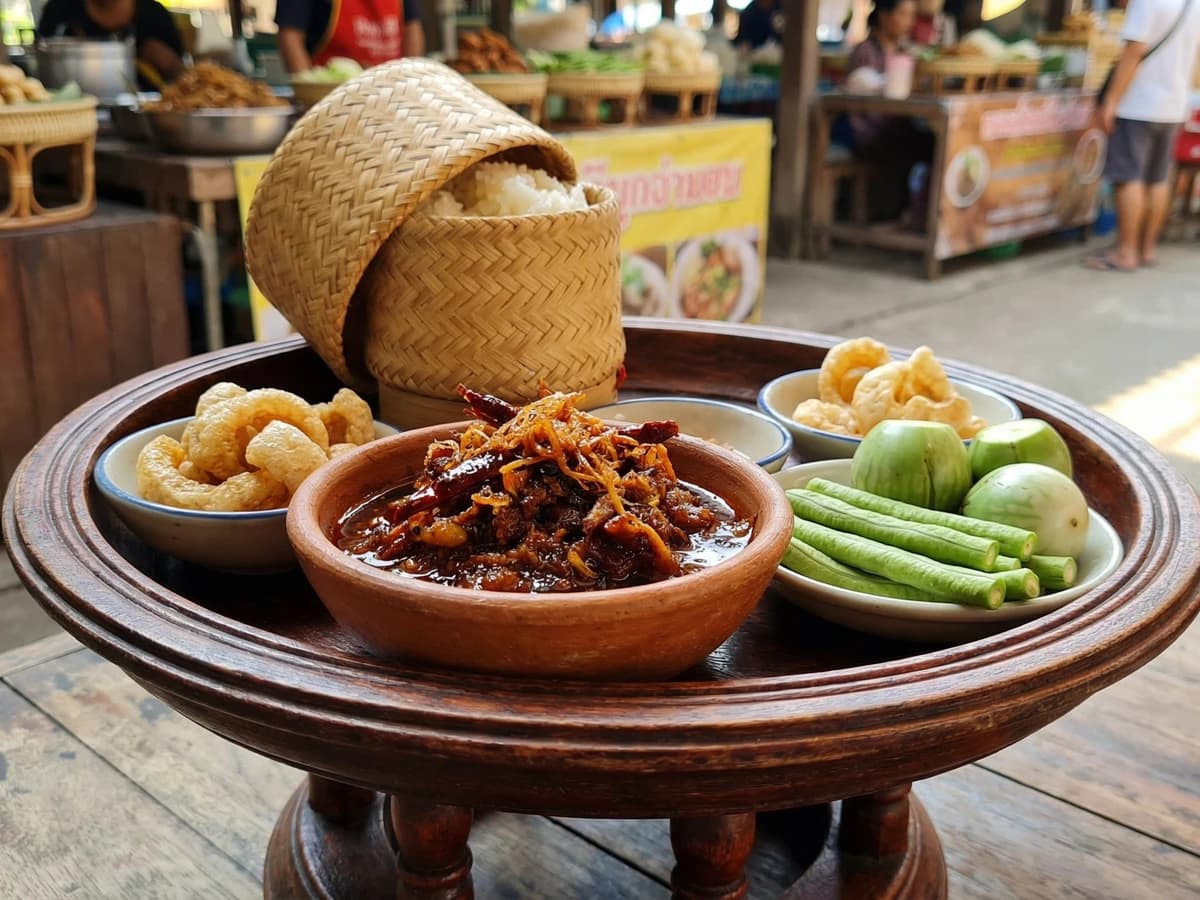
Roasted dried chilies and galangal pounded to a rough paste, folded with shredded pork skin and palm sugar until it becomes something sweet, smoky, and chewy that belongs on every khantoke tray in Chiang Mai.
Chef Fai
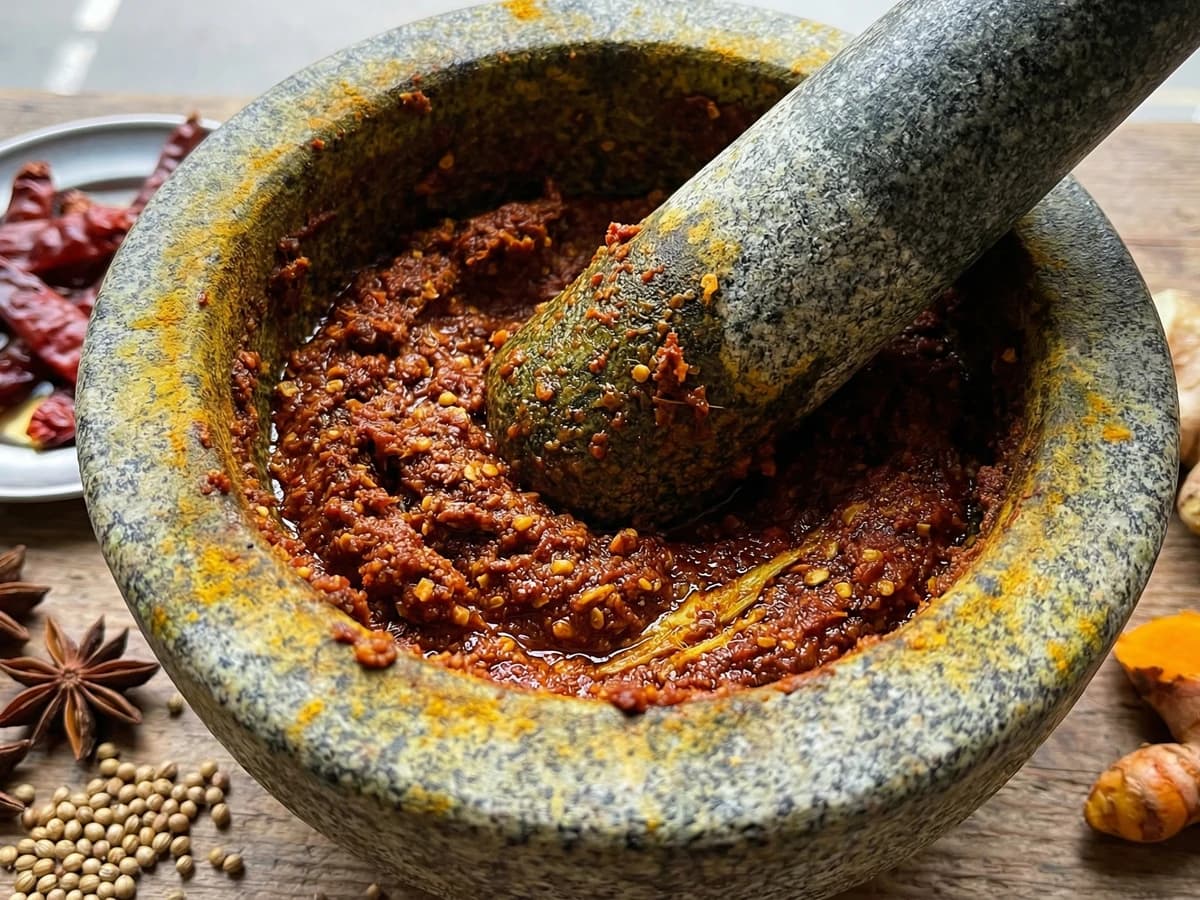
The kreung tam that proves the system adapts. Ginger instead of galangal, cumin and star anise alongside lemongrass. Lanna's mortar holds the whole Burma-to-Chiang Mai trade route in a single paste.