
Chef Jeong-sun
Agwi-jjim (Braised Monkfish with Bean Sprouts)
Firm monkfish buried under crisp soybean sprouts, minari, and a red gochugaru sauce thickened at the end; Masan's market dish asks for heat, timing, and a steady hand.
A cooking platform built around craft, culture, and the stories behind what we eat.
Created by
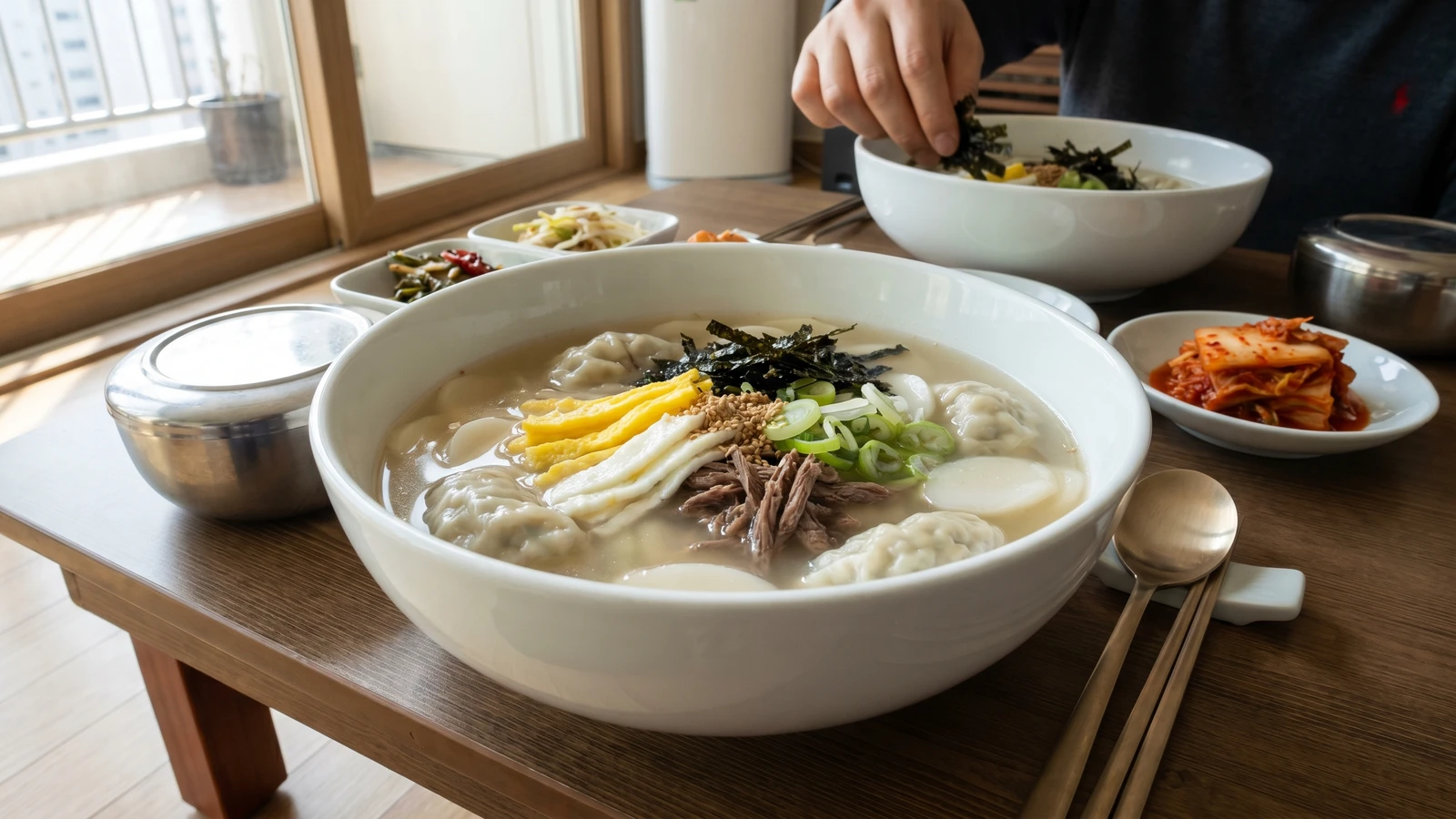
Where the rice-cake New Year bowl meets northern dumpling comfort: chewy oval tteok and plump mandu in clear broth, finished cleanly for Seollal.
On Seollal morning, the soup comes before almost everything else. Children wait for it because someone will ask how many bowls they have eaten, meaning how many years they have taken on. Adults smile at that joke because it is old and still works. Tteok-manduguk is a bowl for the family table, not a quiet meal for one.
The rice cakes must be soaked until they bend a little, but not until they sag. The dumplings must simmer gently, because hard boiling tears them open and clouds the broth with filling. That is the whole discipline of this dish: clear broth, tender mandu, chewy tteok, and seasoning restrained enough that each part still speaks for itself.
My teacher Master Seong-nyeo made us cut the egg garnish thin enough that a careless hand could ruin it by breathing too hard. I don't ask that from a tired home cook on a holiday morning, but I do ask you to separate the yolk and white and cook them gently. The yellow and white on top are not decoration only; they tell the bowl someone gave it attention.
Write down the salt at the end. Beef broth, anchovy broth, and store-bought broth all ask for different hands, and 손맛 is real. I still measure it, so it can be handed on.
Tteokguk appears in late Joseon seasonal records such as Dongguksesigi, published in 1849, as a New Year dish eaten at Seollal, with white sliced rice cakes marking a clean beginning and the taking on of another year. Mandu has especially strong ties to Korea's northern and central regions, where wheat and buckwheat dumplings were common winter food, and adding them to tteokguk became a natural holiday bowl in many Seoul, Gyeonggi, and northern-family homes. After the Korean War, displaced northern families helped spread mandu-filled soups more widely through the South.
Quantity
500g
rinsed and soaked 20 minutes if refrigerated or firm
Quantity
12 large
fresh or frozen
Quantity
250g
Quantity
8 cups
Quantity
1/2 medium
peeled
Quantity
4 cloves
lightly crushed
Quantity
1 piece, about 4 inches square
Quantity
2 teaspoons
Quantity
1 teaspoon, plus more as needed
Quantity
1/4 teaspoon
freshly ground
Quantity
2 large
separated
Quantity
1 teaspoon
Quantity
2
thinly sliced
Quantity
1 sheet
cut or crushed into thin strips
Quantity
1 teaspoon
Quantity
1 teaspoon
| Ingredient | Quantity |
|---|---|
| sliced rice cakes for soup (tteokguk-tteok)rinsed and soaked 20 minutes if refrigerated or firm | 500g |
| Korean dumplings (mandu)fresh or frozen | 12 large |
| beef brisket or shank | 250g |
| water | 8 cups |
| onionpeeled | 1/2 medium |
| garliclightly crushed | 4 cloves |
| dried kelp (dasima) | 1 piece, about 4 inches square |
| soup soy sauce (guk-ganjang) | 2 teaspoons |
| kosher salt | 1 teaspoon, plus more as needed |
| black pepperfreshly ground | 1/4 teaspoon |
| eggsseparated | 2 large |
| neutral oil | 1 teaspoon |
| scallionsthinly sliced | 2 |
| roasted gim (seaweed)cut or crushed into thin strips | 1 sheet |
| toasted sesame oil (optional) | 1 teaspoon |
| toasted sesame seeds (optional) | 1 teaspoon |
Rinse the sliced rice cakes under cold water, then soak them in a bowl of cold water for 20 minutes if they are refrigerated, firm, or stuck together. Freshly cut soft rice cakes need only a rinse. Soaking evens the texture so the outside does not turn mushy before the center softens.
Put the beef, 8 cups water, onion, garlic, and kelp in a heavy pot. Bring it slowly to a bare simmer over medium heat. Pull the kelp out as soon as the water begins to simmer, after about 10 minutes, because kelp left too long can make the broth slick and bitter.
Lower the heat and simmer the beef broth gently for 55 to 60 minutes, until the meat is tender and the broth tastes full but clean. Lift out the beef, onion, and garlic. Discard the onion and garlic, then shred or slice the beef thinly. Strain the broth if you want the clearest bowl.
Return 6 cups of broth to the pot. If you have less, add water; if you have more, save the extra. Season with 2 teaspoons soup soy sauce, 1 teaspoon kosher salt, and 1/4 teaspoon black pepper. Taste it now. It should be a little more seasoned than plain soup, because the rice cakes will soften the saltiness.
Beat the egg yolks with a pinch of salt in one bowl and the whites with a pinch of salt in another. Wipe a skillet with a little neutral oil and cook each into a thin sheet over low heat, about 1 minute per side. Keep the heat low so the colors stay clean. Cool, then slice into thin threads for jidan (egg garnish).
Drain the rice cakes and add them to the simmering broth. Stir once so they do not settle and stick. Simmer 3 to 4 minutes, until they float and turn tender but still chewy. Do not walk away here; rice cakes move from correct to swollen quickly.
Add the mandu and keep the broth at a gentle simmer, not a rolling boil. Fresh mandu usually need 4 to 5 minutes; frozen mandu need 7 to 8 minutes. They are done when the skins look slightly translucent and the filling is hot through. Hard boiling tears the wrappers and muddies the soup.
Taste the broth one last time and add salt in 1/4 teaspoon increments only if it needs it. Divide the rice cakes, mandu, broth, and shredded beef among four bowls. Top with jidan, scallion, gim, and a few sesame seeds if using. Add a few drops of sesame oil only at the table, because too much turns a clean broth heavy.
1 serving (about 520g)
Culinary guides, cultural storytelling, and the editorial depth that makes cooking meaningful.
Discover Culinary ExplorerChef Jeong-sun
Firm monkfish buried under crisp soybean sprouts, minari, and a red gochugaru sauce thickened at the end; Masan's market dish asks for heat, timing, and a steady hand.

Chef Jeong-sun
A quick Korean rice bowl built on contrast: warm rice, cold popping flying-fish roe, chopped vegetables, gim, sesame oil, and the crisp rice bottom a hot stone bowl gives you.
Chef Jeong-sun
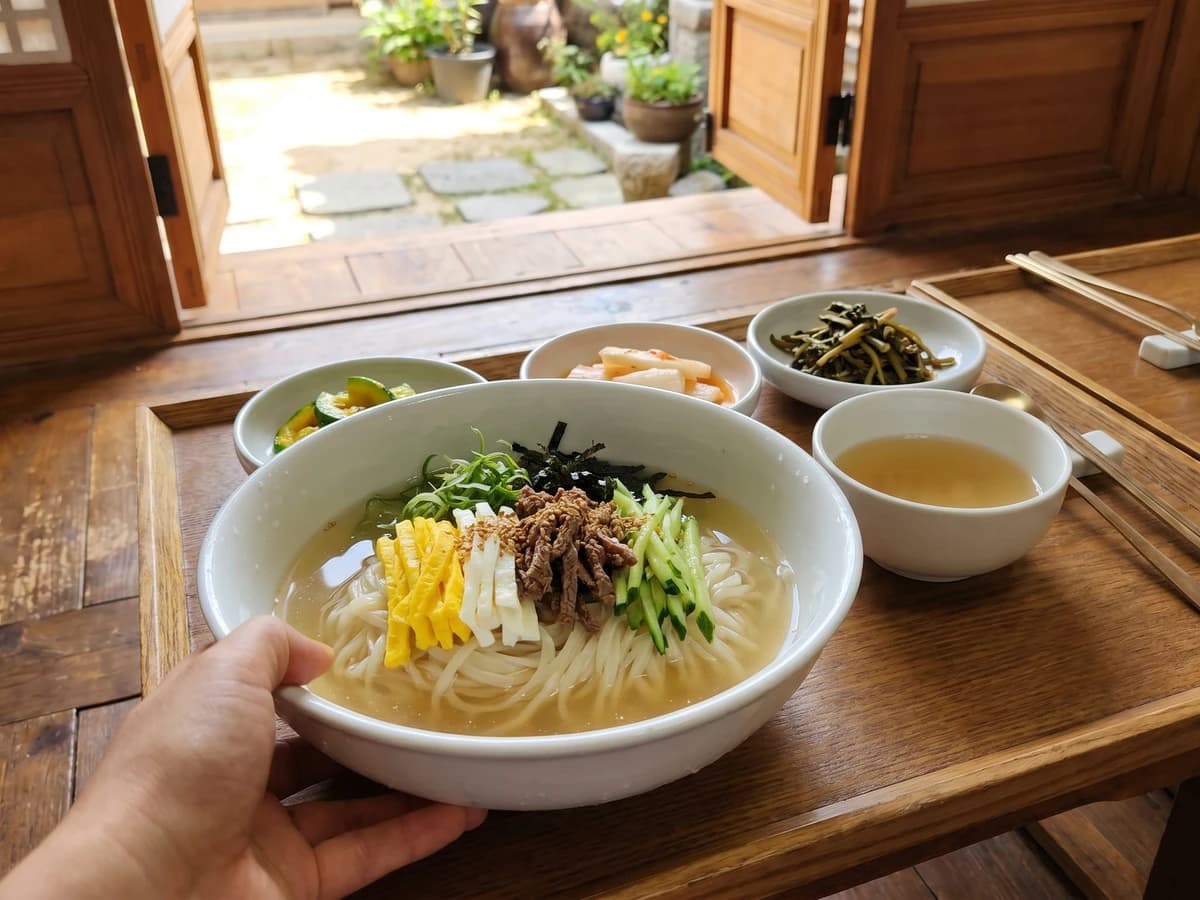
Andong's guest noodles, wheat and roasted soybean flour rolled thin, boiled and rinsed cold, then set in a clear chilled anchovy broth with careful strips of beef, egg, and cucumber.

Chef Jeong-sun
Andong's ritual-table rice served on an ordinary day: separate soy-sesame namul, warm rice, and clear radish soup, mixed without gochujang so every vegetable keeps its own voice.