
Chef Dimitra
Agrafa Batzina (Μπατζίνα), Courgette and Feta Pie
Agrafa's batzina is the no-phyllo pie of Karditsa: grated courgette, feta, eggs, milk, and flour poured thin into a hot oiled tapsi.
A cooking platform built around craft, culture, and the stories behind what we eat.
Created by
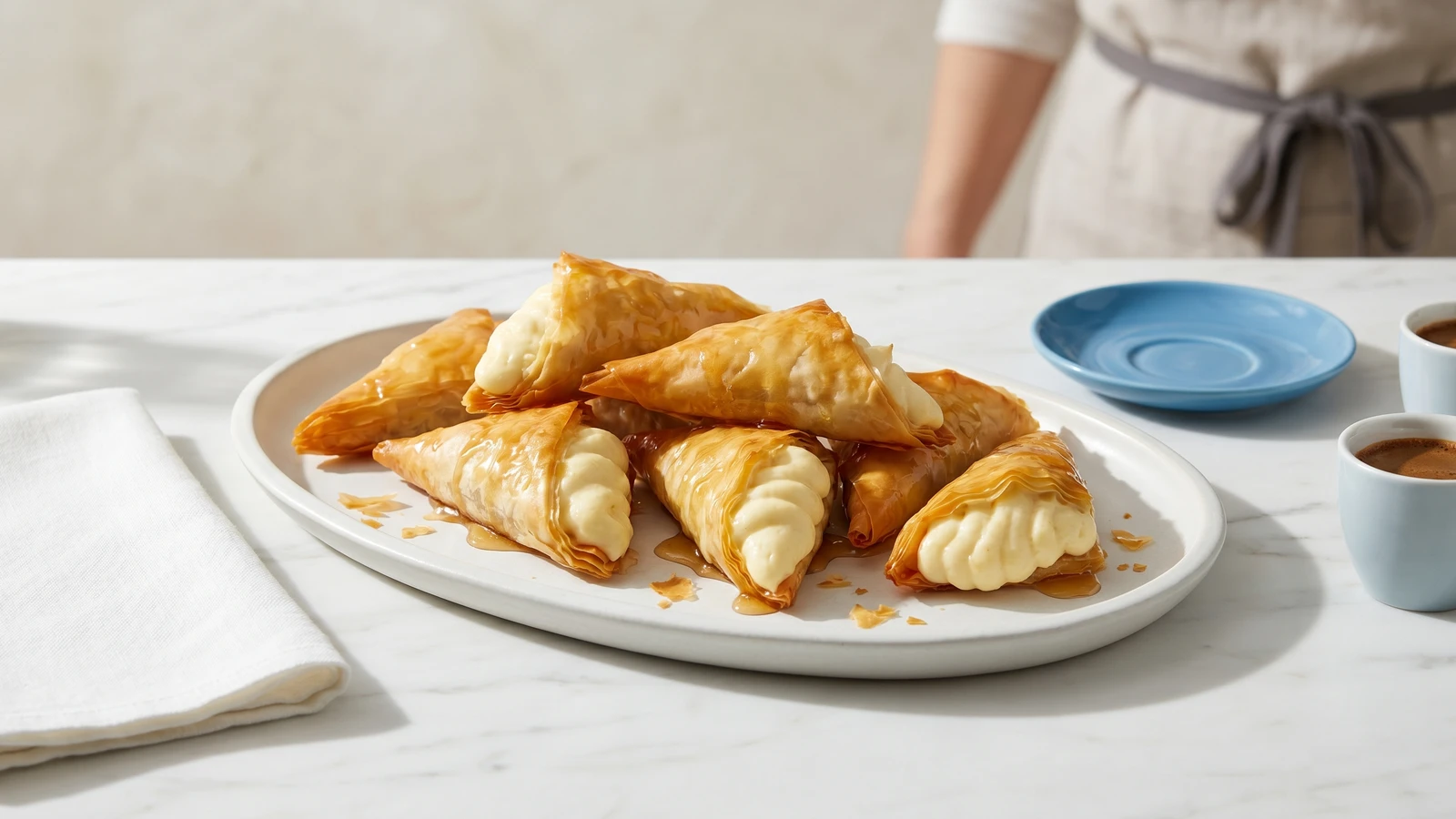
Panorama gives these Thessaloniki pastries their name: syruped phyllo triangles, crisp at the points, filled only at the last moment with cold vanilla custard.
Trigona Panoramatos are Thessaloniki's pastry by surname, born in Panorama and known by the crackle of syruped phyllo around cold vanilla custard. They are not ordinary triangles of phyllo. They are hollow cones, baked until gold, dipped in syrup, drained, then filled from the wide mouth so the custard sits proud and pale against the amber shell.
The one rule is service. Keep the shells and the custard separate until the last moment. Phyllo loves moisture, too much, the poor thing, and custard will soften those fine layers faster than you think. Fill to order and you get the proper contrast: cold cream, sweet syrup, crisp points that break cleanly under your teeth.
This is special-occasion Thessaloniki food, the box you carry carefully to a name-day table or buy after a walk up in Panorama. I don't invent it. I find it, I test it, I write it down. Here the numbers are only there so your first tray comes out like something you would be proud to serve.
Trigona Panoramatos are tied to Panorama, the hillside suburb of Thessaloniki, where the pastry became famous in the mid-20th century through local pastry shops, especially the Elenidis family business. The form belongs to the northern Greek love of syruped phyllo sweets, but the cold custard filling and hollow triangular shell made Panorama's version distinct from baklava-style triangles. Its name preserves the place of origin, which is why the region is the dish's surname.
Quantity
450g
thawed overnight in the refrigerator
Quantity
180g
melted and cooled slightly
Quantity
40g
Quantity
500ml
Quantity
100g
Quantity
40g
Quantity
25g
Quantity
2
Quantity
1
Quantity
1 teaspoon
Quantity
1 strip
Quantity
30g
Quantity
600g
Quantity
400ml
Quantity
1 tablespoon
Quantity
1 strip
| Ingredient | Quantity |
|---|---|
| phyllo pastrythawed overnight in the refrigerator | 450g |
| unsalted buttermelted and cooled slightly | 180g |
| fine dry breadcrumbs | 40g |
| whole milk | 500ml |
| granulated sugar | 100g |
| fine semolina | 40g |
| cornstarch | 25g |
| large eggs | 2 |
| large egg yolk | 1 |
| vanilla extract | 1 teaspoon |
| lemon peel | 1 strip |
| unsalted butter, for the custard | 30g |
| granulated sugar, for the syrup | 600g |
| water, for the syrup | 400ml |
| lemon juice | 1 tablespoon |
| lemon peel, for the syrup | 1 strip |
Put the sugar, water, lemon juice, and lemon peel in a saucepan. Bring to a boil, then simmer for 6 minutes until clear and lightly thickened. Take it off the heat and let it cool completely. The shells will go into cold syrup after baking, so don't rush this.
Warm the milk with the lemon peel until hot but not boiling, then remove the peel. In a bowl, whisk the eggs, yolk, sugar, semolina, cornstarch, and vanilla until smooth. Pour in the hot milk slowly, whisking all the time, then return everything to the saucepan. Cook over medium-low heat, stirring constantly, until the custard thickens and leaves a clean trail on the spoon, 4 to 6 minutes. Beat in the butter, scrape into a shallow dish, cover the surface directly, and chill until cold.
Heat the oven to 180C. Lay the phyllo under a barely damp towel so it doesn't dry while you work. Cut the sheets lengthwise into strips about 9cm wide. Brush one strip with butter, lay a second strip over it, brush again, and sprinkle a pinch of breadcrumbs near the first fold. The crumbs are not there for taste. They help keep the inner layers apart so the syruped shell still has bite.
Fold the end of each buttered strip over a small cone mold or your fingers to make a hollow triangle, then keep folding like a flag until you reach the end. The point should be closed and the wide side open for filling. Brush the outside lightly with butter and set the triangles seam-side down on a lined baking tray.
Bake for 18 to 22 minutes, turning the tray once, until the phyllo is deep gold and crisp at the edges. Let them stand for 3 minutes, just long enough that they stop hissing on the tray, but don't let them cool fully before syruping.
Dip the warm shells into the cold syrup for 20 to 30 seconds, turning once so the outside drinks evenly. Lift them out, open side down, and drain on a rack set over a tray. Leave them until completely cool and dry to the touch on the outside, at least 45 minutes.
Whisk the cold custard until smooth, then pipe it generously into the open side of each triangle. Serve within the hour. This is the rule that decides the dish: cold custard goes into cooled syruped shells only when you're ready to eat. Fill them early and the sharp phyllo turns to paste.
1 serving (about 115g)
Culinary guides, cultural storytelling, and the editorial depth that makes cooking meaningful.
Discover Culinary ExplorerChef Dimitra
Agrafa's batzina is the no-phyllo pie of Karditsa: grated courgette, feta, eggs, milk, and flour poured thin into a hot oiled tapsi.

Chef Dimitra
Zagori's flour pie skips phyllo completely: a loose egg-and-flour batter, crumbled feta, and a hot buttered tapsi that makes the edges crisp.

Chef Dimitra
Hydra and Andros give amygdalota their island surname: ground almond, sugar, egg white, and rosewater, baked pale so the center stays soft as marzipan.

Chef Dimitra
Asia Minor ekmek kataifi is built in three clear layers: crisp syruped kataifi, thick semolina custard, and cold kaimaki cream under pistachios.