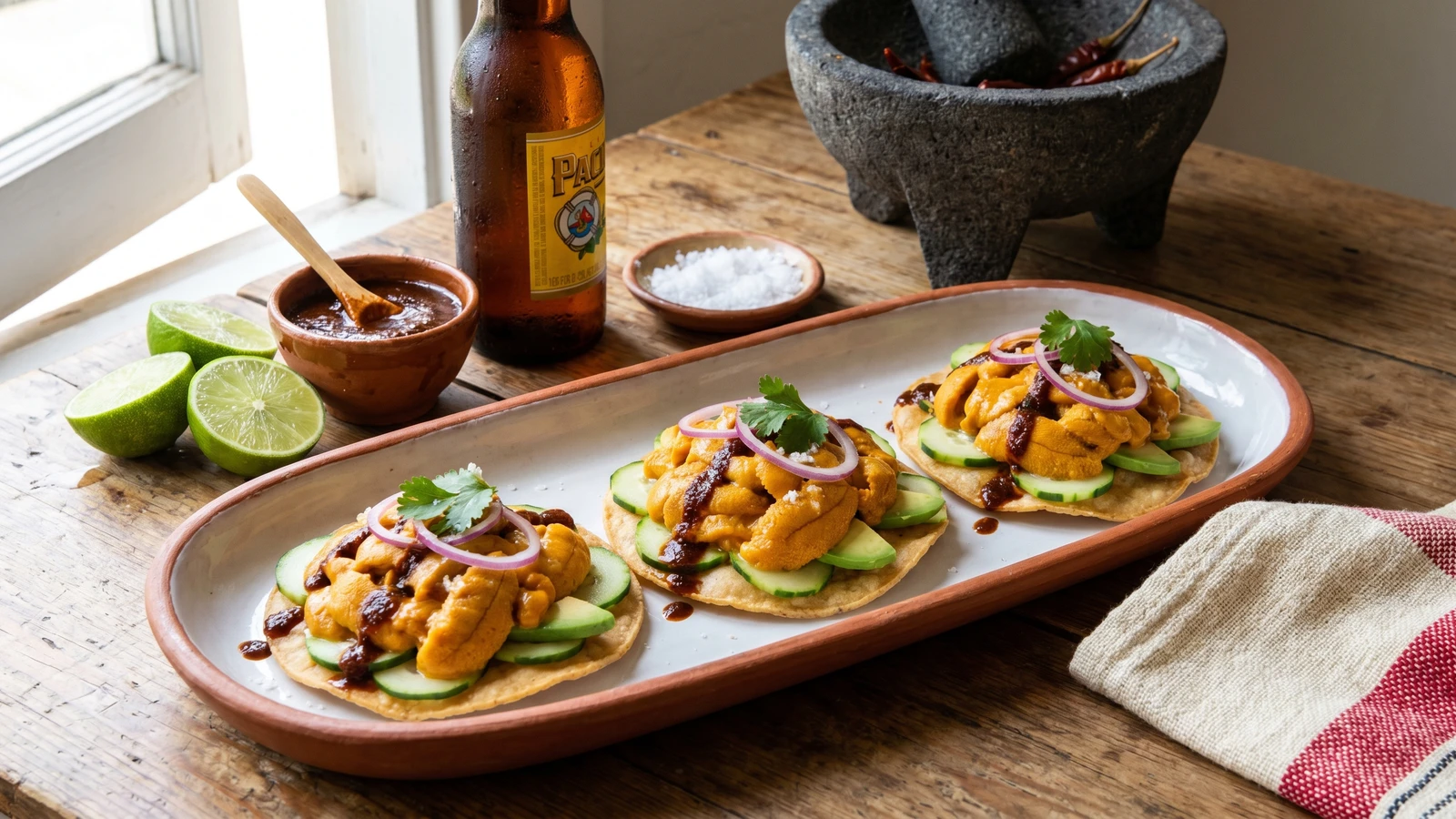
Ensenada's Mercado Negro tostada, fresh sea urchin spooned over a lard-fried tortilla with avocado, cucumber, a smoky chile de arbol salsa, and a hard squeeze of limon mexicano.
Appetizers & Snacks
Mexican
Special Occasion
Dinner Party
Date Night
30 min
Active Time
10 min cook•40 min total
Yield6 tostadas
This is from Baja California. Specifically from Ensenada, the port city two hours south of the border, where the Mercado Negro pulls fish out of the Pacific every morning and the sidewalk carts outside the market turn that catch into tostadas before lunch. There is no other place this dish belongs to. Erizo de mar is the wild, golden interior of the sea urchin, and Baja's coast is one of the few places in Mexico where it comes out of the water in the volume and quality this preparation demands.
Sabina Bandera built her name on this tostada. La Guerrerense, her cart on the corner of Avenida Ruiz and Calle Primera, has been serving these for over sixty years and the line still wraps around the block at noon. Sabina did not invent the tostada de mariscos. She perfected the version with erizo and put Ensenada on the map for it. Anthony Bourdain ate there. The James Beard people gave her an award. None of that changed the cart, the line, or the way she insists the salsa goes on last.
The rules are short and absolute. The erizo must be alive that morning. The tortilla must be fried in lard, not oil. The salsa must be charred on a comal, not blended raw. The lime must be limon mexicano, the small bracing green ones, not Persian lime. And the tostada must be eaten the moment it is dressed, standing at the cart, before the tortilla begins to soften beneath the weight of the sea. My mother never made this dish. She never lived on the coast. But the first time I ate one at La Guerrerense in my twenties I understood what the people of Baja already knew: that some dishes are the place they come from, and you cannot move them. Saber cocinar es saber vivir.
Sea urchin harvesting in Baja California's Pacific waters became a commercial industry in the 1970s, driven largely by Japanese demand for uni, and the local fishing cooperatives in Ensenada and along the Punta Banda peninsula began retaining a portion of the catch for the city's own marisquerias and street carts. The tostada de mariscos as a format predates the erizo version by decades and traces to the broader northwestern Mexican tradition of cocteles and tostadas served at puerto markets from Mazatlan up to Tijuana. Sabina Bandera Gonzalez opened La Guerrerense in 1960 and is widely credited with codifying the erizo tostada as a specifically Ensenadense dish; the carts soy-and-chile salsa lineage reflects the historic Cantonese presence in Baja California, dating to Chinese immigration through the port of Ensenada in the late 19th and early 20th centuries.
The technique, the tradition, and the story behind every dish.
pork lard (manteca de cerdo) or neutral oilfor frying
1/2 cup
ripe Hass avocadosliced thin
1
small cucumberpeeled and sliced into thin half-moons
1
small red onionsliced paper-thin
1/4
limones mexicanos (Key limes)halved
2
flaky sea salt
for finishing
fresh cilantroleaves only
6 sprigs
dried chile de arbolstemmed (for the salsa)
4
dried chile guajillostemmed and seeded (for the salsa)
2
garlic clovesunpeeled (for the salsa)
2
Roma tomatofor the salsa
1 small
fresh lime juicefor the salsa
2 tablespoons
soy saucefor the salsa
2 tablespoons
kosher saltfor the salsa
1 teaspoon
Equipment Needed
•Cast iron comal or heavy skillet for charring and toasting
•Small heavy skillet for frying the tortillas
•Wire rack set over a sheet pan for draining the tostadas
•Blender for the salsa
•Sharp paring knife for the avocado and cucumber
Instructions
1
Inspect the erizo
Open the container of sea urchin lobes on a cold work surface and look at them. They should be firm, intact, and the color of a Baja sunset, deep gold to bright orange. They should smell like the open ocean and nothing else. If they smell of ammonia or sit slack and broken in their tray, they are gone. Send them back. Erizo waits for nobody. Cover the good ones with a damp paper towel and return them to the refrigerator while you work. Si no conoces el mercado, no conoces la cocina.
2
Char the salsa ingredients
Heat a dry comal or heavy skillet over medium-high. Lay the unpeeled garlic and the whole tomato directly on the hot surface. Turn the garlic every minute or so until the skin is blackened in patches and the clove inside is soft, about 8 minutes. The tomato wants charred, blistered skin on every side and a soft, slumped interior, about 10 minutes. Pull both off and let them cool enough to handle.
Char on a comal, not in the oven. The dry, direct heat is what gives the salsa that smoke-edged depth that distinguishes a Baja salsa from a generic blender salsa.
3
Toast the chiles
Lower the comal to medium. Toast the chile de arbol and chile guajillo separately, about 20 seconds per side for the arbol, 30 seconds for the guajillo. The arbol turns the fastest because it is thin and dry. Watch it. The skin should puff and the kitchen should smell of toasted chile, never of burning. Burned chile is bitter chile and there is no fixing it later. Asi se hace y punto.
4
Build the salsa
Peel the charred garlic. Drop it into a blender with the toasted chiles, the charred tomato (skin and all), the lime juice, the soy sauce, the kosher salt, and 3 tablespoons of cold water. Blend in short pulses until you have a thick, dark salsa with visible flecks of chile. You want texture, not a smooth puree. Taste. It should be salty, smoky, hot, and bright with the lime. The soy is not a fusion gesture. The Chinese-Mexican community in Baja built it into the local salsas a hundred years ago and it belongs there. Set the salsa aside in a small clay bowl.
5
Fry the tortillas
Heat the lard in a small heavy skillet over medium-high until it shimmers. The fat is ready when a corner of tortilla dropped in bubbles immediately. Slide one tortilla in at a time. Press it down with the back of a slotted spatula so it stays flat and crisps evenly, about 45 seconds per side. The tostada is done when it is pale gold and rigid. Drain on a wire rack, never on paper towels stacked flat, or the steam beneath them turns the bottom soggy. Salt them lightly the second they come out of the fat. La manteca es el sabor and a tostada fried in lard is a different animal from one fried in oil.
6
Dress the tostadas
Work fast and serve immediately. Lay each tostada on a plate. Fan two or three thin slices of avocado across the surface. Add three or four cucumber half-moons and a few rings of red onion. Spoon the erizo on top in generous lobes, six or seven pieces per tostada, arranged so every bite gets some. Do not crush them. The lobes should sit whole and proud.
7
Finish at the table
Drizzle a small spoonful of the chile de arbol salsa across the erizo, never enough to drown it. Scatter the cilantro leaves on top. Hit each tostada with a pinch of flaky salt and a squeeze of limon mexicano right before it goes to the mouth. The lime is not a garnish. It is the ingredient that wakes the erizo up and tells you it came from the Pacific that morning. Eat it standing up, the way they do at La Guerrerense. Recetas probadas y garantizadas.
Chef Tips
•Source the erizo from a fishmonger who deals directly with a diver or a Pacific cooperative. The lobes should arrive in seawater or on clean ice, never frozen and thawed. If your only option is a frozen tray from the supermarket, this is not the dish to make today. Cook something else and wait.
•Limon mexicano is not interchangeable with Persian lime. The small green ones with the thin skin are sharper, more floral, more bracing. They are what cuts the richness of the erizo. If you cannot find them, use the juice of one Persian lime mixed with a little fresh grapefruit juice. A substitution is a compromise, not an upgrade.
•The soy sauce in the salsa is not a fusion experiment. The Chinese-Mexican community has been part of Baja California for over a century and their influence is woven into the local salsas, the cocteles, and the seasoning of the seafood. Leave it in. It is the recipe.
•Do not stack the tostadas, do not transport them, do not try to plate them ahead. The whole architecture collapses in five minutes. Build them at the counter and eat them at the counter. No me vengas con atajos.
Advance Preparation
•The chile de arbol salsa can be made one day ahead and refrigerated in a sealed glass jar. The flavors deepen overnight.
•The tostadas can be fried up to four hours ahead and held at room temperature on a wire rack, uncovered, so they stay crisp.
•The erizo cannot be held. Buy it the morning you serve it, keep it on ice, and dress the tostadas only at the moment of eating. There is no advance preparation that respects this ingredient.
Frequently Asked Questions
Nutrition Information
1 serving (about 165g)
Calories
220 calories
Total Fat
13 g
Saturated Fat
3 g
Trans Fat
0 g
Unsaturated Fat
9 g
Cholesterol
165 mg
Sodium
680 mg
Total Carbohydrates
14 g
Dietary Fiber
3 g
Sugars
1 g
Protein
11 g
Where cooking meets culture.
Culinary guides, cultural storytelling, and the editorial depth that makes cooking meaningful.