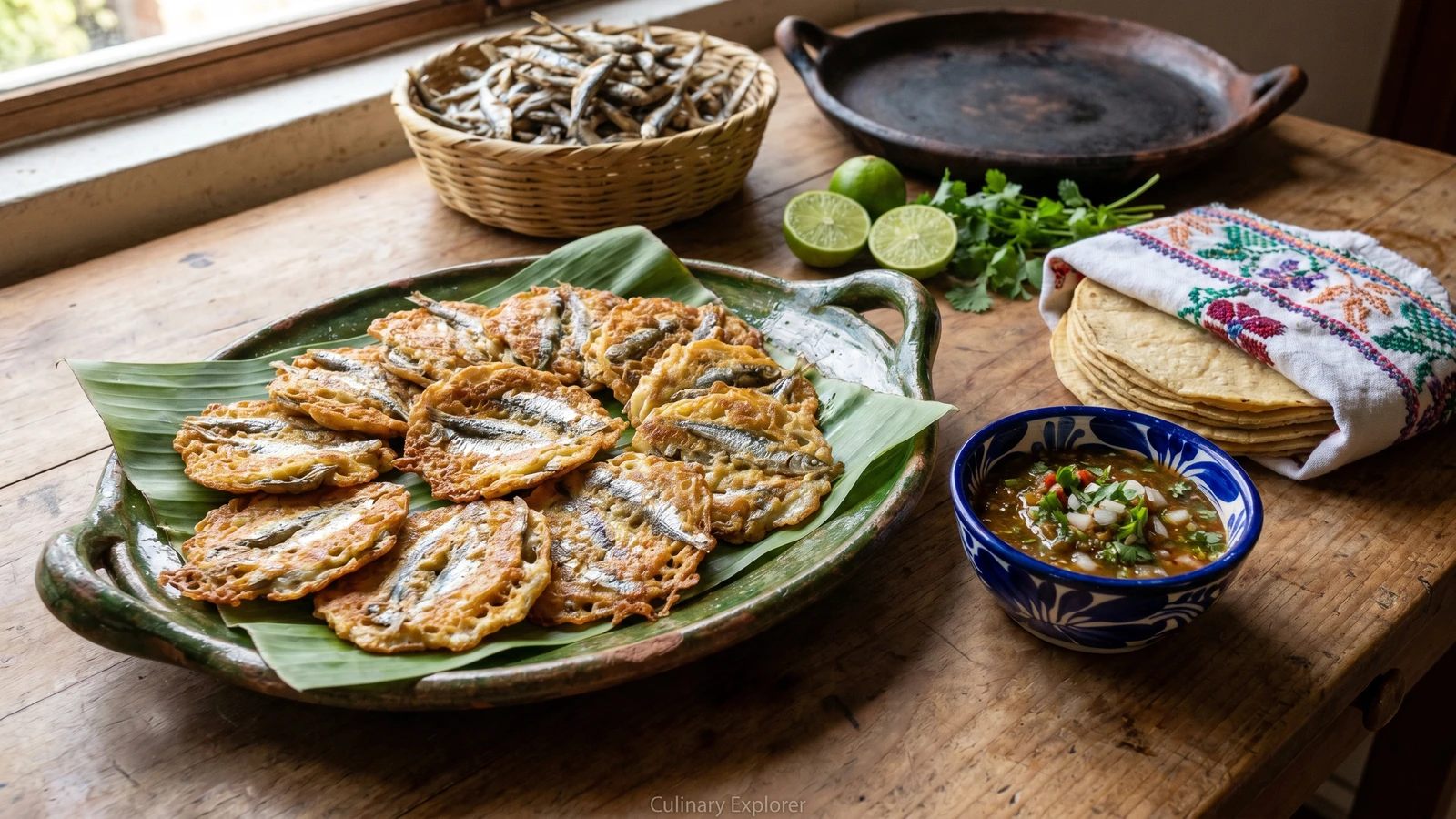
Michoacán's Pátzcuaro lake fritters, made with tiny endemic charales, masa nixtamalizada, egg, and manteca, served with chile perón salsa from the Meseta.
Appetizers & Snacks
Mexican
Comfort Food
Budget Friendly
Quick Meal
25 min
Active Time
20 min cook•45 min total
Yield12 small tortitas, 4 servings
Michoacán, the Lake Pátzcuaro basin, the Japunda in P'urhépecha memory. That is where these tortitas live. Charal is not just a small fish. It is the lake in edible form, Chirostoma jordani and its relatives, dried in the sun, sold in woven baskets, carried into kitchens where nothing is wasted because the lake has never been a pantry for lazy people.
The cocineras tradicionales of Pátzcuaro, Uruapan, and the Meseta know this food as work, not decoration. They bind the charales with egg, masa nixtamalizada, a little harina, onion, cilantro, and fry the tortitas in manteca de cerdo until the edges crisp. La manteca es el sabor. The salsa belongs beside it: chile perón, called chile manzano in some markets, thick-fleshed, with black seeds and a clean bite that cuts the fat.
Do not flatten Michoacán into one regional label. This is P'urhépecha country, older than the Aztec empire and still speaking in its own vocabulary: corunda, uchepo, jahuácata, tsïkanarhikata, kurucha, minguiche, kamáta. The tamal family alone is an architecture lesson. Corunda is triangular, charicorunda is smaller with chile in the masa, jahuácata layers masa and bean for Candelaria, chápata carries piloncillo and bean, nacatamal belongs to Day of the Dead in Angahuan, and toquera sits between tamal and gordita when maíz nuevo arrives.
My mother was from Jalisco, so these were not her daily food. I learned them at the lake, from women who worked over leña and served them on clay from Capula and Patamban, with hoja de maíz fresca de la planta under the fritters to keep the table honest. Saber cocinar es saber vivir. Cada estado, su propia cocina.
The P'urhépecha, called Tarascans by the Spanish, formed an empire in western Mexico that resisted Mexica expansion before the conquest, and Lake Pátzcuaro's small endemic whitefish and charales were central to its lacustrine food economy. Charales belong to the genus Chirostoma, a group native to central Mexican lakes, and their drying and frying made them portable, economical protein long before refrigeration. UNESCO's 2010 inscription of Traditional Mexican Cuisine as Intangible Cultural Heritage cited the Michoacán paradigm specifically, including the role of cocineras tradicionales in keeping indigenous corn, lake, and hearth techniques alive.
The technique, the tradition, and the story behind every dish.
also sold as chile manzano, black seeds visible when cut
tomatillos
Quantity
2 medium
husked and rinsed
white onion for salsa
Quantity
1/4 small
garlic clove for salsa
Quantity
1 small
lime juice
Quantity
1 tablespoon
hoja de maíz fresca de la planta (optional)
Quantity
as needed
rinsed, for lining the platter
lime halves (optional)
Quantity
for serving
warm corn tortillas (optional)
Quantity
for serving
Ingredient
Quantity
dried charal (Chirostoma jordani et al.)rinsed quickly and picked over
3 ounces
large eggsseparated
2
masa nixtamalizada or fresh masa for tortillas
1/4 cup
all-purpose flour
2 tablespoons
white onionfinely chopped
2 tablespoons
cilantrochopped
2 tablespoons
garlic clovefinely grated
1 small
kosher salt
1/4 teaspoon, plus more to taste
manteca de cerdofor frying
1/2 cup
fresh chile perónalso sold as chile manzano, black seeds visible when cut
6
tomatilloshusked and rinsed
2 medium
white onion for salsa
1/4 small
garlic clove for salsa
1 small
lime juice
1 tablespoon
hoja de maíz fresca de la planta (optional)rinsed, for lining the platter
as needed
lime halves (optional)
for serving
warm corn tortillas (optional)
for serving
Equipment Needed
•Comal de barro or heavy cast iron skillet
•Volcanic stone molcajete
•Wide heavy skillet for frying
•Wire rack or brown paper for draining
•Green-glazed clay platter from Capula or Patamban, if available
Instructions
1
Clean the charales
Rinse the dried charales quickly under cool water and drain them well on a clean towel. Do not soak them like beans. They should soften slightly but keep their lake flavor and their shape. Pick out any hard bits. A good charal smells clean and saline, not rancid. If it smells old, the mercado failed you before the stove had a chance.
2
Roast the salsa
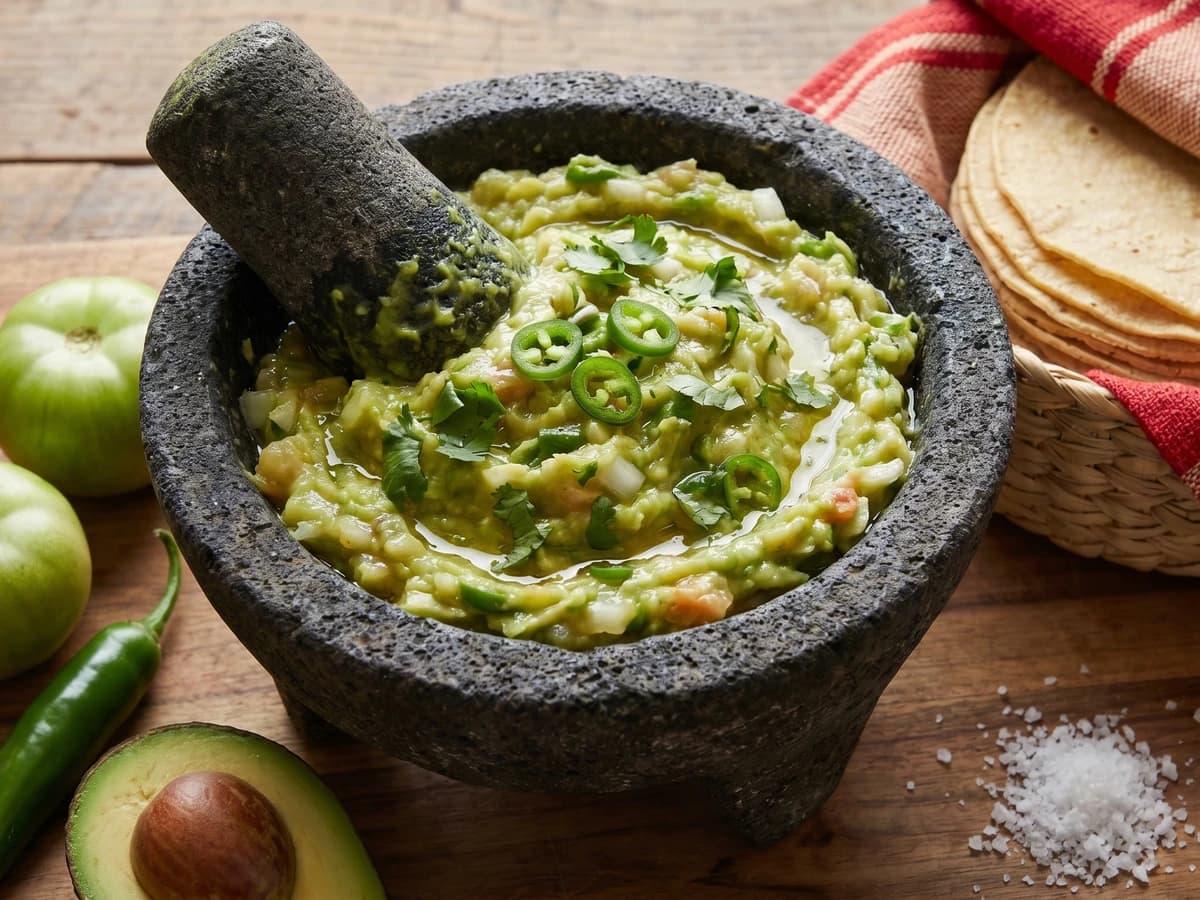
Set a comal de barro or heavy skillet over medium heat. Roast the chile perón, tomatillos, onion, and garlic until the skins blister and dark spots appear. The chile perón is round, thick-fleshed, and has black seeds. That is how you know you have the right chile. Remove the stems, keep some seeds if you want the salsa stronger, and grind everything in a molcajete with lime juice and salt. The salsa should be bright, sharp, and a little rough. A blender works, but the molcajete gives this salsa its teeth.
Chile perón is called chile manzano in many markets outside Michoacán. Ask for the round chile with black seeds. Pregúntale a las señoras del mercado.
3
Make the batter
Beat the egg whites in a bowl until they hold soft peaks. In another bowl, mix the yolks with the masa nixtamalizada, flour, onion, cilantro, grated garlic, and salt. Fold in the charales, then fold in the beaten whites. The mixture should hold together in a spoon but still feel light. The masa gives corn flavor and grip. The flour steadies it. Too much flour makes a heavy tortita, and nobody in Pátzcuaro asked for that.
4
Fry in manteca
Melt the manteca de cerdo in a wide skillet over medium heat until it shimmers. Drop heaping tablespoons of the charal mixture into the fat and flatten them gently into small cakes. Fry 2 to 3 minutes per side, until golden, crisp at the edges, and firm in the center. La manteca es el sabor. Shortening is not manteca. No me vengas con atajos.
Do not crowd the pan. Crowding drops the temperature and the tortitas drink fat instead of frying clean.
5
Drain and serve
Lift the tortitas onto a rack or brown paper for one minute, then move them to a platter lined with hoja de maíz fresca de la planta. This is the fresh leaf from the corn plant, not the dry corn husk used for many tamales. Spoon chile perón salsa over some tortitas and leave some dry for the table. Serve with lime halves and warm corn tortillas. Eat them while the edges are still crisp.
Chef Tips
•Buy charales from a vendor who moves product quickly. They should look silvery beige and smell clean, not oily or stale. If you are outside Mexico, look in Mexican markets that stock Lenten ingredients and ask for charal from Michoacán.
•Use masa nixtamalizada if you can get it from a tortillería. Masa harina mixed with a little warm water will work, but it is a compromise, not an upgrade. Fresh masa tastes like corn because it is corn treated with cal, not powder pretending to be memory.
•Chile perón is the Michoacán chile for this table. If your market only labels it chile manzano, cut one open and look for black seeds. That is the signature.
•Hoja de maíz fresca de la planta is not the same thing as the dry husk used to wrap tamales. Here it lines the platter and gives the serving the green, field smell of new corn. If you cannot get it, use a clean cloth servilleta instead of pretending a dry husk is the same thing.
•Cook over leña if you have a safe outdoor setup. If not, use a comal de barro for the salsa and a heavy skillet for the tortitas. The point is steady heat and real browning, not performance.
Advance Preparation
•The chile perón salsa can be made up to one day ahead and refrigerated. Bring it to room temperature before serving so the chile flavor wakes back up.
•The charales can be picked over and rinsed two hours ahead. Keep them spread on a towel so they do not sit wet.
•Fry the tortitas close to serving. They can be reheated on a dry comal for a few minutes, but they are best when the edges are still crisp from the manteca.
Frequently Asked Questions
Nutrition Information
1 serving (about 205g)
Calories
340 calories
Total Fat
18 g
Saturated Fat
6 g
Trans Fat
0 g
Unsaturated Fat
10 g
Cholesterol
185 mg
Sodium
650 mg
Total Carbohydrates
23 g
Dietary Fiber
4 g
Sugars
4 g
Protein
23 g
Where cooking meets culture.
Culinary guides, cultural storytelling, and the editorial depth that makes cooking meaningful.