
Chef Lupita
Birria Tacos with Consome
Jalisco's goat birria, born around Cocula and carried into Guadalajara's markets, slow-braised in ancho, guajillo, cascabel, and chile de arbol, then tucked into corn tortillas crisped in its own red fat.
A cooking platform built around craft, culture, and the stories behind what we eat.
Created by
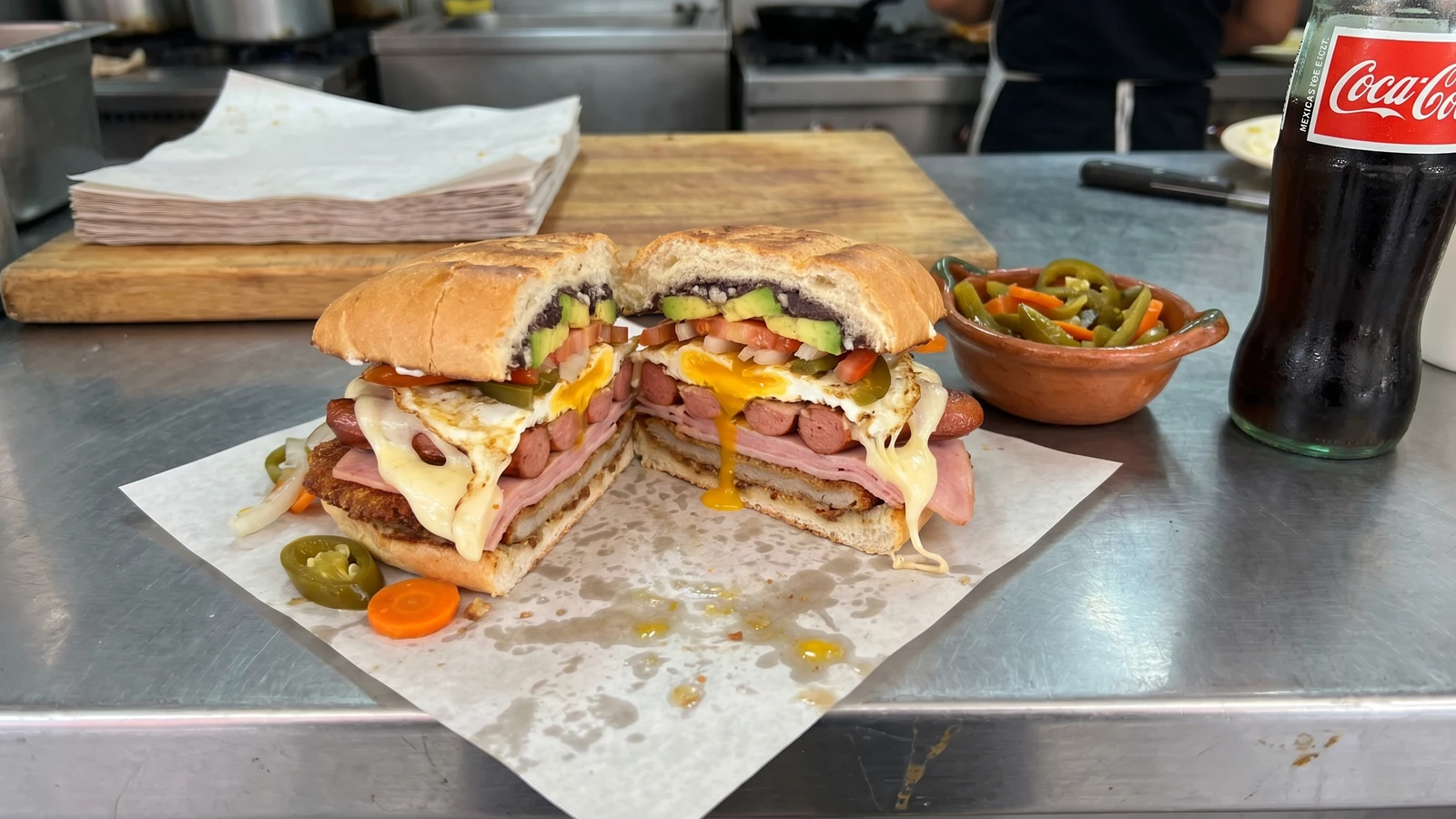
Ciudad de Mexico's maximalist torta, built on a telera and stacked with milanesa, pierna, ham, salchicha, queso, fried egg, and avocado. Nothing Cuban about it. All chilango excess and proud of it.
This torta is from Ciudad de Mexico. Not Cuba. The name is a chilango joke that nobody can explain anymore, and the dish has nothing to do with the island. It is a creation of the torterias around the Centro Historico, places like Tortas Robles and El Cuadrilatero, where the cooks behind the counter have spent decades stacking everything in the cooler between two halves of a telera.
The telera is the foundation. Soft oval bread with three scored ridges, a tender crumb, just enough crust to hold the weight. If you cannot find a telera, do not make a torta cubana. Make something else. The bread is not interchangeable. Neither is the pierna, the slow-roasted pork leg you buy by the kilo from any tortilleria-rosticeria in the city, sliced thin and warmed in lard before it goes into the bread.
The layers are not a suggestion. Milanesa, ham, pierna, salchicha, queso, egg, beans, avocado, tomato, onion, rajas en vinagre, crema, mayonnaise. Every chilango knows the order. Some add a slice of queso de puerco. Some skip the egg. The argument goes on. What does not change is the principle: this is a maximalist sandwich for a maximalist city, and the cook who tries to trim it down has misunderstood the dish.
My mother did not make tortas cubanas. She made tortas de milanesa, simple, three layers, the Jalisco way. The cubana belongs to the city. I learned to build them watching the men at the torteria on Calle Donceles work three sandwiches at a time without a recipe, their hands moving in the order they had moved a thousand times before. Saber cocinar es saber vivir, and in Ciudad de Mexico, saber vivir means knowing how to build a torta cubana before midnight on a Friday.
The torta cubana is a Ciudad de Mexico invention, not a Caribbean import, and food historians trace its emergence to the torterias of the Centro Historico in the mid-20th century, when post-revolutionary urban growth created a working-class lunch culture organized around the telera, a bread the Spanish brought and Mexican bakers reshaped into its current scored oval form. The name 'cubana' likely references the wave of Cuban migrants and traders who passed through Mexico City in the early 20th century, though no Cuban torta tradition resembles this one; the term seems to have meant simply 'exotic' or 'extravagant' to the chilangos who coined it. Tortas Robles on Mesones, founded in 1892, and a generation of mid-century counter operations including El Cuadrilatero established the layered maximalist style that defines the dish today, treating the torta as a canvas for every cured and cooked meat the rosticeria sold.
Quantity
4
the soft oval Mexican bread with three ridges on top
Quantity
4 thin slices
pounded to 1/4 inch
Quantity
1 cup
Quantity
2
beaten with 1 tablespoon water
Quantity
1 1/2 cups
Quantity
1 teaspoon
Quantity
1/2 teaspoon
Quantity
1/2 cup
Quantity
4 thick slices
from the deli at any tortilleria-rosticeria
Quantity
4 slices
Quantity
4 slices or pulled handfuls
pulled into ribbons if using Oaxaca
Quantity
4
split lengthwise
Quantity
2 tablespoons
Quantity
4
Quantity
1 cup
warm and loose
Quantity
2
sliced
Quantity
1 medium
thinly sliced into half-moons
Quantity
2 medium
sliced
Quantity
1 cup
Quantity
1/2 cup
Quantity
1/4 cup
Quantity
for sprinkling
| Ingredient | Quantity |
|---|---|
| fresh telerasthe soft oval Mexican bread with three ridges on top | 4 |
| pork loin or beef top round for milanesapounded to 1/4 inch | 4 thin slices |
| all-purpose flour | 1 cup |
| large eggsbeaten with 1 tablespoon water | 2 |
| fine dry breadcrumbs (pan molido) | 1 1/2 cups |
| kosher salt | 1 teaspoon |
| freshly ground black pepper | 1/2 teaspoon |
| vegetable oil for frying | 1/2 cup |
| pierna (Mexican roast pork leg)from the deli at any tortilleria-rosticeria | 4 thick slices |
| Mexican ham (jamon de pierna) | 4 slices |
| queso Oaxaca or queso manchego mexicanopulled into ribbons if using Oaxaca | 4 slices or pulled handfuls |
| hot dogs (salchichas)split lengthwise | 4 |
| pork lard (manteca de cerdo) | 2 tablespoons |
| large eggs | 4 |
| refried black beans (frijoles refritos negros)warm and loose | 1 cup |
| ripe Hass avocadossliced | 2 |
| white onionthinly sliced into half-moons | 1 medium |
| ripe tomatoessliced | 2 medium |
| pickled jalapenos en escabeche with carrots and onion | 1 cup |
| Mexican crema | 1/2 cup |
| mayonnaise | 1/4 cup |
| pickled jalapeno liquid (optional) | for sprinkling |
Before you cook anything, find proper teleras at a Mexican bakery. Not bolillos. Not ciabatta. Not brioche. Teleras are oval, flat, with three ridges scored on top, and a soft crumb that absorbs sauce without falling apart. The torta cubana is built on the telera. Substitute the bread and you have made something else. No me vengas con atajos.
Season the pounded meat with salt and pepper on both sides. Set up three shallow plates: flour, beaten egg, breadcrumbs. Dredge each piece in flour, shake off the excess, dip in egg, then press firmly into the breadcrumbs on both sides until fully coated. The crumbs need to grip the meat. Loose breading falls off in the pan and you end up with bald milanesa, which is no milanesa at all.
Heat the vegetable oil in a wide skillet over medium-high. The oil should shimmer but not smoke. Fry the milanesas one or two at a time, about 2 minutes per side, until golden brown and crisp. Drain on a wire rack, never paper towels. Paper towels steam the bottom and ruin the crust you just built. Keep warm.
Melt the lard in a clean skillet over medium heat. La manteca es el sabor. Lay the split salchichas cut-side down and cook until the edges curl and brown, about 2 minutes. Push them to one side and warm the pierna and the ham in the same fat for one minute per side, just enough to soften them and let the fat carry the flavor.
In the same skillet, fry the four eggs in the remaining lard. You want the whites set with crisp lacy edges and the yolks still soft. The yolk is part of the architecture of this torta. It breaks when you bite and runs through the layers. Cook them too hard and you lose that.
Slice each telera in half horizontally. Toast the cut sides on a dry comal or in a clean skillet over medium heat until golden and lightly crisp. While the bread is still warm, spread the bottom half with a generous layer of refried black beans and the top half with a smear of mayonnaise. The beans are the glue. They keep the bread from going soggy under the weight of everything else.
Now you stack. On the bean side, layer in this order: pierna, ham, milanesa, queso Oaxaca pulled into ribbons across the hot milanesa so it melts on contact, two halves of split salchicha, the fried egg, two slices of tomato, a handful of sliced white onion, sliced avocado, a generous pile of pickled jalapenos en escabeche with their carrots and onion. Drizzle with crema. Sprinkle a teaspoon of the pickle liquid over everything. Close with the mayonnaise-spread top.
Press the torta firmly with the palm of your hand. The bread should compress and the layers should settle into one another. This is not a sandwich you eat politely. Cut diagonally if you must, but in any tortería in Ciudad de México they hand it to you whole, wrapped in waxed paper, and you eat it standing up. Así se hace y punto.
1 serving (about 580g)
Culinary guides, cultural storytelling, and the editorial depth that makes cooking meaningful.
Discover Culinary ExplorerChef Lupita
Jalisco's goat birria, born around Cocula and carried into Guadalajara's markets, slow-braised in ancho, guajillo, cascabel, and chile de arbol, then tucked into corn tortillas crisped in its own red fat.

Chef Lupita
Sonora's working morning burrito: chicharrón de cáscara stewed in chile colorado with diced potato, rolled tight in a paper-thin tortilla sobaquera and eaten standing up at the carreta.

Chef Lupita
Mocorito's pork chilorio, shredded and confited in lard with chile ancho and pasilla, rolled into a thin handmade flour tortilla. The burrito Sinaloa sends out into the world.

Chef Lupita
Sonora's morning burrito of mashed pinto frijoles puercos and melted queso asadero, wrapped in a paper-thin sobaquera and seared on the comal until the cheese pulls in long strings.