Chef Lupita
Acúmara Tatemada al Comal
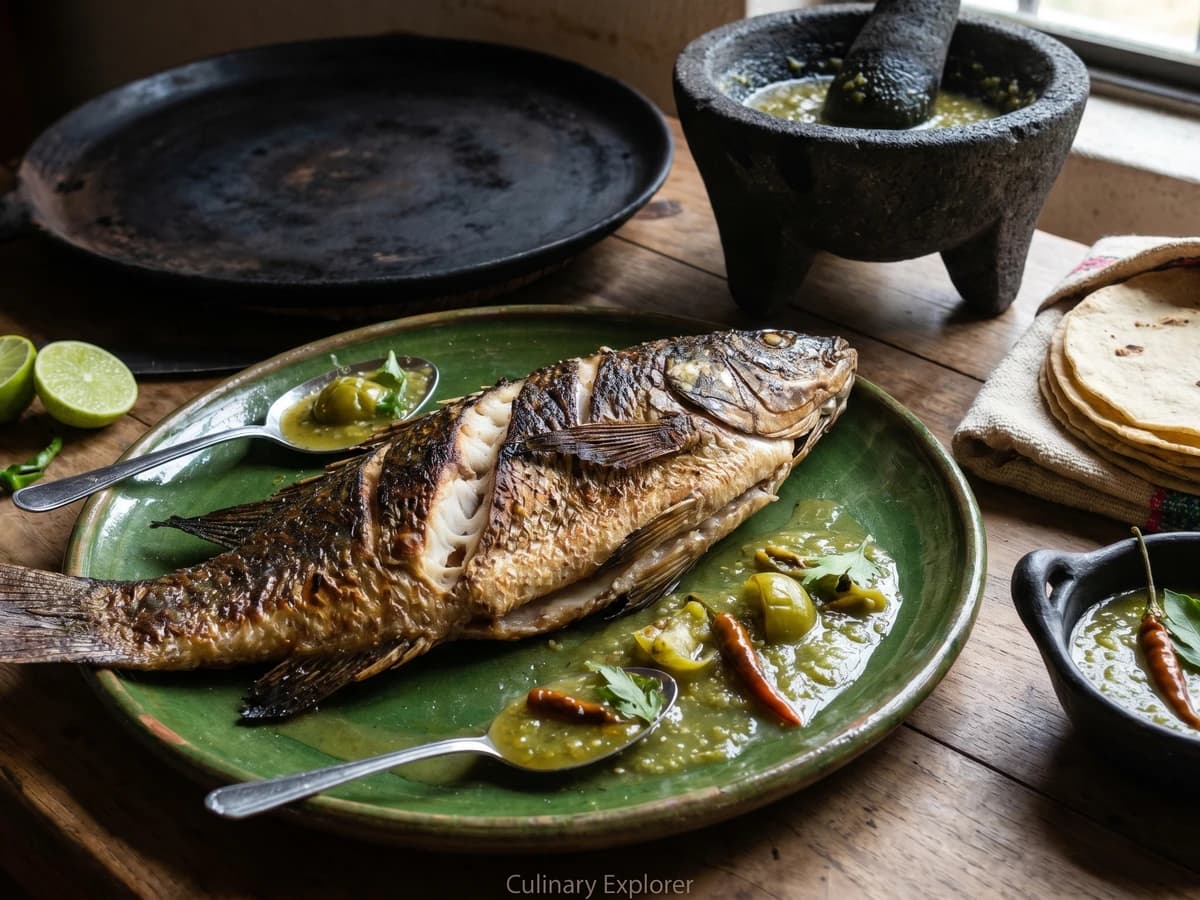
Michoacán's Lake Pátzcuaro acúmara, a whole kurucha from the lago tatemada on a comal de leña and served with chile perón atápakua, corn tortillas, and P'urhépecha discipline.
A cooking platform built around craft, culture, and the stories behind what we eat.
Created by
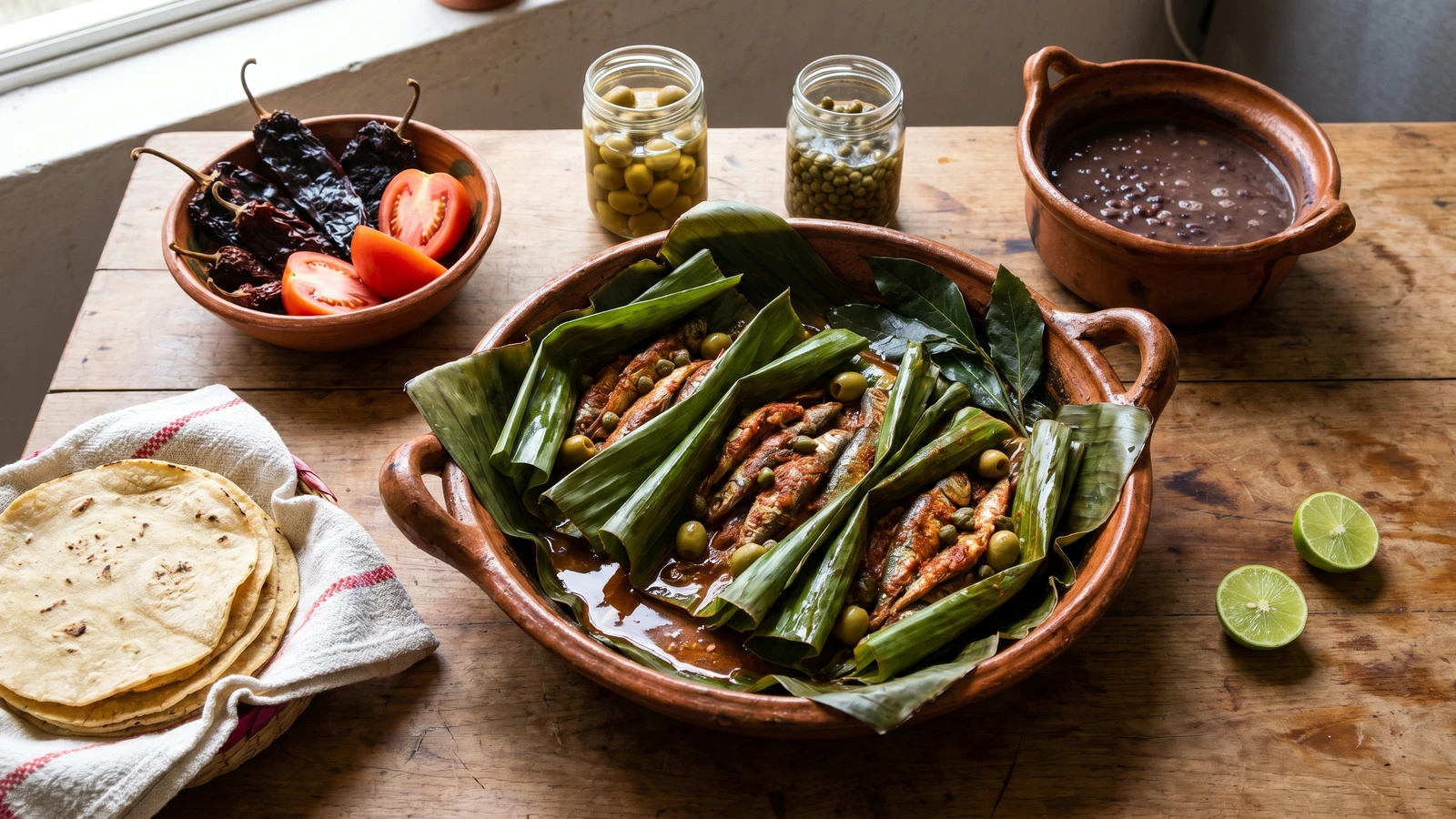
Veracruz's Los Tuxtlas fish package: tiny Catemaco topotes folded in acuyo and berijao leaves with jitomate, chile ancho, chipotle, olives, and capers until the leaves perfume every bite.
Veracruz, the Los Tuxtlas region, around Catemaco, San Andres Tuxtla, and the mercados that feed those towns, is where topotes en tapicte belongs. This is not generic coastal fish. Topote is the small local river and lake fish that cooks fast, carries the taste of the water, and embarrasses anyone who thinks a big fillet is automatically better.
Tapicte is the leaf package. Berijao gives the outer wrap. Acuyo, also called hoja santa, gives the perfume: anise, green pepper, wet earth after rain. The women of Los Tuxtlas perfected this because a leaf bundle lets you cook many small fish gently without breaking them into paste. La cocina no es decoracion, es trabajo.
The sauce is Veracruz and Los Tuxtlas meeting in one bundle: jitomate de bola, chile ancho for body, dried chipotle meco for smoke, white onion, garlic, capers, and green olives. The capers and olives are not decoration. They are Veracruz's old port pantry folded into indigenous leaf cookery. Cada estado, su propia cocina.
I learned a version of this at the Mercado Municipal de Catemaco from a woman who sold topotes in small piles on a metal tray. She corrected my hands before she corrected my words: do not crush the fish, do not drown them in sauce, do not be stingy with the acuyo. Preguntale a las senoras del mercado. They know where the recipe lives.
Tapicte, also written tapixte in parts of the Gulf coast, names a leaf-wrapped cooking method used in southern Veracruz and neighboring lowland communities, where large aromatic leaves functioned as cooking vessels before metal cookware became ordinary in rural kitchens. In Los Tuxtlas, topote refers to small local freshwater fish from the Catemaco and Sontecomapan watersheds, a household ingredient that rarely leaves the region. After the Spanish founded Veracruz in 1519, olives and capers entered coastal fish cookery through the port pantry, but acuyo, berijao, corn tortillas, and chile keep the older Gulf lowland base visible.
Quantity
2 pounds
rinsed and drained, tiny fish left whole and any fish larger than 3 inches gutted
Quantity
2 teaspoons
divided
Quantity
2 tablespoons
Quantity
8 large
wiped clean and softened over flame
Quantity
14 large
12 left whole for wrapping, 2 finely sliced
Quantity
3
stemmed and seeded
Quantity
2
stemmed
Quantity
4 medium
roasted
Quantity
1/2 medium
roasted
Quantity
4
unpeeled and roasted
Quantity
2 tablespoons
Quantity
1
thinly sliced
Quantity
1/2 cup
sliced
Quantity
2 tablespoons
rinsed
Quantity
4 sprigs
leaves torn
Quantity
1/2 cup
as needed for blending
Quantity
for serving
Quantity
for serving
Quantity
for serving
| Ingredient | Quantity |
|---|---|
| fresh topotesrinsed and drained, tiny fish left whole and any fish larger than 3 inches gutted | 2 pounds |
| fine sea saltdivided | 2 teaspoons |
| fresh lime juice | 2 tablespoons |
| berijao leaves or banana leaveswiped clean and softened over flame | 8 large |
| acuyo leaves (hoja santa)12 left whole for wrapping, 2 finely sliced | 14 large |
| dried chile anchostemmed and seeded | 3 |
| dried chile chipotle mecostemmed | 2 |
| ripe jitomate de bolaroasted | 4 medium |
| white onionroasted | 1/2 medium |
| garlic clovesunpeeled and roasted | 4 |
| manteca de cerdo | 2 tablespoons |
| fresh chile jalapenothinly sliced | 1 |
| pitted green olivessliced | 1/2 cup |
| capersrinsed | 2 tablespoons |
| fresh epazoteleaves torn | 4 sprigs |
| water or light fish stockas needed for blending | 1/2 cup |
| warm corn tortillas (optional) | for serving |
| frijoles negros de olla (optional) | for serving |
| lime halves (optional) | for serving |
Rinse the topotes in cold water and drain well. If they are tiny, leave them whole. If any are longer than 3 inches, slit the belly with a small knife and remove the guts and gills. Toss the fish with 1 teaspoon of the salt and the lime juice. Let them sit 10 minutes, then drain again. The lime brightens the fish. It is not a marinade, so do not leave them soaking until the flesh turns chalky.
Wipe the berijao leaves clean with a damp cloth. Pass each leaf quickly over a gas flame or hot comal until it turns glossy and flexible, a few seconds per side. Keep it moving. Do not burn it. Wipe the acuyo leaves and leave them whole, except for 2 leaves, which you slice finely for the sauce. Berijao holds the package. Acuyo gives the flavor.
Heat a dry comal over medium. Toast the chile ancho for about 20 to 30 seconds per side, just until the skin puffs and the smell deepens. Toast the chipotle meco more briefly, 10 to 15 seconds per side. Put the chiles in a bowl and cover with hot water for 15 minutes. Hot water, not boiling. Boiling pulls bitterness from the skins.
On the same comal, roast the jitomates, onion, and unpeeled garlic until the tomato skins blister, the onion has browned edges, and the garlic softens inside its skin. Peel the garlic. This is where the sauce gets depth before it ever touches the fish.
Drain the softened chiles. Blend them with the roasted jitomates, roasted onion, peeled garlic, and 1/4 cup of water or light fish stock. Add more liquid only if the blender refuses to move. The texture should be thick and rough-smooth, not watery. This recado has to cling to the fish inside the leaf.
Melt the manteca de cerdo in a clay cazuela or heavy skillet over medium heat. Add the blended recado carefully. It will sputter. Cook 6 to 8 minutes, stirring often, until the color turns brick red and small dots of fat show at the edge. Stir in the sliced jalapeno, green olives, capers, epazote, the finely sliced acuyo, and the remaining 1 teaspoon salt. Cook 2 minutes more. La manteca es el sabor, but here it works as a carrier, not a flood.
Lay 1 softened berijao leaf on the work surface. If it is narrow, overlap 2 leaves. Place 2 whole acuyo leaves in the center. Add one-sixth of the topotes in a loose mound, then spoon over one-sixth of the recado with olives and capers. Fold the sides of the berijao over the fish, then fold the top and bottom into a tight rectangular package. Tie with strips of leaf or kitchen twine. Repeat to make 6 packages.
Set a tamalera or wide steamer with 2 inches of water below the rack. Line the rack with torn leaf scraps. Bring the water to a steady simmer, then place the packages seam side down in a single layer or a loose stack. Cover and cook 35 to 40 minutes, checking the water level once. Open one package to test: the fish should be opaque, the sauce should smell of acuyo and chile, and there should be no raw fish smell. If using a thermometer on larger fish, the center should reach 145F.
Let the packages rest 10 minutes before opening. Set them family-style in a terracotta cazuela or on a clay platter and open the leaves at the table so the juices stay with the fish. Serve with warm corn tortillas, frijoles negros de olla, and lime halves. No cheese. No crema. This is Veracruz, and the leaf already did the work. Asi se hace y punto.
1 serving (about 360g)
Culinary guides, cultural storytelling, and the editorial depth that makes cooking meaningful.
Discover Culinary ExplorerChef Lupita
Michoacán's Lake Pátzcuaro acúmara, a whole kurucha from the lago tatemada on a comal de leña and served with chile perón atápakua, corn tortillas, and P'urhépecha discipline.

Chef Lupita
Puebla's weekday adobo of pork shoulder braised in a thick guajillo and ancho sauce sharpened with vinegar, cumin, and clove. The deep red of a market spice stall, the dish a poblana cooks without thinking.

Chef Lupita
Loreto's pit-roasted clams, planted hinge-up in beach sand and tatemadas under a fast fire of dried romerillo brush, the resinous Baja desert shrub that gives this dish its smoke.

Chef Lupita
Oaxaca's eighth mole, the silky, almond-and-cinnamon almendrado, served over poached chicken. Mild, sweet, restrained, and a quiet rebuttal to anyone who thinks Mexican food has to be hot to be Mexican.