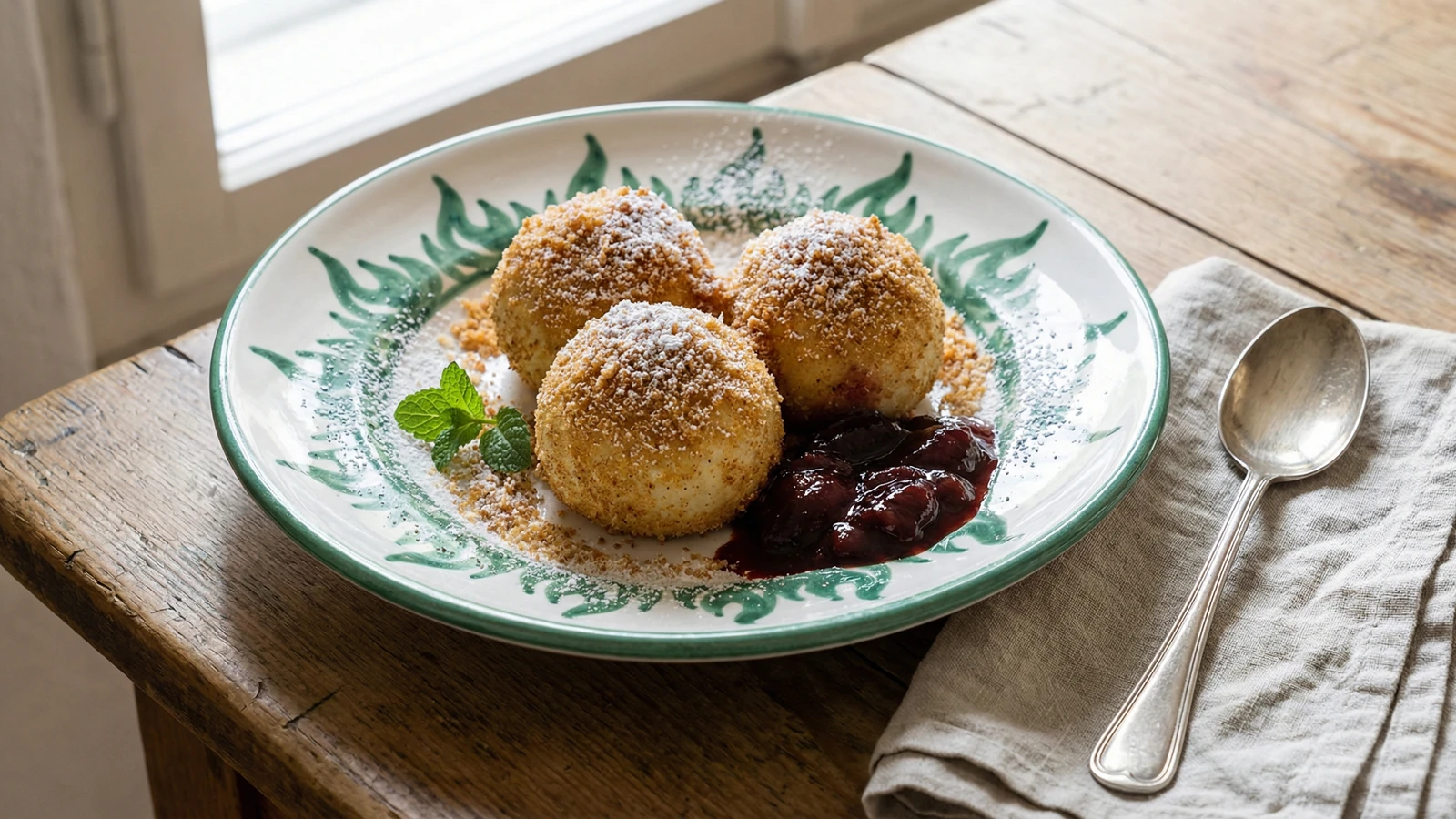
Tender quark dumplings poached until they float, then rolled through butter-toasted breadcrumbs until golden all over. Mehlspeisen at their quietest and best.
Desserts
Austrian
Weeknight
Comfort Food
25 min
Active Time
20 min cook•1 hr 15 min total
Yield4 servings (about 12 dumplings)
Topfenknödel are the dish I make when I want to explain what Mehlspeisen really means. Not just "flour foods," which is the literal translation, but the whole world of Austrian dough and batter and pastry that sits at the center of this cuisine. Americans think dessert is the last course. Austrians think dessert is the point.
These Knödel are made from Topfen, the Austrian fresh curd cheese that's drier and more crumbly than the quark you find in most German supermarkets. Mixed with eggs, a little semolina, butter, and just enough sugar to know it's there. You roll them into balls, poach them in barely trembling water, then toss them through a pan of breadcrumbs that you've toasted in far too much butter. The crumbs cling and turn the outside golden and crunchy. The inside stays soft and cool and faintly tangy from the Topfen. A dusting of powdered sugar at the table. That's the whole thing.
In my grandmother Eva's kitchen in Kent, Gretel would make these on a Tuesday afternoon like it was nothing. No occasion required. She'd press the Topfen dry in a tea towel, mix the dough with her hands, and have them poaching within the hour. I remember thinking they looked plain sitting on the board before they went into the water, just pale little balls of nothing. Then the breadcrumbs happened and they became something completely different. That's the lesson of Topfenknödel: the simplest preparations demand the most from your ingredients. There's nowhere for bad Topfen to hide.
Topfenknödel belong to the vast family of Austrian Knödel, which absorbed influences from Bohemian dumpling traditions during the centuries of Habsburg rule. Topfen itself has been a staple of Alpine dairy cooking since the Middle Ages, appearing in everything from Strudel fillings to Palatschinken. The sweet Knödel tradition, where dumplings are served as a main course rather than a side, is distinctly Austrian and reflects the Mehlspeisen philosophy that flour-based dishes deserve the same respect as meat or fish.
The technique, the tradition, and the story behind every dish.
•Clean tea towel or cheesecloth for draining Topfen
•Wide heavy pan (28cm) for toasting breadcrumbs
•Slotted spoon
Instructions
1
Drain the Topfen
If your Topfen or quark feels at all wet, spoon it into a clean tea towel, gather the corners, and squeeze out the excess moisture over the sink. You want it as dry as you can get it. This is the single most important step in the entire recipe. Wet Topfen means a loose dough, and a loose dough means Knödel that fall apart in the water and break your heart. The pressed Topfen should hold its shape when you squeeze a handful.
Austrian Topfen is naturally drier and more crumbly than most quark sold outside Austria. If you're using German quark or a softer variety, you may need to drain it overnight in the fridge, hung in cheesecloth over a bowl. Don't skip this.
2
Mix the dough
Beat the softened butter with the sugar, Vanillezucker, salt, and lemon zest until light and creamy. Add the eggs one at a time, beating after each. Fold in the drained Topfen until just combined, then gently stir in the semolina. Stop mixing the moment everything comes together. You're not making bread. Overworking this dough toughens it, and Topfenknödel should be so tender they barely hold their shape on the spoon.
3
Rest the dough
Cover the bowl and let the dough rest in the fridge for thirty minutes. The semolina needs this time to absorb the moisture from the Topfen and swell. If you skip the rest, your dough will be too soft to shape and you'll add more flour out of panic, which makes the Knödel dense and heavy. Patience here costs you nothing and earns you everything.
Gretel always said that a Knödel dough tells you when it's ready. After thirty minutes, pinch off a small piece and roll it between wet hands. If it holds together without sticking, you're good. If it's still slack, give it another fifteen minutes.
4
Shape the Knödel
Wet your hands to prevent sticking. Scoop a generous tablespoon of dough and roll it gently between your palms into a ball about the size of a small apricot. Don't squeeze or compress. You're coaxing the dough into shape, not forcing it. Set each Knödel on a lightly floured board. You should get about twelve from this batch.
5
Poach the Knödel
Bring a wide pot of lightly salted water to a gentle simmer. Not a boil. The surface should tremble, not roll. Slide the Knödel in carefully, a few at a time so they don't crowd. They'll sink to the bottom and then slowly float to the top after three to four minutes. Once they float, let them cook for another eight to ten minutes. They're done when they feel firm but still give slightly when you press one with a spoon. Pull one out and cut it open if you're unsure. Better to sacrifice one Knödel than serve twelve that are raw in the middle.
A rolling boil will rip your Knödel apart. Keep the water at a bare simmer. If you see aggressive bubbles, turn the heat down immediately. This is the kind of cooking that rewards you for doing less.
6
Toast the breadcrumbs
While the Knödel poach, melt the 80g butter in a wide pan over medium heat. When it foams, add the breadcrumbs and stir constantly. They go from pale to golden to burnt in about ninety seconds, so stay at the stove. When they turn an even golden brown and smell nutty and rich, sprinkle in the sugar and stir for another thirty seconds until it melts into the crumbs. Take the pan off the heat.
7
Roll and serve
Lift the Knödel from the water with a slotted spoon and let them drain for a moment. Drop them into the pan of butter-toasted breadcrumbs and roll them gently until coated on all sides. The crumbs should cling in a golden, buttery crust. Plate three Knödel per person, dust with powdered sugar, and serve with a spoonful of sour cream or warm fruit compote on the side. Mahlzeit!
Chef Tips
•The quality of your Topfen determines everything. If you can find Austrian Topfen at a specialty shop, buy it. If you're using quark, choose full-fat and drain it thoroughly. Ricotta is not a substitute. It's too wet and too grainy, and you'll end up adding so much flour to compensate that the Knödel taste like bread.
•Test one Knödel before committing the whole batch to the water. Shape a single dumpling, poach it, and check the texture. If it falls apart, your dough needs another ten minutes in the fridge. If it's dense and heavy, you've added too much semolina. Better to know with one than to find out with twelve.
•The breadcrumbs must be fine and dry. Fresh breadcrumbs hold too much moisture and won't toast properly. If you can only find coarse ones, blitz them in a food processor until fine. Gretel always said the breadcrumb coating should crunch once, not crumble.
•Topfenknödel are a main course in Austria, not a side dish. Serve three per person with compote and call it dinner. Austrians have been doing this for centuries and they're right.
Advance Preparation
•The dough can be made and shaped up to four hours ahead. Keep the uncooked Knödel on a floured board in the fridge, covered with cling film.
•Breadcrumbs can be toasted up to a day ahead and stored in a sealed container. Reheat gently in butter before rolling the Knödel through them.
•Cooked Topfenknödel don't store well. They're best eaten within minutes of being rolled in the breadcrumbs. This is a dish that rewards you for eating it the moment it's ready.
Frequently Asked Questions
Nutrition Information
1 serving (about 250g)
Calories
650 calories
Total Fat
41 g
Saturated Fat
25 g
Trans Fat
1 g
Unsaturated Fat
15 g
Cholesterol
200 mg
Sodium
275 mg
Total Carbohydrates
48 g
Dietary Fiber
2 g
Sugars
24 g
Protein
22 g
Where cooking meets culture.
Culinary guides, cultural storytelling, and the editorial depth that makes cooking meaningful.