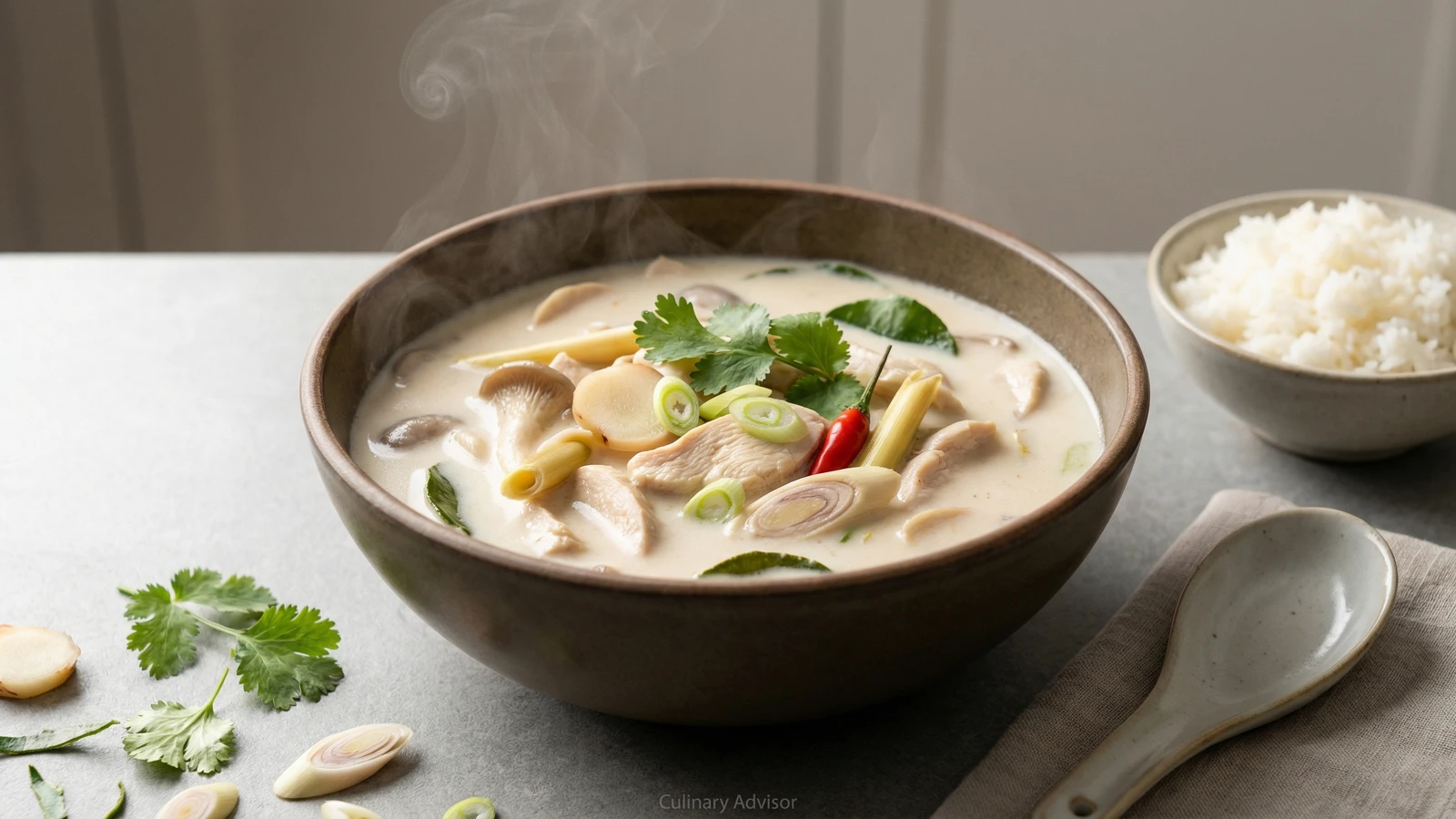
A silken coconut broth perfumed with galangal, lemongrass, and makrut lime, cradling tender chicken and mushrooms in a bowl that balances sour, salty, and gently spiced in perfect Thai harmony.
Soups & Stews
Thai
Weeknight
Date Night
Comfort Food
25 min
Active Time
30 min cook•55 min total
Yield4 servings
Tom Kha Gai is Thailand's answer to chicken soup. Where we Americans reach for broth and noodles, Thai cooks build something altogether more complex: a coconut-enriched bowl that hits every taste receptor you possess. Sour from lime, salty from fish sauce, aromatic from a trinity of galangal, lemongrass, and makrut lime leaves. It heals what ails you while teaching you something about balance.
The name tells you everything. Tom means boiled. Kha is galangal, that knobby rhizome cousin of ginger with its sharp, almost piney bite. Gai is chicken. Simple ingredients, profound results. I've watched Thai grandmothers make this in minutes, smashing aromatics with the flat of a cleaver, trusting their noses more than any timer. You'll learn to do the same.
Don't let the ingredient list intimidate you. Most well-stocked Asian markets carry everything you need. The technique is gentler than you might expect. Coconut milk rebels against hard boiling, so we coax the aromatics at a bare simmer, building layers of fragrance before the chicken ever touches the pot. The result is something you'll crave on cold nights, sick days, and any Tuesday when ordinary dinner won't do.
The technique, the tradition, and the story behind every dish.
Slice the galangal into coins about the thickness of a quarter. Don't bother peeling it. Trim the lemongrass to the bottom four inches, peel away the tough outer layer, and bruise each stalk with the flat side of your knife or a meat mallet until you smell its citrus perfume. Tear the makrut lime leaves to release their oils, removing the tough center rib. Smash the chilies lightly, just enough to crack them open.
These aromatics flavor the broth but aren't meant to be eaten. They stay whole so diners can push them aside, releasing fragrance with every stir.
2
Prepare the chicken
Slice the chicken thighs against the grain into strips about a quarter inch thick and two inches long. Thigh meat stays tender in soup; breast meat turns stringy and dry. Set aside at room temperature while you build the broth.
3
Build the aromatic base
Open your coconut milk without shaking. Scoop the thick cream from the top of both cans into a large Dutch oven or heavy pot. Set the remaining thinner milk aside. Heat the coconut cream over medium heat until it begins to separate, about three to four minutes. You'll see the fat become glossy and the cream start to look slightly broken. This is correct.
Separating the coconut cream blooms the fat, giving your aromatics a richer medium to infuse. Skip this step and your soup tastes flatter.
4
Infuse the aromatics
Add the galangal, lemongrass, lime leaves, and chilies to the separated coconut cream. Let them sizzle gently for two minutes, stirring occasionally. Your kitchen will fill with an almost medicinal fragrance, bright and sharp. This is the soul of the soup being born.
5
Add liquids and simmer
Pour in the reserved thin coconut milk and the chicken stock. Stir to combine. Bring to a gentle simmer over medium heat. Do not let this boil hard. Aggressive heat causes coconut milk to break and turn grainy. Reduce heat to medium-low and let the aromatics steep for ten minutes, maintaining lazy bubbles that barely disturb the surface.
If you've made your own chicken stock, this is where it shows. Commercial stock works, but homemade stock with its natural gelatin creates body that no carton can match.
6
Cook the chicken and mushrooms
Add the sliced chicken and mushrooms to the simmering broth. Stir gently to separate the chicken pieces. Cook at a bare simmer until the chicken is just cooked through, about five to six minutes. The meat should be white throughout but still tender and yielding. Overcooking is the enemy here.
7
Season and balance
Remove the pot from heat. Stir in the fish sauce and sugar until the sugar dissolves. Add the lime juice and stir gently. Taste the broth. It should be sour first, then salty, with a gentle sweetness in the background and aromatic heat building slowly. Adjust fish sauce for salt, lime for brightness, sugar if it tastes too sharp.
Thai soups are seasoned off heat to preserve the bright, raw quality of the lime juice. Cooking the lime juice dulls its punch.
8
Serve immediately
Ladle the soup into deep bowls, distributing chicken and mushrooms evenly. Include a few pieces of galangal, lemongrass, and lime leaves in each bowl for fragrance and presentation. Scatter cilantro and scallions over each serving. Set chili oil at the table for those who want more heat. Serve with steamed jasmine rice alongside to stretch the meal.
Chef Tips
•Fresh galangal is not optional. Ginger is a different flavor entirely. If your regular grocery store doesn't carry galangal, find an Asian market. The frozen version works in a pinch, though fresh is superior.
•For homemade stock that complements Thai flavors, simmer chicken bones with lemongrass trimmings, galangal peels, cilantro stems, and a halved onion. An hour produces excellent results. Strain and use immediately or freeze for future batches.
•The soup's color should be creamy white, not yellow or gray. Gray means you've overcooked it. Yellow usually indicates too much curry paste, which doesn't belong in traditional Tom Kha.
•Thai cooks often add a splash of evaporated milk for extra richness. It's not traditional, but it works. Add two tablespoons with the coconut milk if you want that street-vendor silkiness.
Advance Preparation
•The aromatic broth base (through step 5, before adding chicken) can be made up to two days ahead and refrigerated. The flavors deepen overnight. Reheat gently before proceeding.
•Complete soup keeps refrigerated for three days. The lime juice will mellow and the coconut may separate; stir well when reheating and add a squeeze of fresh lime to brighten.
•For freezing, prepare the soup without lime juice, cilantro, and scallions. Freeze for up to two months. After thawing and reheating, add fresh lime juice and garnishes. The aromatics hold up remarkably well.
Frequently Asked Questions
Nutrition Information
1 serving (about 420g)
Calories
410 calories
Total Fat
28 g
Saturated Fat
24 g
Trans Fat
0 g
Unsaturated Fat
3 g
Cholesterol
45 mg
Sodium
715 mg
Total Carbohydrates
23 g
Dietary Fiber
1 g
Sugars
8 g
Protein
25 g
Where cooking meets culture.
Culinary guides, cultural storytelling, and the editorial depth that makes cooking meaningful.