
Chef Lupita
Birria Tacos with Consome
Jalisco's goat birria, born around Cocula and carried into Guadalajara's markets, slow-braised in ancho, guajillo, cascabel, and chile de arbol, then tucked into corn tortillas crisped in its own red fat.
A cooking platform built around craft, culture, and the stories behind what we eat.
Created by
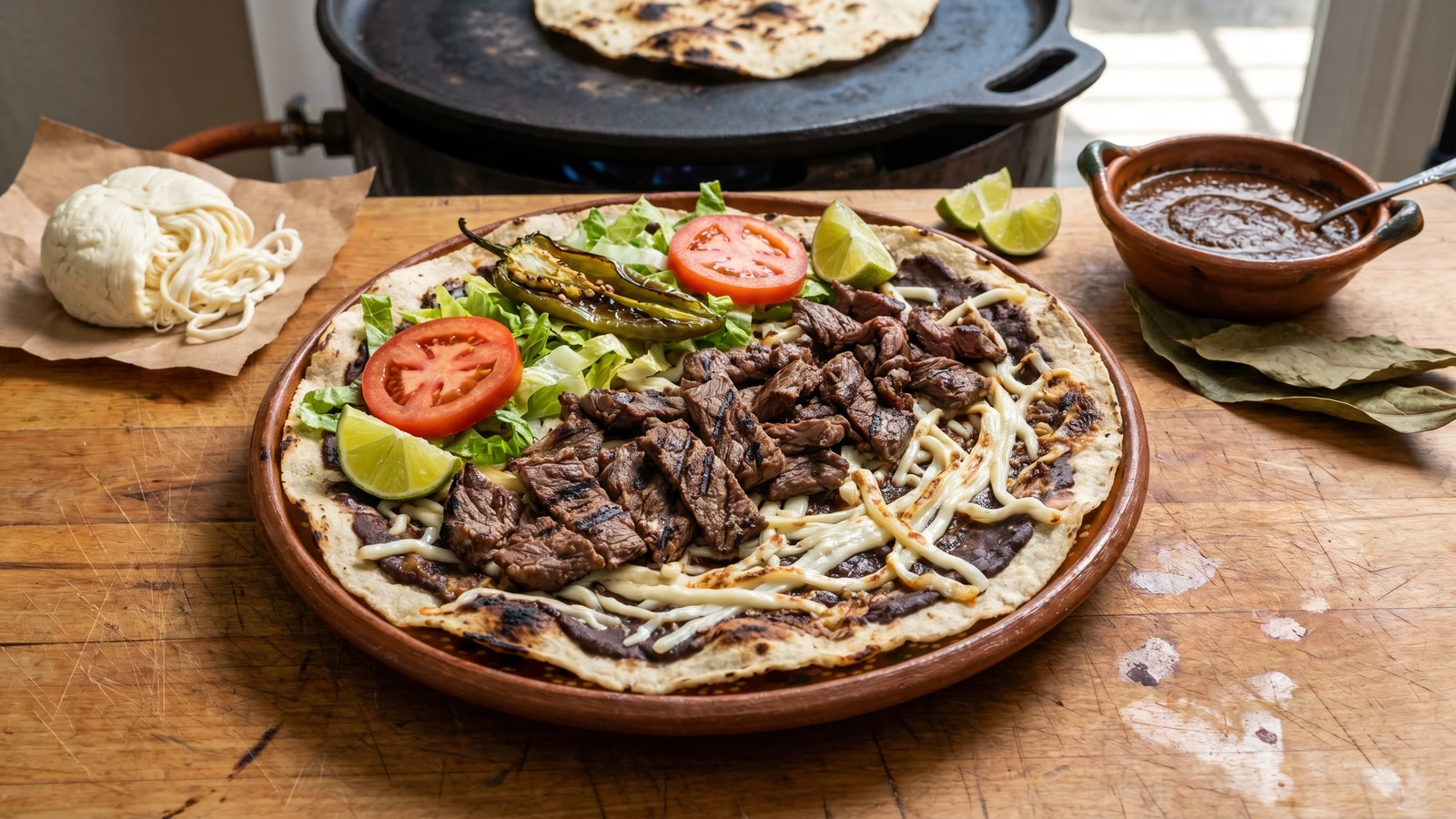
The canonical tlayuda from Oaxaca's Valles Centrales: a massive comal-dried tortilla spread with asiento and black beans fragrant with hoja de aguacate, pulled quesillo, grilled tasajo, and roasted chile de agua. This is not a big tostada. This is architecture.
This is Oaxaca's dish. Valles Centrales. If you have walked through the Mercado 20 de Noviembre in Oaxaca city, you have seen the senoras at the pasillos de carnes asadas grilling tasajo over mesquite coals, the smoke thick enough to taste from across the hall. The tlayuda is what that tasajo goes on, and it is not a tortilla in the way the rest of Mexico understands the word.
The tlayuda tortilla is 30 to 40 centimeters across, made from a coarser grind of nixtamalized corn, and dried on the comal until it turns leathery and stiff. That stiffness is the point. It is the plate, the structure, the thing that holds everything without collapsing into your hands. When you heat it over coals or on a comal, the edges char and the center stays pliable enough to fold. If your tortilla is soft and floppy, you do not have a tlayuda. You have a quesadilla grande.
The spread is asiento, not butter, not oil, not even regular manteca. Asiento is the dark, grainy sediment that settles at the bottom of the pot when you render pork lard slowly. It tastes like smoke and pork and the comal it was made on. Over that goes a layer of refried black beans cooked with hoja de aguacate, the toasted avocado leaf that gives Oaxacan beans their anise-like perfume. Then quesillo pulled into strings, then tasajo off the grill, then shredded lettuce and roasted chile de agua. Cada estado, su propia cocina. This one is Oaxaca's and nobody else's.
My mother did not make tlayudas. She was jalisciense. But she had a page in her notebook where she had written, in her careful pencil: 'Tlayuda, Oaxaca, preguntar por asiento en el mercado.' She never made it, but she knew it mattered enough to write down. I made my first one in a market stall in Tlacolula de Matamoros, watching a senora who had been making them since before I was born. She did not measure anything. She spread the asiento by feel, folded the tlayuda in half, and set it directly on the coals. Saber cocinar es saber vivir.
The tlayuda has pre-Columbian roots as a travel and storage food in the Valles Centrales of Oaxaca, where the partially dehydrated tortilla could last several days without refrigeration, making it essential provisions for merchants walking to market towns like Tlacolula, Ocotlan, and Zaachila. The word 'tlayuda' likely derives from the Nahuatl 'tlaolli' (corn) combined with a Zapotec suffix, reflecting the linguistic mestizaje of a region where Zapotec communities have cultivated native corn varieties for thousands of years. The modern street-food format, assembled with asiento, beans, and grilled meats at market stalls, became codified in the mid-20th century as Oaxaca city's mercados expanded, and the dish's 2010 inclusion in broader discussions around Mexico's UNESCO Intangible Cultural Heritage inscription cemented its status as one of the country's most recognized regional preparations, though Oaxacans had never needed outside validation to know what they had.
Quantity
4
30-40 cm diameter
Quantity
1/2 cup
Quantity
1 pound
Quantity
3
Quantity
2 tablespoons
Quantity
1
Quantity
to taste
Quantity
1 pound
sliced thin
Quantity
300 grams
pulled into strings
Quantity
4
Quantity
1 small head
shredded
Quantity
2 medium
sliced into rounds
Quantity
for serving
Quantity
for serving
| Ingredient | Quantity |
|---|---|
| tlayuda tortillas30-40 cm diameter | 4 |
| asiento (unrefined pork lard sediment) | 1/2 cup |
| dried black beans (frijol negro) | 1 pound |
| dried hojas de aguacate (avocado leaves) | 3 |
| manteca de cerdo (pork lard) | 2 tablespoons |
| garlic clove | 1 |
| salt | to taste |
| tasajo (Oaxacan salted dried beef)sliced thin | 1 pound |
| quesillo Oaxaqueno (Oaxacan string cheese)pulled into strings | 300 grams |
| fresh chile de agua | 4 |
| romaine lettuceshredded | 1 small head |
| tomatoessliced into rounds | 2 medium |
| lime wedges (optional) | for serving |
| sliced radishes (optional) | for serving |
Rinse the black beans and pick through them for stones. Place in a large pot and cover with water by three inches. Add one whole hoja de aguacate and the garlic clove. Bring to a boil, then reduce to a low simmer. Cook partially covered for two hours, until the beans are completely soft and the broth is dark and thick. Add salt only in the last 20 minutes. Salt too early and the skins stay tough. Check the water level every 30 minutes and add hot water if the beans start to peek above the surface. They should always be submerged.
Toast the remaining two hojas de aguacate on a dry comal over medium heat for about 10 seconds per side, until fragrant and brittle. Crumble them with your fingers and set aside. Melt the manteca de cerdo in a heavy skillet over medium heat. Ladle in about two cups of cooked beans with enough broth to keep them loose. Mash with a bean masher or the back of a wooden spoon, working them into a thick, spreadable paste. Stir in the crumbled hoja de aguacate. The beans should smell like anise and pork fat. Cook for five to seven minutes, stirring constantly, until the paste pulls away from the sides of the skillet and holds its shape on a spoon. If they are too thick, add a spoonful of bean broth. Too thin and they will slide off the tlayuda.
Tasajo is already salted and partially dried. Lay the slices flat in a shallow dish and cover with cold water for 15 minutes to pull out excess salt. Taste a small piece after soaking. If it is still aggressively salty, soak for another 10 minutes. Drain and pat dry with clean towels. Heat a comal or cast iron griddle over high heat until it is screaming hot. Grill the tasajo for about one to two minutes per side. The slices are thin, so they cook fast. You want dark grill marks and slightly charred edges, but the center should still be tender. Do not overcook or it turns to jerky. Set aside and chop into rough strips when cool enough to handle.
Place the chiles de agua directly on the hot comal. Roast them, turning with tongs, until the skin is blistered and charred in spots on all sides. This takes about five to eight minutes. The chile de agua is a fresh chile specific to Oaxaca, mild to medium in heat, with a grassy, slightly sweet flavor. Do not remove the skin. Do not sweat them in a bag. The charred skin is part of the flavor. Slice each chile in half lengthwise and remove the seeds if you want less heat. Leave the seeds if you want the full experience.
Unwind the ball of quesillo Oaxaqueno and pull it into long, thin strings with your hands. This cheese is meant to be pulled, not sliced. It is Oaxaca's string cheese, salty and elastic, and when it melts on the hot tlayuda it stretches and browns at the edges. If you slice it into discs, you lose the texture that makes it work. Pile the strings loosely on a plate and keep them ready for assembly.
Heat the comal over medium-high heat. Place one tlayuda directly on the comal and warm it for about two minutes, flipping once. The tlayuda should become pliable in the center but stay stiff at the edges. You are not making it soft. You are waking it up. If you have a gas burner, you can hold the edges briefly over the open flame to char them. The char is the flavor. A tlayuda without char marks is a cracker with toppings.
With the tlayuda still on the warm comal, spread about two tablespoons of asiento over the entire surface using the back of a spoon. The asiento will melt immediately on contact. Then spread a generous layer of the refried black beans over the asiento, leaving about a one-inch border at the edges. The asiento goes first because it waterproofs the tortilla and keeps the beans from making it soggy. This is the engineering of the dish. Every layer has a reason.
Scatter the pulled quesillo strings over the bean layer. At this point you choose: open or folded. For a tlayuda abierta, leave it flat and let the cheese melt on the comal for another minute. For a tlayuda empalmada, fold it in half like a giant quesadilla and press gently. The empalmada is how you see them at the market stalls, folded and placed directly on the coals until the cheese melts and the outside chars. Either way, cook until the quesillo is soft and beginning to stretch when you lift the edge. Two to three minutes, no more.
Transfer the tlayuda to a cutting board or clay plate. If serving open, pile the chopped grilled tasajo down the center. Lay the roasted chile de agua alongside. Scatter the shredded lettuce and tomato slices over the top. Squeeze lime over everything. If serving folded, open it slightly and stuff the tasajo, lettuce, tomato, and chile inside. Serve immediately. A tlayuda does not wait. The second it cools, the tortilla loses its char-crisp texture and the quesillo seizes up. Asi se hace y punto.
1 serving (about 600g)
Culinary guides, cultural storytelling, and the editorial depth that makes cooking meaningful.
Discover Culinary ExplorerChef Lupita
Jalisco's goat birria, born around Cocula and carried into Guadalajara's markets, slow-braised in ancho, guajillo, cascabel, and chile de arbol, then tucked into corn tortillas crisped in its own red fat.

Chef Lupita
Sonora's working morning burrito: chicharrón de cáscara stewed in chile colorado with diced potato, rolled tight in a paper-thin tortilla sobaquera and eaten standing up at the carreta.

Chef Lupita
Mocorito's pork chilorio, shredded and confited in lard with chile ancho and pasilla, rolled into a thin handmade flour tortilla. The burrito Sinaloa sends out into the world.

Chef Lupita
Sonora's morning burrito of mashed pinto frijoles puercos and melted queso asadero, wrapped in a paper-thin sobaquera and seared on the comal until the cheese pulls in long strings.