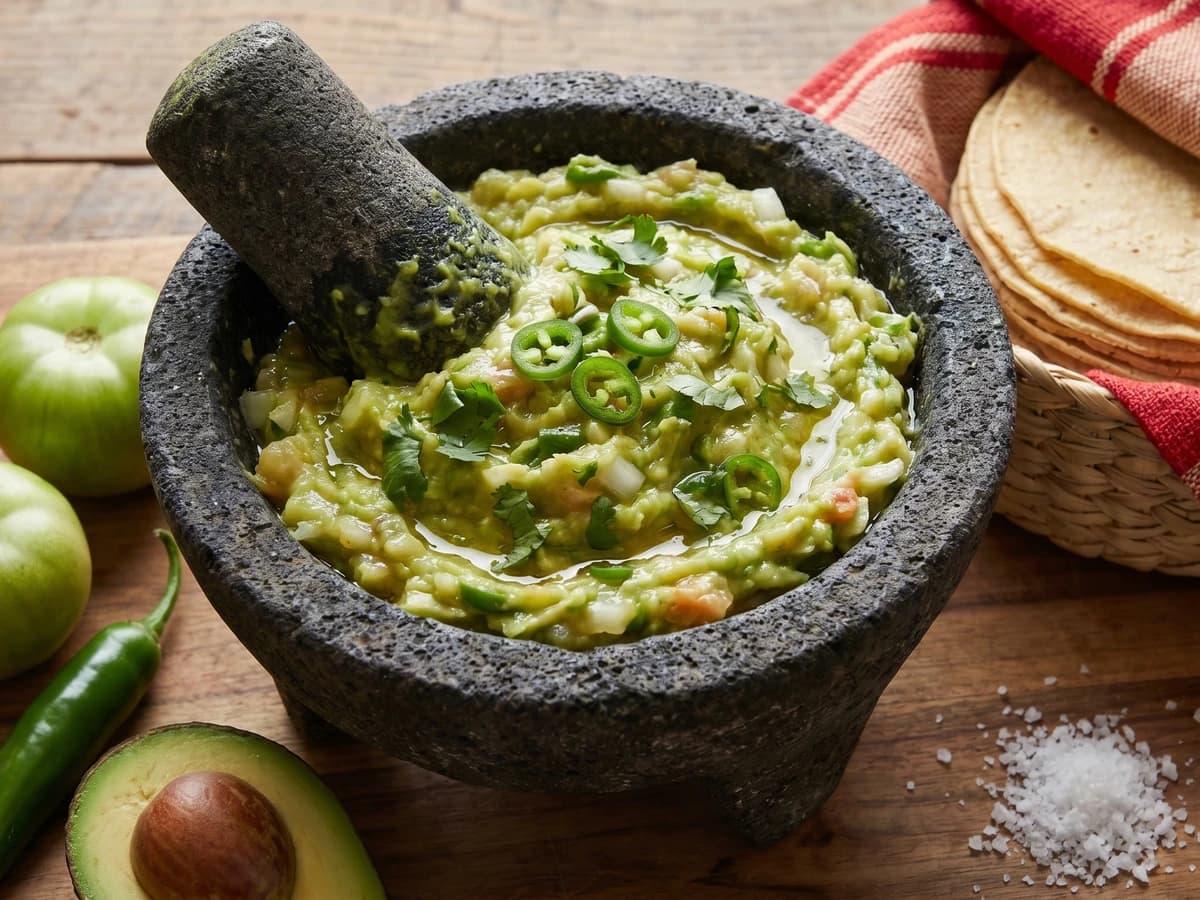
Blue-corn tlacoyos from the Valle de México, oval masa cakes stuffed with mashed fava bean paste, toasted on a comal and dressed at the stand with nopales, queso fresco, and salsa verde cruda.
Appetizers & Snacks
Mexican
Weeknight
Budget Friendly
45 min
Active Time
30 min cook•1 hr 15 min total
Yield10 to 12 tlacoyos, serving 4 to 6
Tlacoyos belong to the Valle de México. To Ciudad de México, to the State of México, to Tlaxcala, to the towns spread across the central altiplano where blue corn has been ground on metates for as long as anyone can remember. This is pre-Hispanic food. The word itself comes from the Nahuatl 'tlaoyo,' and the shape, that pointed oval pressed between two palms, was already being cooked on comales when the Spanish arrived.
The color of the masa is not decoration. Blue corn, maíz azul, is a distinct variety grown in the central highlands, with more protein and a deeper, earthier flavor than white or yellow corn. When you buy masa harina azul, you are buying a piece of agricultural heritage that almost disappeared in the 20th century when industrial white corn pushed the native varieties to the margins. The cooperatives in Milpa Alta and the small farmers in Tlaxcala kept it alive. Honor them by using the real thing.
The filling here is haba, dried peeled fava bean, cooked down with epazote and lard until it can be mashed into a paste that holds together inside the masa. Fava is the working-class filling. Tlacoyos can also be stuffed with requesón, with frijol, with chicharrón prensado, but the haba version is the one you find at the puestos outside Mercado de Coyoacán and along the streets of the historic center, sold by women who arrive before dawn with comales already hot. Each tlacoyo costs less than a bus fare. That is part of what they are.
My mother did not make tlacoyos. They were not Jalisciense and she was loyal to her own region. But there was a tlacoyera on the corner of our street in Colonia Roma who set up every morning, and after my mother died I learned to make them by standing at that woman's elbow for a month of mornings, watching how she folded the masa and listening to her talk about her village in Tlaxcala. She told me the shape has to be oval because that is what a tlacoyo is, and if I made it round I was making a sope and should call it one. Saber cocinar es saber vivir.
Tlacoyos are among the oldest continuously prepared dishes in Mesoamerican cuisine, with archaeological and codex evidence placing the oval stuffed masa cake in central Mexican kitchens for at least 2,000 years before the Spanish conquest. The Florentine Codex compiled by Bernardino de Sahagún in the 16th century describes tlaoyos sold in the markets of Tenochtitlán, stuffed with beans and amaranth seed and toasted on clay comales. Blue corn (maíz azul) is one of several native landraces nearly displaced by mid-20th-century agricultural policy favoring high-yield white corn hybrids; its survival is owed largely to milpa farmers in Milpa Alta, Tlaxcala, and the State of Mexico who continued planting it for household use, and the recent revival of blue corn tlacoyos in Mexico City reflects a broader rescue movement for native maize varieties.
The technique, the tradition, and the story behind every dish.
masa harina azul (blue corn masa flour)or 1 pound fresh blue corn masa
2 cups
warm water for the masaonly if using masa harina
1 1/4 cups, adjust as needed
kosher salt for the masa
1 teaspoon
nopal paddlesspines removed, diced
2 medium
white vinegar
1 tablespoon
manteca de cerdo for the comal
1 tablespoon
queso frescocrumbled
1 cup
salsa verde crudatomatillo, chile serrano, cilantro, white onion
1 cup
Mexican crema (optional)
1/2 cup
fresh cilantro leaves (optional)
for serving
sliced raw white onion (optional)
for serving
lime wedges (optional)
for serving
Equipment Needed
•Cast iron comal or heavy 12-inch skillet
•Tortilla press lined with cut freezer-bag plastic
•Heavy 2-quart pot for cooking the favas
•Wide bowl for mixing the masa
•Wooden spoon for mashing the fava paste
Instructions
1
Cook the fava beans
Rinse the dried peeled favas and place them in a medium pot with the 3 cups water, the half white onion left whole, the 2 whole garlic cloves, and 2 sprigs of the epazote. Bring to a simmer and cook uncovered for about 40 minutes, stirring occasionally, until the favas fall apart on their own and the liquid has thickened into a loose paste. Add the salt only in the last 10 minutes. Salt added early hardens the skins and you will be waiting all afternoon for them to soften.
Use the peeled yellow favas, not the whole green dried ones. Habas peladas break down into a paste. Whole favas with skins on will not, and you will be picking skins out of your relleno.
2
Fry the fava paste
In a heavy skillet, melt the 2 tablespoons manteca over medium heat. Add the finely chopped onion and minced garlic and cook for 3 minutes until soft and fragrant. Fish the whole onion, whole garlic, and spent epazote out of the cooked favas and discard them. Pour the fava mixture into the skillet along with the remaining 2 sprigs epazote, chopped. Mash with a wooden spoon or the back of a fork as it cooks. Fry for 8 to 10 minutes, stirring often, until the paste pulls away from the bottom of the pan in a single mass. That is the texture you need. A wet relleno will leak out the seams of the tlacoyo. Cool the paste to room temperature before stuffing. La manteca es el sabor.
3
Mix the blue masa
If using masa harina azul, combine it with the 1 teaspoon salt in a wide bowl. Add the warm water gradually, kneading with your hands, until you have a smooth dough that holds together when squeezed but does not crack at the edges. The masa should feel like soft clay. Cover with a damp cloth and rest for 20 minutes. If using fresh masa, just work the salt in and add a tablespoon of water at a time if it feels stiff.
Blue corn masa drinks more water than white. If your masa cracks when you press it, your dough is too dry. Wet your hands and knead a little more water in. Pregúntale a las señoras del mercado, they will tell you the same thing.
4
Prepare the nopales
Bring a small pot of water to a boil with the tablespoon of vinegar and a generous pinch of salt. Add the diced nopales and cook for 8 to 10 minutes, until they lose their slick texture and the water turns a little cloudy. Drain in a colander and rinse under cold water until the babita, that slippery liquid, is gone. Spread them on a clean towel to dry. Wet nopales will steam on the comal instead of browning.
5
Form the tlacoyos
Line a tortilla press with two squares of plastic cut from a freezer bag. Take a ball of masa about the size of a small lemon, roughly 2 ounces. Press it into a thick oval disc, about 1/4 inch thick. The shape matters. A tlacoyo is oval, not round. That is what tells you it is a tlacoyo and not a sope. Place a generous tablespoon of cooled fava paste down the center, leaving a half inch of border at each long edge. Fold one long side of the masa up and over the filling, then the other, pinching gently to seal. Roll the sealed package between your palms, then flatten again into an oval about 1/2 inch thick and 4 inches long. The seam should disappear. Repeat with the rest of the masa.
If the masa cracks when you fold it, your dough is too dry. Wet your hands lightly and work a few drops of water into the masa before trying again. Cracks in the seam will open up on the comal and the filling will weep out.
6
Toast on the comal
Heat a cast iron comal or heavy skillet over medium heat for 5 minutes. Brush lightly with the tablespoon of manteca. Lay the tlacoyos on the comal in a single layer, no crowding. Cook 4 to 5 minutes on the first side, until the masa is dry to the touch and dark blue-purple patches appear underneath. Flip and cook 4 to 5 minutes more. The finished tlacoyo should be firm at the edges, slightly puffed at the center, and marked with toasted patches. The kitchen will smell like a tlacoyera setting up her stall in Coyoacán on a Sunday morning.
7
Dress and serve
Move the toasted tlacoyos to a warm plate. While they are still hot, spoon a small pile of nopales over each one. Top with crumbled queso fresco, a drizzle of crema if you like, a spoonful of salsa verde cruda, sliced raw white onion, and a few cilantro leaves. Serve immediately with lime wedges on the side. A tlacoyo waits for no one. The masa stiffens as it cools and the joy of it is in that contrast: hot, toasty shell against cool salsa and crumbly cheese. Así se hace y punto.
Chef Tips
•Source your blue masa harina from a brand that actually uses nixtamalized blue corn, not a tinted product. Look for 'maíz azul nixtamalizado' on the label. If you can find fresh masa azul from a molino, even better. In Mexico City I send people to the tortillerías in Coyoacán or the molino in Mercado Medellín.
•Habas peladas, the yellow split peeled fava beans, are sold in any Mexican mercado and in the dried bean section of most Latin grocers. Do not substitute green frozen favas or whole brown dried favas. The peeled yellow ones break down into a paste. The others do not.
•The nopales must be rinsed thoroughly after boiling to wash off the babita. If you skip that step, the slippery liquid coats the tlacoyo and ruins the texture. A pinch of salt and the vinegar in the cooking water help, but the cold rinse is what gets it clean.
•Tlacoyos do not reheat well. The masa loses its toasted crust and turns rubbery in the microwave. Make the filling and the masa ahead, but press and toast them at the last minute. No me vengas con atajos.
Advance Preparation
•The fava paste can be made up to 3 days ahead and refrigerated. Bring it to room temperature before stuffing so it does not chill the masa.
•The nopales can be boiled, rinsed, and refrigerated up to 2 days ahead.
•The masa is best mixed and used the same day. If you must hold it, wrap tightly in plastic and refrigerate for up to 24 hours, then knead in a tablespoon of warm water to bring it back to life.
•Do not press or toast the tlacoyos in advance. They lose everything that makes them worth eating within 20 minutes of leaving the comal.
Frequently Asked Questions
Nutrition Information
1 serving (about 320g)
Calories
540 calories
Total Fat
21 g
Saturated Fat
10 g
Trans Fat
0 g
Unsaturated Fat
11 g
Cholesterol
40 mg
Sodium
980 mg
Total Carbohydrates
65 g
Dietary Fiber
14 g
Sugars
3 g
Protein
22 g
Where cooking meets culture.
Culinary guides, cultural storytelling, and the editorial depth that makes cooking meaningful.