
Chef Zohra
Bocadillo Marocain de Tanger
The northern street sandwich: crisp bread opened wide, harissa rubbed into the crumb, tuna or kefta, egg, olives, and hot fries pushed right in so supper can travel in one hand.
A cooking platform built around craft, culture, and the stories behind what we eat.
Created by
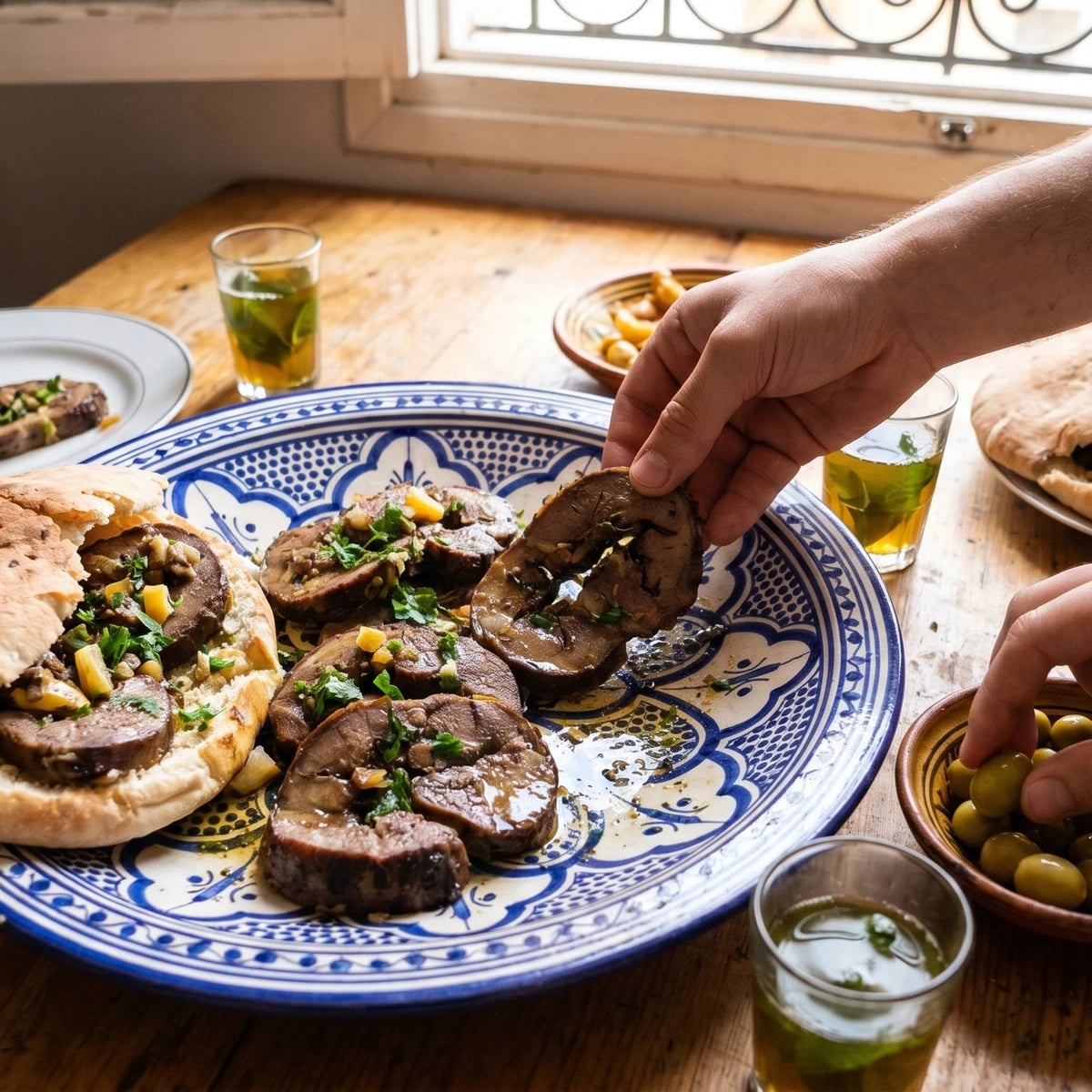
A medina sandwich with a deep memory: beef or camel spleen stuffed with kefta, fat, herbs, and spices, baked until firm, then sliced hot into khobz.
The spleen looks impossible at first: dark, flat, and quiet on the board, with no promise in it until your knife finds the pocket. Then the dish opens. You fill it with kefta, chopped fat, herbs, garlic, preserved lemon, and warm spices, not to disguise the organ but to help it stay juicy as it bakes.
The one rule is restraint. Don't pack it tight. The stuffing swells, the fat melts, and the spleen needs room to tighten around everything without bursting. Sew it closed or pin it well, rub the outside with oil and spices, and bake it until it feels firm under your hand and the center is properly cooked. This is street cooking, yes, but street cooking has its own discipline.
In Fez and Marrakech, tihane is sliced hot and pushed into round khobz, sometimes with cumin-salt, sometimes with a little harissa if the stall keeps it. It is nose-to-tail cooking from the medina, budget food with a serious hand behind it. Make one whole spleen even if you think you need less. A table is a door you leave open, and an extra sandwich never harmed a house.
Tihane belongs to the offal cookery of the old urban medinas, especially Fez and Marrakech, where butchers, communal ovens, and sandwich stalls turned every part of the animal into food for workers and passersby. Fez's Talaa Kbira sits inside a city founded in the 9th century and enlarged under the Marinids in the 13th and 14th centuries, while Marrakech's camel version reflects the Saharan caravan routes that fed the southern markets. The exact date of the stuffed spleen sandwich is not fixed in written sources; dishes like this lived in stalls, ovens, and hands before they lived on paper.
Quantity
1, about 700g to 1kg
cleaned by the butcher
Quantity
300g
not too lean
Quantity
100g
finely chopped
Quantity
3
grated
Quantity
1
grated and squeezed dry
Quantity
2 tbsp
finely chopped
Quantity
2 tbsp
finely chopped
Quantity
1/2
pulp discarded, finely chopped
Quantity
1 1/2 tsp
Quantity
1 tsp
Quantity
1 tsp
from a trusted spice merchant
Quantity
1/2 tsp
Quantity
1/2 tsp
Quantity
1/4 tsp
Quantity
1 1/4 tsp, plus more to taste
Quantity
2 tbsp
divided
Quantity
1 tbsp
for rinsing the spleen
Quantity
6
split
Quantity
1 tsp cumin plus 1 tsp salt
for serving
Quantity
to taste
for serving
| Ingredient | Quantity |
|---|---|
| whole beef or camel spleencleaned by the butcher | 1, about 700g to 1kg |
| kefta, beef or camelnot too lean | 300g |
| beef fat, camel fat, or lamb suetfinely chopped | 100g |
| garlic clovesgrated | 3 |
| small oniongrated and squeezed dry | 1 |
| flat-leaf parsleyfinely chopped | 2 tbsp |
| fresh corianderfinely chopped | 2 tbsp |
| preserved lemon rindpulp discarded, finely chopped | 1/2 |
| ground cumin | 1 1/2 tsp |
| sweet paprika | 1 tsp |
| ras el hanoutfrom a trusted spice merchant | 1 tsp |
| ground ginger | 1/2 tsp |
| freshly ground black pepper | 1/2 tsp |
| cayenne or hot paprika (optional) | 1/4 tsp |
| sea salt | 1 1/4 tsp, plus more to taste |
| olive oildivided | 2 tbsp |
| vinegarfor rinsing the spleen | 1 tbsp |
| small round khobzsplit | 6 |
| ground cumin mixed with sea saltfor serving | 1 tsp cumin plus 1 tsp salt |
| harissa (optional)for serving | to taste |
Rinse the spleen under cold water with the vinegar, then pat it very dry. Lay it smooth side down on the board. If the butcher left heavy membrane or thick veins, trim only what is loose; don't carve away so much that the pocket tears.
With a small sharp knife, make one long slit along the thick side of the spleen, then work the blade gently inside to form a pocket. Keep your other hand flat on top so you can feel where the knife is traveling. Stop before the edges grow thin. The pocket matters because it keeps the filling inside the organ, not loose around it.
In a bowl, mix the kefta, chopped fat, garlic, squeezed onion, parsley, coriander, preserved lemon, cumin, paprika, ras el hanout, ginger, black pepper, cayenne if using, salt, and 1 tablespoon of olive oil. Work it with your hand until it feels sticky and even. La balance est dans les yeux, the scale is in the eyes, but for a stuffed organ the salt must be steady, so taste a tiny cooked pinch if you're unsure.
Fill the spleen no more than two-thirds full, pressing the stuffing into the far end without forcing it. Leave space along the opening. Sew the slit closed with kitchen twine and a large needle, or fasten it tightly with metal skewers. This restraint is what keeps the tihane from splitting as the fat melts and the filling swells.
Rub the outside with the remaining tablespoon of olive oil and a small pinch each of cumin, paprika, and salt. Set it on a rack in a roasting tray, or directly in a lightly oiled baking dish if that's what you have. Let it sit while the oven heats to 180°C, 350°F.
Bake for 1 hour 20 minutes to 1 hour 40 minutes, turning once halfway through and spooning the pan juices over the top. The outside should darken, the surface should look glossy with rendered fat, and the spleen should feel firm when pressed. Check the center of the stuffing with a thermometer: it must reach 74°C, 165°F.
Rest the tihane for 10 to 15 minutes so the juices settle and the slices hold. Cut across into thick rounds. You should see a dark outer ring around a spiced kefta center flecked with herbs and preserved lemon.
Tuck the hot slices into split khobz with a pinch of cumin-salt and a little harissa if your table wants heat. Spoon in a little of the roasting juices if they are clean and glossy. Serve at once, with olives or mint tea nearby and enough bread for one more person.
1 serving (about 270g)
Culinary guides, cultural storytelling, and the editorial depth that makes cooking meaningful.
Discover Culinary Explorer
Chef Zohra
The northern street sandwich: crisp bread opened wide, harissa rubbed into the crumb, tuna or kefta, egg, olives, and hot fries pushed right in so supper can travel in one hand.

Chef Zohra
A Tafilalet bread sealed around spiced meat, onions, almonds, and herbs, baked until the crust turns gold and the filling perfumes the whole table.

Chef Zohra
A Casaoui street sandwich of canned tuna crushed hot with harissa, olive oil, and chili, then packed into a split baguette for beaches, school breaks, and hungry walks home.