
Chef Klaus
Apfelmus
The apple-harvest preserve of the German kitchen, cooked low until the fruit collapses, then kept smooth, tart, and ready for potato pancakes or warm Mehlspeisen.
A cooking platform built around craft, culture, and the stories behind what we eat.
Created by
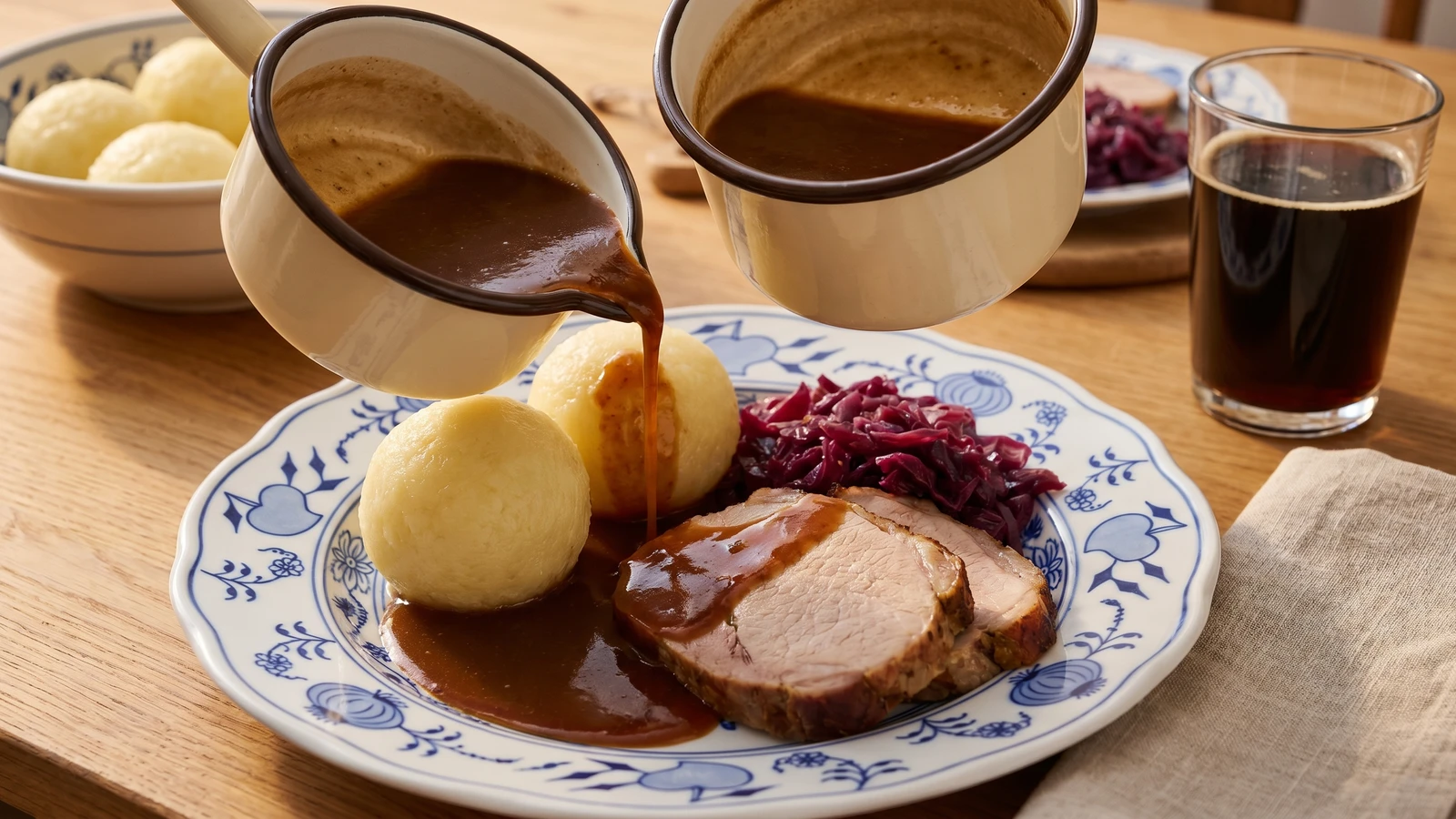
The eastern Sunday gravy for pork roast, rouladen, and Klöße, built from browned drippings and thickened with crumbled Soßenkuchen, not flour from a packet.
Thüringer Bratensoße belongs beside a roast and a bowl of Klöße, potato dumplings, on the Sunday table. It is not a brown liquid poured out of a jar. Nicht aus dem Glas. In Thuringia and Saxony, the sauce often takes its body from Soßenkuchen, a dry spiced sauce cake, while Franconia leans darker and plainer, and the Rhineland sweetens the same idea with Printen or Lebkuchen. Im Norden anders, im Süden anders.
The whole sauce is decided before the liquid goes in. Brown the bones, onion, and roots properly, because water can only take flavour that is already there. Pale vegetables make pale sauce. Burnt vegetables make bitter sauce. Deep brown at the edge of the pan gives you colour, body, and that roast taste people pretend came from a cube.
I cook it from what the roast leaves behind: bones, rind, browned bits, a spoon of fat, the trimmings from the vegetables. Weggeworfen wird nichts. The Soßenkuchen goes in near the end, crumbled fine, so it dissolves into the simmering gravy and thickens it slowly. Rush it and it tastes raw and dusty. Das braucht seine Zeit.
Watch the pan, not the clock. When the sauce coats a spoon and tastes of meat first, spice second, you are there. Salt at the end, because reduction concentrates everything. Würzen, Fett, Salz zum Schluss.
Soßenkuchen belongs to the central German Pfefferkuchen tradition, especially in Saxony and Thuringia, where dry spiced cakes were used not as sweets but as thickeners for dark roast and sour sauces. Pulsnitz in Saxony recorded organised Pfefferkuchen bakers by the 16th century, and that spice-baking trade helped put gingerbread-like thickeners into eastern German sauce pots. The same method appears differently by region: Thuringia and Saxony keep the sauce savoury with Soßenkuchen, while the Rhineland often turns sweeter with Printen, raisins, and vinegar.
Quantity
2 tablespoons
Quantity
700g
pork, beef, or veal bones, chopped
Quantity
1
unpeeled and quartered
Quantity
1
chopped
Quantity
100g
chopped
Quantity
1 small
washed and chopped
Quantity
1 tablespoon
Quantity
150ml
Quantity
1.2 litres
Quantity
1
Quantity
4
lightly crushed
Quantity
6
Quantity
1 small sprig
Quantity
40g
finely crumbled
Quantity
1 teaspoon
or to taste
Quantity
to taste
| Ingredient | Quantity |
|---|---|
| pork fat, beef dripping, or neutral oil | 2 tablespoons |
| mixed roast bonespork, beef, or veal bones, chopped | 700g |
| onionunpeeled and quartered | 1 |
| carrotchopped | 1 |
| celeriac or celerychopped | 100g |
| leekwashed and chopped | 1 small |
| tomato paste | 1 tablespoon |
| dry red wine or dark beer | 150ml |
| unsalted beef, pork, or mixed bone stock | 1.2 litres |
| bay leaf | 1 |
| juniper berrieslightly crushed | 4 |
| black peppercorns | 6 |
| marjoram | 1 small sprig |
| Thüringer Soßenkuchen or dry sauce gingerbreadfinely crumbled | 40g |
| red wine vinegaror to taste | 1 teaspoon |
| salt and black pepper | to taste |
Heat the fat in a wide heavy pot and brown the bones over medium-high heat until they are dark at the edges, 12 to 15 minutes. Do not crowd the pot. Crowding traps moisture, and wet bones boil grey instead of giving you the browned bits that make the sauce taste of roast.
Add the onion, carrot, celeriac, and leek and cook until the cut sides are well browned, another 10 minutes. Let the onion skin go dark; it gives colour without tasting burnt. Stir in the tomato paste and cook it for 2 minutes, because raw paste tastes tinny and browned paste tastes round.
Pour in the red wine or dark beer and scrape the bottom of the pot until every browned bit lifts. Those stuck bits are the sauce, not dirt. Let the liquid reduce by half so the alcohol edge cooks off and the flavour tightens before the stock goes in.
Add the stock, bay, juniper, peppercorns, and marjoram, then bring the pot just to a simmer. Runter mit der Temperatur. A hard boil clouds the sauce and knocks fat through it; a quiet simmer pulls flavour from the bones and leaves the gravy clean enough to finish well.
After 90 minutes, strain the sauce through a fine sieve into a clean pot, pressing the vegetables lightly but not mashing them through. Skim the fat from the surface. Whisk in the crumbled Soßenkuchen and simmer gently for 15 to 20 minutes, until it dissolves and the sauce coats a spoon. The cake thickens slowly; boil it hard and you get lumps and bitterness.
Taste the sauce, then add the vinegar, salt, and black pepper. Salt goes in now, not before, because the sauce has reduced and concentrated. The vinegar is not there to make it sour; it wakes up the meat and spice so the gravy does not sit heavy on the dumplings.
1 serving (about 125g)
Culinary guides, cultural storytelling, and the editorial depth that makes cooking meaningful.
Discover Culinary ExplorerChef Klaus
The apple-harvest preserve of the German kitchen, cooked low until the fruit collapses, then kept smooth, tart, and ready for potato pancakes or warm Mehlspeisen.

Chef Klaus
The northern marinated herring that belongs to the cold larder: salt fish, vinegar, onion, and time doing the work before bread or potatoes ever reach the table.

Chef Klaus
A proper Bratensoße begins with the brown bits in the pan, not a packet: bones roasted dark, wine scraped clean, stock reduced until it coats the spoon.

Chef Klaus
Plain mushrooms browned hard, then loosened with stock and cream. The sauce is mild, pale, quick, and honest, made for Schnitzel, Spätzle, or a weeknight pork cutlet.