
Chef Lupita
Agua de Alfalfa
Ciudad de México's highland market agua fresca, fresh alfalfa blended with pineapple and lime until bright green, strained clean, and poured cold from the vitrolero.
A cooking platform built around craft, culture, and the stories behind what we eat.
Created by
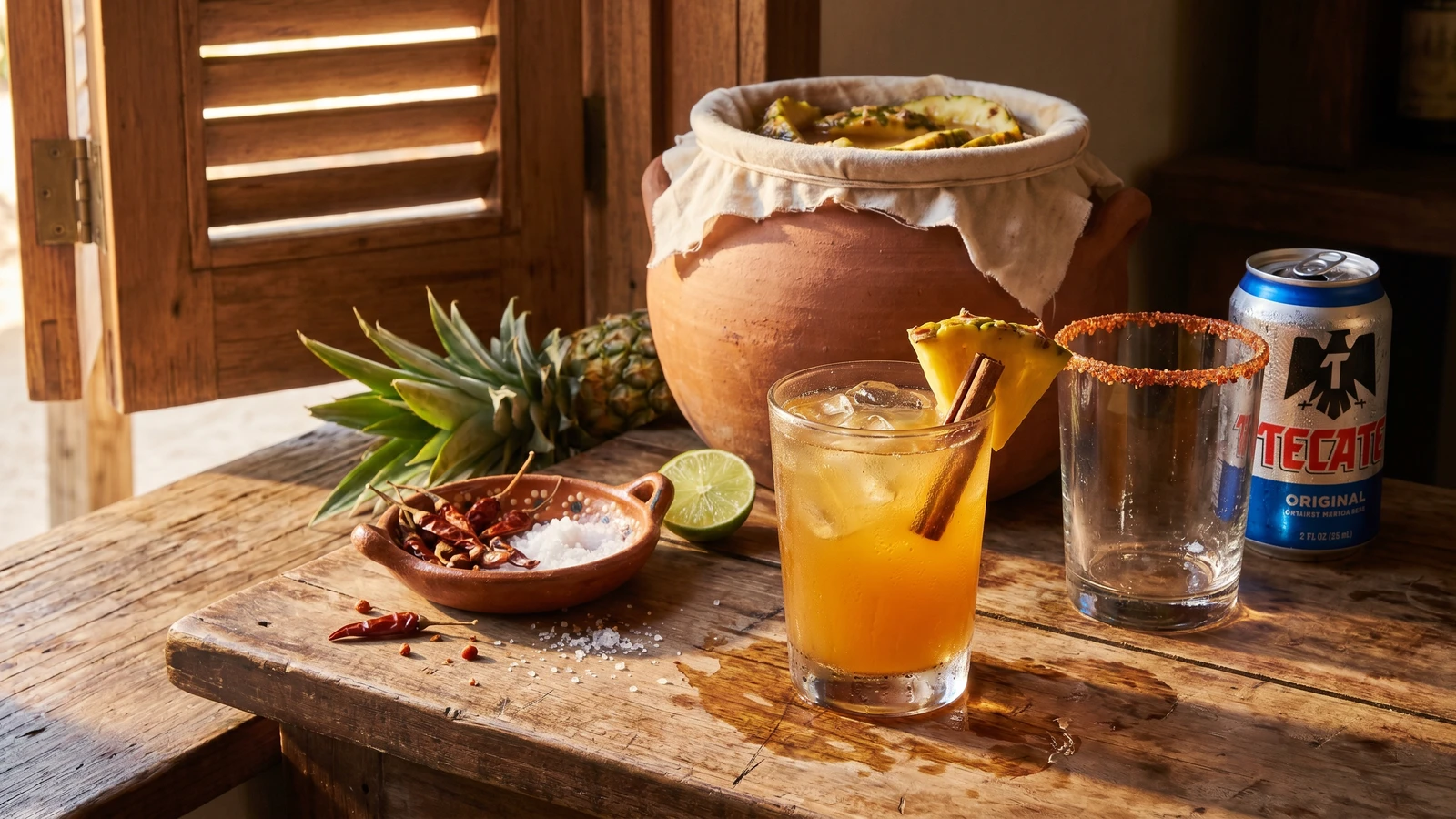
Northern Mexico's lightly fermented pineapple drink, built on ripe rinds, piloncillo, canela, and clove, left to wake up in a clay olla for three days. Sweet, tangy, and cut with a cold lager in the Sonoran heat.
Tepache lives across Mexico, but the norteña version has its own logic. In Sonora, Sinaloa, and Chihuahua, where the summer settles in at forty degrees Celsius and stays there, tepache is the working drink of the afternoon. The jarra sits in the refrigerator alongside the agua de jamaica and the agua de cebada. It gets poured over ice, sometimes cut with a cold Tecate, and the glass empties before the condensation has time to run down the side.
The drink is simple to build and unforgiving to rush. Ripe pineapple, piloncillo, canela, clove, water. Three days in a clay olla, covered with cotton cloth, in a warm corner of the kitchen. The wild yeasts that live on the pineapple rind do the work. You do not add yeast. You do not add a starter. The fermentation happens because the rind already carries everything it needs, and your job is to stay out of its way. No me vengas con atajos.
My mother kept a clay olla on the back of the stove during the summer months in Colonia Roma. She had learned tepache from a vecina who came up from Hermosillo, and she swore the norteña version was sweeter and more honest than the central Mexican one because the north drinks it for thirst, not for ceremony. Piloncillo, not white sugar. Canela de Ceylán, not the hard cassia bark. Cloves whole, never ground. A few allspice berries because her vecina insisted. Cada estado, su propia cocina, and this version belongs to the north.
This is not a cocktail. It is not artisanal. It is a household drink that ferments on the counter while the family eats dinner, gets strained on the third day, and disappears by the weekend. Recetas probadas y garantizadas.
Tepache traces back to pre-Columbian Mexico, where the Nahuatl word 'tepiatl' described a fermented corn-based beverage that predates the conquest. The arrival of pineapple, originally domesticated in South America and spread northward through trade, shifted the recipe in the colonial period, and by the 19th century, the pineapple-and-piloncillo version had become the dominant form across central and northern Mexico. The northwestern adaptation, characterized by a stronger reliance on the pineapple flesh and a tradition of cutting the finished drink with cold lager, developed alongside Sonora and Sinaloa's brewing culture in the early 20th century, when Cervecería Cuauhtémoc Moctezuma's regional distribution made cold beer a household staple.
Quantity
1 large
well-scrubbed under cold water, top intact
Quantity
12 ounces (about 2 cones)
chopped or grated for easier dissolving
Quantity
2 sticks, about 4 inches each
Quantity
4
Quantity
2
lightly crushed
Quantity
2 liters, plus more as needed
Quantity
1
for a Sonoran rim
Quantity
for serving over ice
| Ingredient | Quantity |
|---|---|
| ripe pineapplewell-scrubbed under cold water, top intact | 1 large |
| piloncillochopped or grated for easier dissolving | 12 ounces (about 2 cones) |
| Mexican cinnamon (canela de Ceylán) | 2 sticks, about 4 inches each |
| whole cloves | 4 |
| allspice berries (pimienta gorda)lightly crushed | 2 |
| filtered water, room temperature | 2 liters, plus more as needed |
| dried chiltepín or chile de árbol (optional)for a Sonoran rim | 1 |
| Tecate or Pacifico lager (optional) | for serving over ice |
The pineapple has to be ripe. Not green, not pale, not the underweight kind they ship north of the border in winter. You want fragrant at the base, golden under the rind, heavy in the hand. Tepache is a rind fermentation. The yeast lives on the skin. A green pineapple has nothing to give you. Si no conoces el mercado, no conoces la cocina.
Slice off the crown and the base. Stand the pineapple up and cut down the sides, removing the rind in long strips. Reserve every piece of rind. Cube the yellow flesh and save about half of it for the olla. Eat the rest, or save it for an agua fresca. The rind and the flesh together make a tepache with body. Rind alone makes a thinner drink. Both ways are correct. The norteña version leans on more flesh because the heat of the region calls for a sweeter, fuller jarra.
Chop the piloncillo cones with a heavy knife or grate them on the coarse side of a box grater. Place the piloncillo in a small saucepan with one cup of the filtered water. Warm over medium-low heat, stirring, until the piloncillo dissolves completely. About 5 to 7 minutes. Do not boil. Boiling caramelizes the sugar and dulls the molasses notes that make piloncillo what it is.
Place the pineapple rinds and reserved flesh in a clean 3-liter clay olla or a large glass jar. Add the cinnamon sticks, cloves, and crushed allspice. Pour in the dissolved piloncillo syrup. Top with the remaining filtered water, leaving about two inches of headroom for the ferment to breathe. Stir once with a wooden spoon. No metal in the olla. Metal reacts with the acids and the wild yeasts do not like it. Asi se hace y punto.
Cover the olla with a clean cotton cloth or a piece of cheesecloth, and tie it with kitchen string. The ferment needs air to breathe and protection from flies. Set it on the counter, out of direct sun, in a warm corner of the kitchen. Sonoran summers ferment tepache in two days. A cool kitchen in winter can take four. Three days is the norteña standard. Taste it on day two and again on day three.
Tepache is ready when it tastes like a sweet pineapple cider with a faint funk and a tickle of carbonation. Sweet but tangy. Not sour. Not alcoholic. If you let it go a day too long, you have vinagre de piña, which is a fine ingredient but not the drink you are making. In summer, check at 48 hours. In winter, give it the full 72. Trust your tongue, not the clock.
Strain the tepache through a fine-mesh sieve lined with cheesecloth into a clean glass pitcher. Press lightly on the solids to release the last of the liquid. Discard the rinds and spices. Refrigerate the tepache for at least four hours. It needs to be served cold. Warm tepache is a confused drink.
Pour over ice into heavy glass tumblers, the kind that live behind the bar at any norteño cantina. In Sonora and Sinaloa, half the glass is tepache and the other half is cold Tecate or Pacifico. They call this a tepache cervecero and it is the working drink of the desert summer. For a Sonoran touch, rim the glass with salt mixed with crushed chiltepín. Serve it the moment it is poured. Saber cocinar es saber vivir.
1 serving (about 260g)
Culinary guides, cultural storytelling, and the editorial depth that makes cooking meaningful.
Discover Culinary ExplorerChef Lupita
Ciudad de México's highland market agua fresca, fresh alfalfa blended with pineapple and lime until bright green, strained clean, and poured cold from the vitrolero.

Chef Lupita
Aguascalientes' Lenten agua fresca, jewel-red from cooked beet and full of apple, banana, orange, lettuce, and ground peanuts, served cold when Holy Week meets the Feria de San Marcos.

Chef Lupita
Sonora and Sinaloa's creamy malted barley water, built on toasted cebada perla, Mexican canela, vanilla from Papantla, and evaporated milk. Pink-beige, rich, and served cold over heavy ice in a heavy glass tumbler. Liquid cookie comfort the northwest way.

Chef Lupita
Yucatán's everyday tonic of boiled chaya leaves blended with lima agria, sugar, and ice. The bright green jarra that sits on every Peninsula table from Mérida to Valladolid.