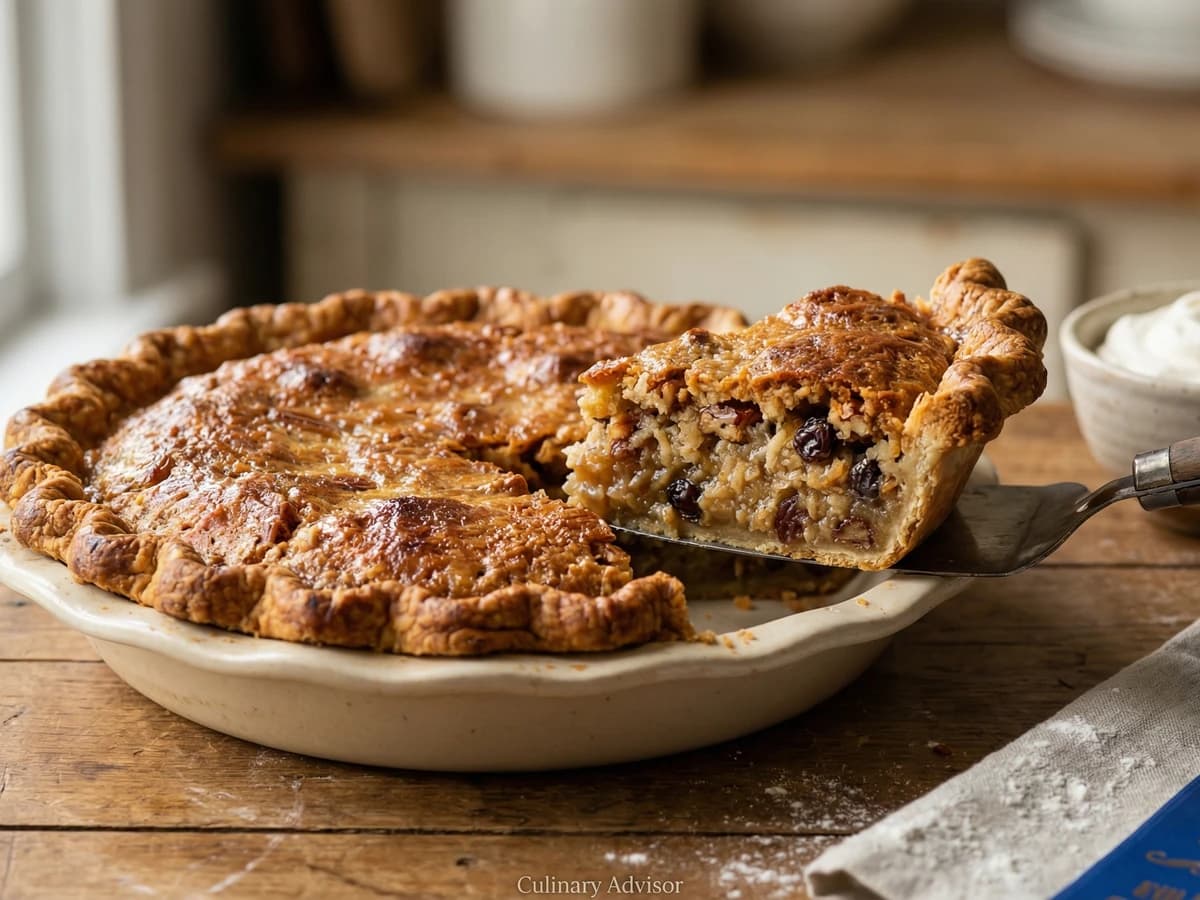
A gloriously simple custard pie with cornmeal grit and a shatteringly caramelized crust, born from pantry staples and perfected by generations of Tennessee grandmothers who knew that the best desserts require no fuss.
Pastries & Cookies
American
Comfort Food, Potluck, Make Ahead
20 min
Active Time
55 min cook•1 hr 15 min total
Yield8 servings
Nobody knows for certain where the name comes from. Some claim it's a corruption of "cheese pie," an old English custard that crossed the Atlantic with colonists. Others insist it derives from "chest pie," kept in the pie safe on the back porch where butter wouldn't spoil. My favorite explanation comes from a Tennessee farmwife who, when asked what kind of pie she'd made, replied "jes' pie." Just pie. Nothing fancy. The name stuck.
What we do know is that chess pie became the signature dessert of the Upper South, from Kentucky down through Tennessee and into the Carolina piedmont. Every county fair has a category for it. Every church supper features at least three versions. The recipe exists because rural cooks had butter, sugar, eggs, and cornmeal in abundance, and these ingredients, combined with nothing more than patience and a hot oven, produce something miraculous.
The cornmeal is what distinguishes Tennessee chess pie from its cousins. That tablespoon of stone-ground meal gives the filling a subtle grit, a textural whisper that tells you this pie comes from somewhere specific. The vinegar seems strange until you understand it: a splash of acid helps the filling set while cutting the sweetness just enough to keep you reaching for another forkful. These are the tricks of cooks who had nothing to prove and everything to share.
The technique, the tradition, and the story behind every dish.
Whisk together the flour and salt in a large bowl. Add the cubed lard and work it into the flour using your fingertips or a pastry blender, pressing and rubbing until the mixture resembles coarse meal with some pea-sized pieces remaining. These larger bits of fat will create flaky pockets when the crust bakes. Sprinkle three tablespoons of ice water over the mixture and stir with a fork until the dough begins to clump. Add more water, a teaspoon at a time, only if needed. The dough should hold together when pressed but not feel sticky.
Lard makes the most tender, flaky crust. Your grandmother knew this. If you can find leaf lard from a butcher, you'll taste the difference.
2
Chill the dough
Gather the dough into a rough ball, then press it into a thick disk about four inches across. Wrap tightly in plastic and refrigerate for at least one hour. Cold fat is the secret to flaky pastry. The gluten also needs this rest to relax, otherwise your crust will shrink in the oven like a nervous guest.
3
Roll and fit the crust
On a lightly floured surface, roll the chilled dough into a circle about twelve inches across, working from the center outward and rotating the dough a quarter turn after each roll. Transfer to a nine-inch pie plate, easing it into the corners without stretching. Stretching now means shrinking later. Trim the overhang to one inch, fold it under itself, and crimp decoratively. Refrigerate the lined pie plate while you make the filling.
4
Prepare the filling
Position a rack in the lower third of your oven and preheat to 325°F. In a large bowl, whisk together the sugar, cornmeal, and salt until well combined. The cornmeal should disappear into the sugar. Pour in the melted butter in a slow stream, whisking constantly, until the mixture looks like wet sand.
5
Add eggs and liquids
Add the eggs one at a time, whisking vigorously after each addition until the mixture turns smooth and pale. The color should lighten as you incorporate air. Whisk in the buttermilk, vinegar, and vanilla until you have a thin, golden custard. It will smell like cake batter with a sharp edge from the vinegar. Trust the process.
Room temperature eggs incorporate more smoothly and create a more stable custard. Pull them from the refrigerator an hour before baking.
6
Fill and bake
Give the filling one final whisk and pour it into the chilled crust. The liquid will come nearly to the top. Carefully transfer to the oven. Bake for 50 to 55 minutes, until the top develops a golden-brown crust that appears set around the edges but still jiggles slightly in the very center when you tap the pan. The pie will continue cooking from residual heat.
7
Cool completely
Transfer to a wire rack and let the pie cool completely at room temperature, at least two hours. This patience is essential. Cut too soon and you'll have a runny mess. Cut at the right time and you'll reveal a filling that slices cleanly while still surrendering to your fork. The surface should be matte and slightly crackled, like antique porcelain.
Chess pie improves overnight. The flavors meld and the texture sets more firmly. Make it the day before you need it.
Chef Tips
•Stone-ground cornmeal is worth seeking out. The texture is coarser and the corn flavor more pronounced than degerminated supermarket varieties. Check the bulk bins at natural food stores or order from a Southern mill.
•If you can only find regular cornmeal, reduce the amount to two teaspoons. Fine-ground meal can turn the filling gritty instead of pleasantly textured.
•A water bath is traditional in some counties but unnecessary if you bake low and slow. The gentle oven temperature prevents the custard from curdling or cracking.
•This pie keeps beautifully at room temperature for two days, loosely covered with foil. Refrigeration firms the filling but dulls the flavor. Let a chilled slice sit out for twenty minutes before serving.
•For a brown sugar variation, substitute half the granulated sugar with packed light brown sugar. The molasses notes push the pie toward caramel territory.
Advance Preparation
•Pie dough can be made up to 3 days ahead and refrigerated, or frozen for up to 2 months. Thaw overnight in the refrigerator before rolling.
•The finished pie tastes best the day after baking, when the filling has fully set and flavors have deepened. Store at room temperature, covered loosely.
•For potlucks, transport at room temperature. No need for ice packs or insulated bags.
Frequently Asked Questions
Nutrition Information
1 serving (about 145g)
Calories
490 calories
Total Fat
28 g
Saturated Fat
9 g
Trans Fat
0 g
Unsaturated Fat
17 g
Cholesterol
148 mg
Sodium
41 mg
Total Carbohydrates
53 g
Dietary Fiber
0 g
Sugars
38 g
Protein
5 g
Where cooking meets culture.
Culinary guides, cultural storytelling, and the editorial depth that makes cooking meaningful.